
All programs › BMPFast › BMPFast 2 sample problems
Composite EMC: nitrogen for a mixed-use site
Single-family, multi-family and commercial parts of a 10-acre site.
Help: Composite EMCs (help page 819) · Download the .bmpf · Link to Solution in BMPFast Version 1
1The problem
A 10-acre mixed-use site is 6 ac single-family (TN 1.77 mg/L, CN 75), 3 ac multi-family (1.84, CN 80) and 1 ac commercial (2.40, CN 85).
| Input | Value | Source |
|---|---|---|
| Project (General Site Information) | ||
| Meteorological zone | Florida Zone 2 | Zone map (help page 815) |
| Mean annual rainfall | 50 in | Mean annual rainfall map (help page 815) |
| Performance standard (analysis type) | BMP Analysis | Site (illustrative) |
| Catchment 1: Mixed use (Watershed Characteristics) | ||
| Land use, pre / post | Agricultural - Pasture / User Defined Values | Site (illustrative) |
| Area, pre / post | 10 / 10 ac | Site (illustrative) |
| Non-DCIA curve number, pre / post | 61 / 78 | Site (illustrative) |
| DCIA, pre / post | 0 / 40 % | Site (illustrative) |
| EMC TN, pre / post | 3.030 / 1.861 mg/L | BMPFast land use table (AH Vol I Table 9.2) |
| EMC TP, pre / post | 0.593 / 0.300 mg/L | BMPFast land use table (AH Vol I Table 9.2) |
| Parts of the catchment | ||
| 6 ac | EMC 1.77 mg/L, CN 75 | Land use table (AH Vol I Table 9.2) |
| 3 ac | EMC 1.84 mg/L, CN 80 | Land use table (AH Vol I Table 9.2) |
| 1 ac | EMC 2.4 mg/L, CN 85 | Land use table (AH Vol I Table 9.2) |
Find: the composite TN EMC and the load it gives.
2Steps in BMPFast 2
Start BMPFast 2 and choose File ▸ New project. The tree on the left opens on the project (General Site Information). On its Entry tab enter: Project name Composite EMC: mixed-use site, nitrogen; Meteorological zone Florida Zone 2; Mean annual rainfall 50.00 in; Type of analysis BMP Analysis. (To see the finished project instead, choose File ▸ Open and open
composite-emc-nitrogen.bmpffrom Files below.)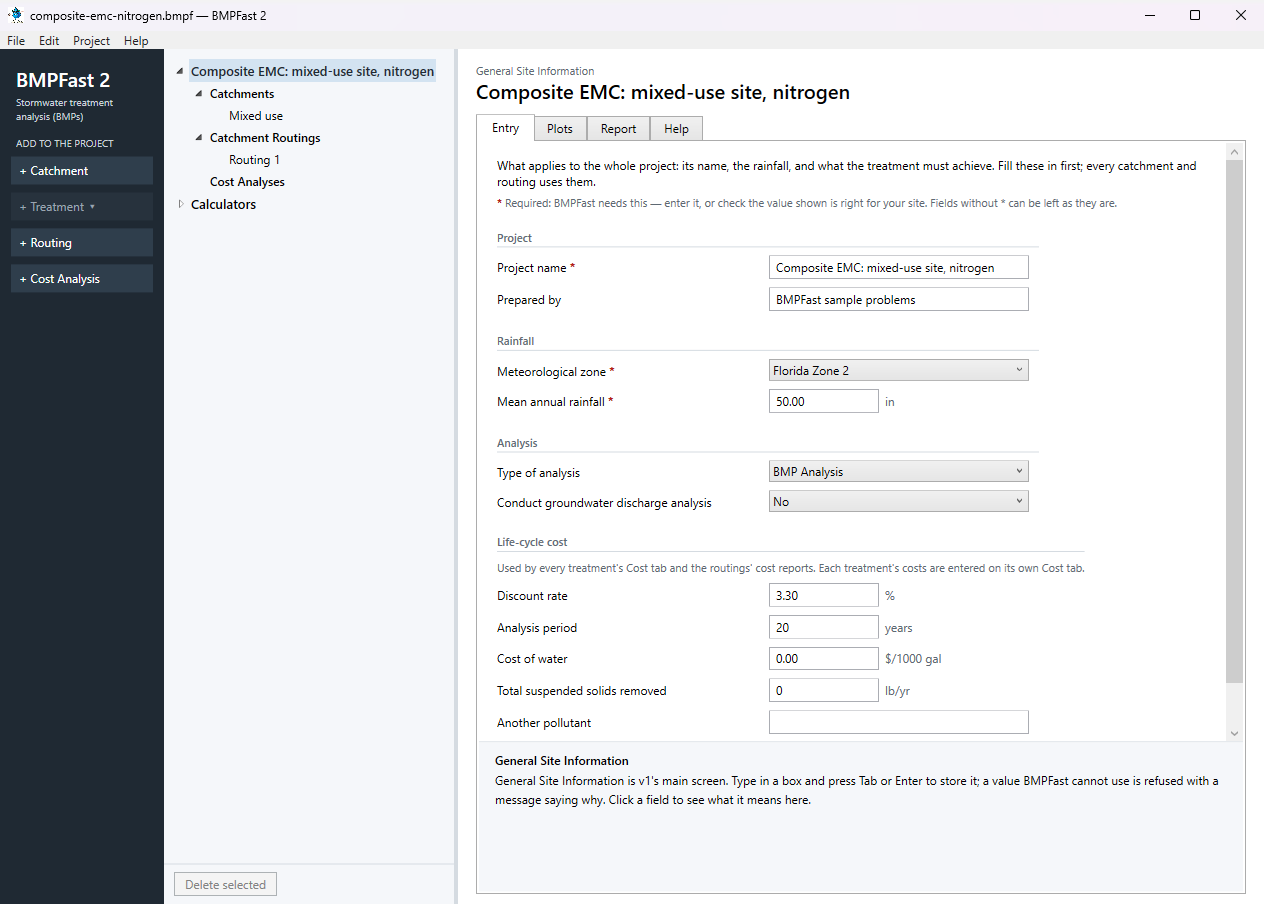
General Site Information: the project’s Entry tab. Press Add Catchment (left) and select the new catchment in the tree. On its Entry tab type the name Mixed use and enter: Land use (pre) Agricultural - Pasture; Land use (post) User Defined Values; Area (pre) 10.00 ac; Area (post) 10.00 ac; Non-DCIA curve number (pre) 61.00; Non-DCIA curve number (post) 78.00; DCIA (post) 40.00 %; Nitrogen EMC (post) 1.500 mg/L; Phosphorus EMC (post) 0.300 mg/L. With the post-development land use User Defined Values the EMC boxes take what you type; the nitrogen EMC 1.500 mg/L is a first guess for the whole catchment, whose parts have different land uses.
Open the catchment’s Composite CN (optional) tab. In the post-development table type each part’s area, non-DCIA curve number and nitrogen EMC: 6 ac with CN 75 and TN 1.77 mg/L, 3 ac with CN 80 and TN 1.84 mg/L, 1 ac with CN 85 and TN 2.4 mg/L. The curve number is needed too: the EMCs are weighted by each part’s runoff, which comes from its curve number. The line Composite shows the composite nitrogen EMC, 1.861 mg/L. Press Use these EMCs (it is available only with the land use User Defined Values). The note above the table says the parts should add up to the post-development area less the DCIA: that check is for a composite curve number. For EMCs the parts are the land uses of the whole catchment, so here they add up to 10 ac; leave the note, and do not press Use this CN (the curve number stays as typed).
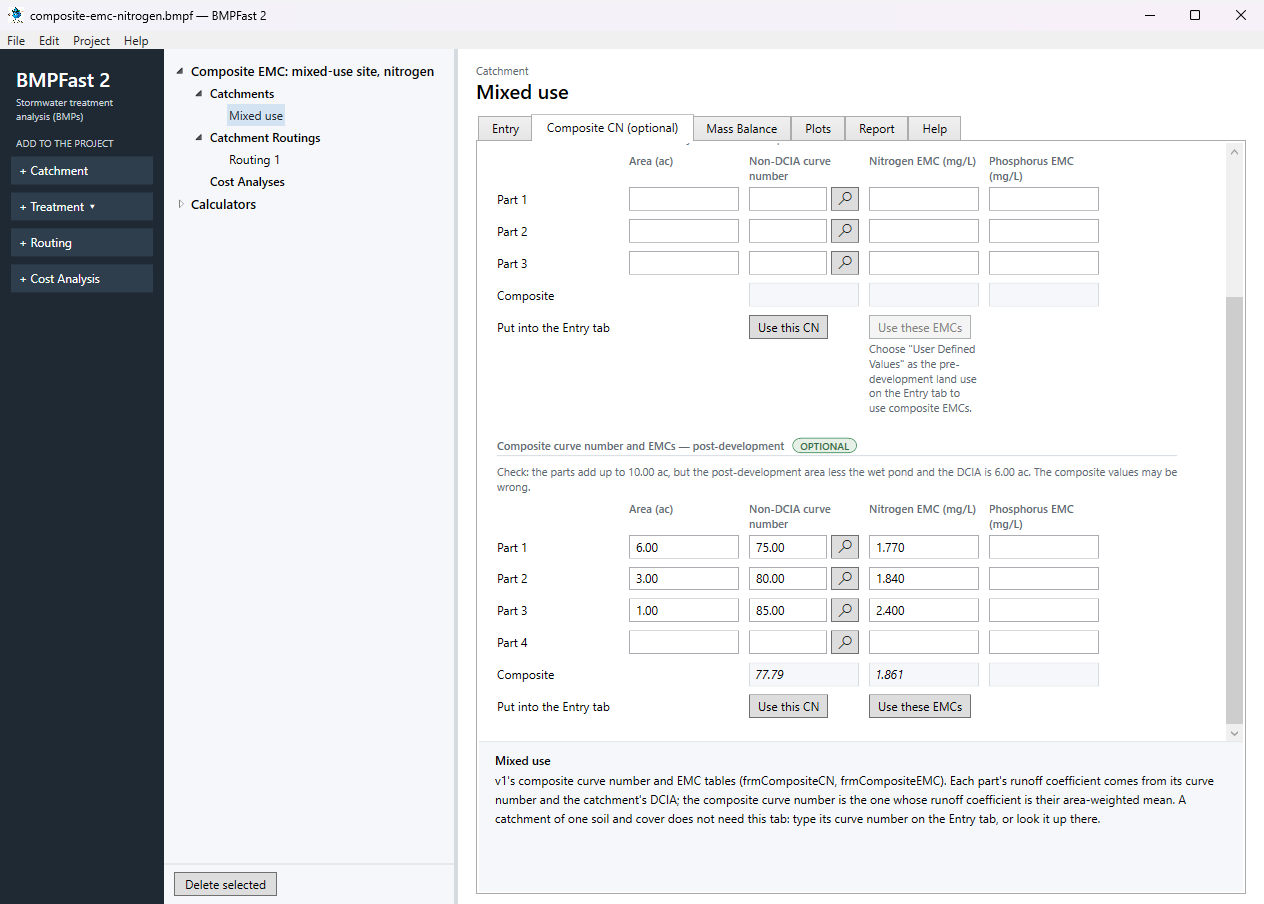
The catchment’s Composite CN (optional) tab: the post-development parts with their nitrogen EMCs, and the composite. BMPFast 2 goes back to the Entry tab with the post-development nitrogen EMC now 1.861 mg/L. The table has no phosphorus EMCs, so the phosphorus EMC stays as typed, 0.300 mg/L.
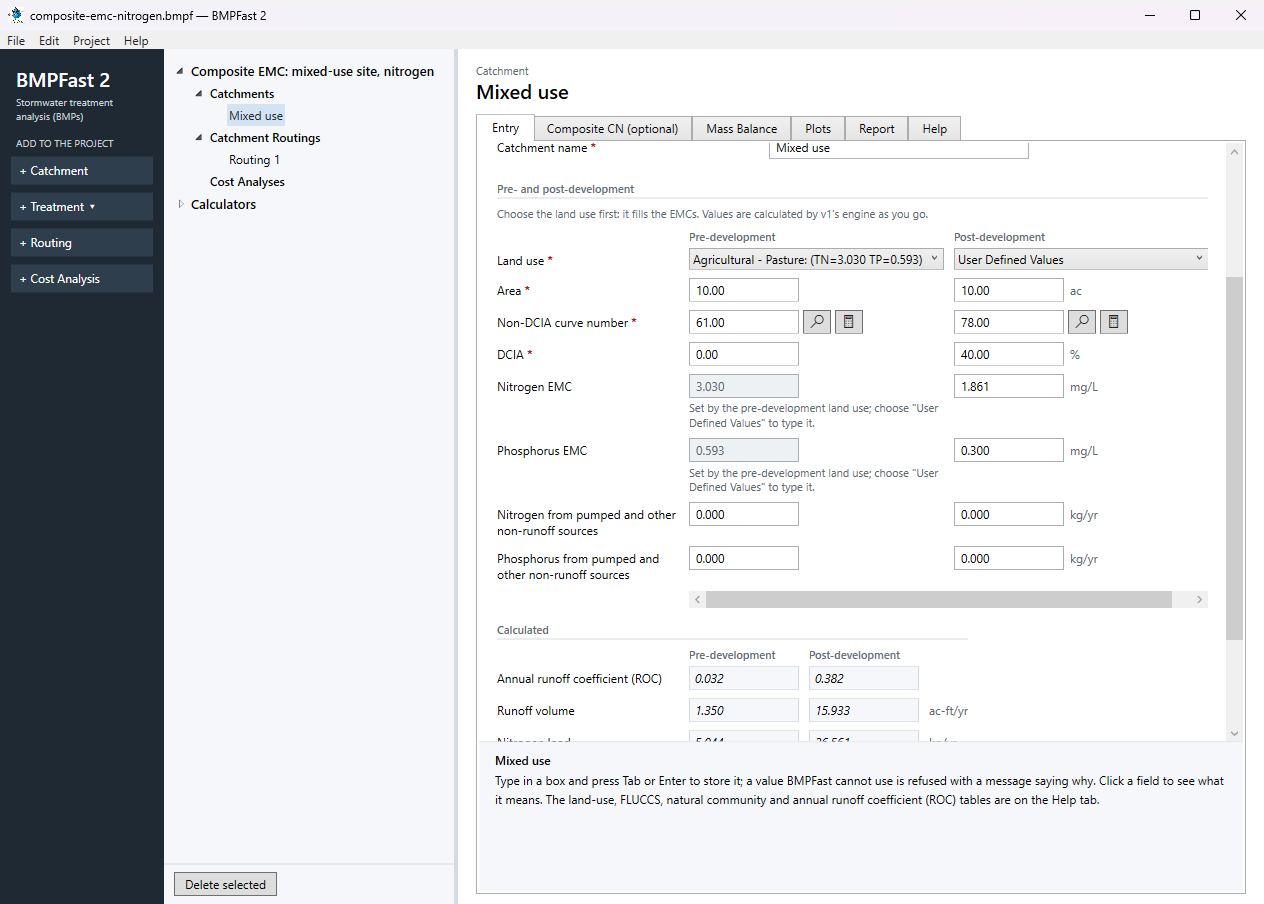
The catchment’s Entry tab with the composite EMC. At the bottom of the Entry tab, under Calculated, the nitrogen load is worked out with the composite EMC. Save the project with File ▸ Save; compare it with
composite-emc-nitrogen.bmpfunder Files.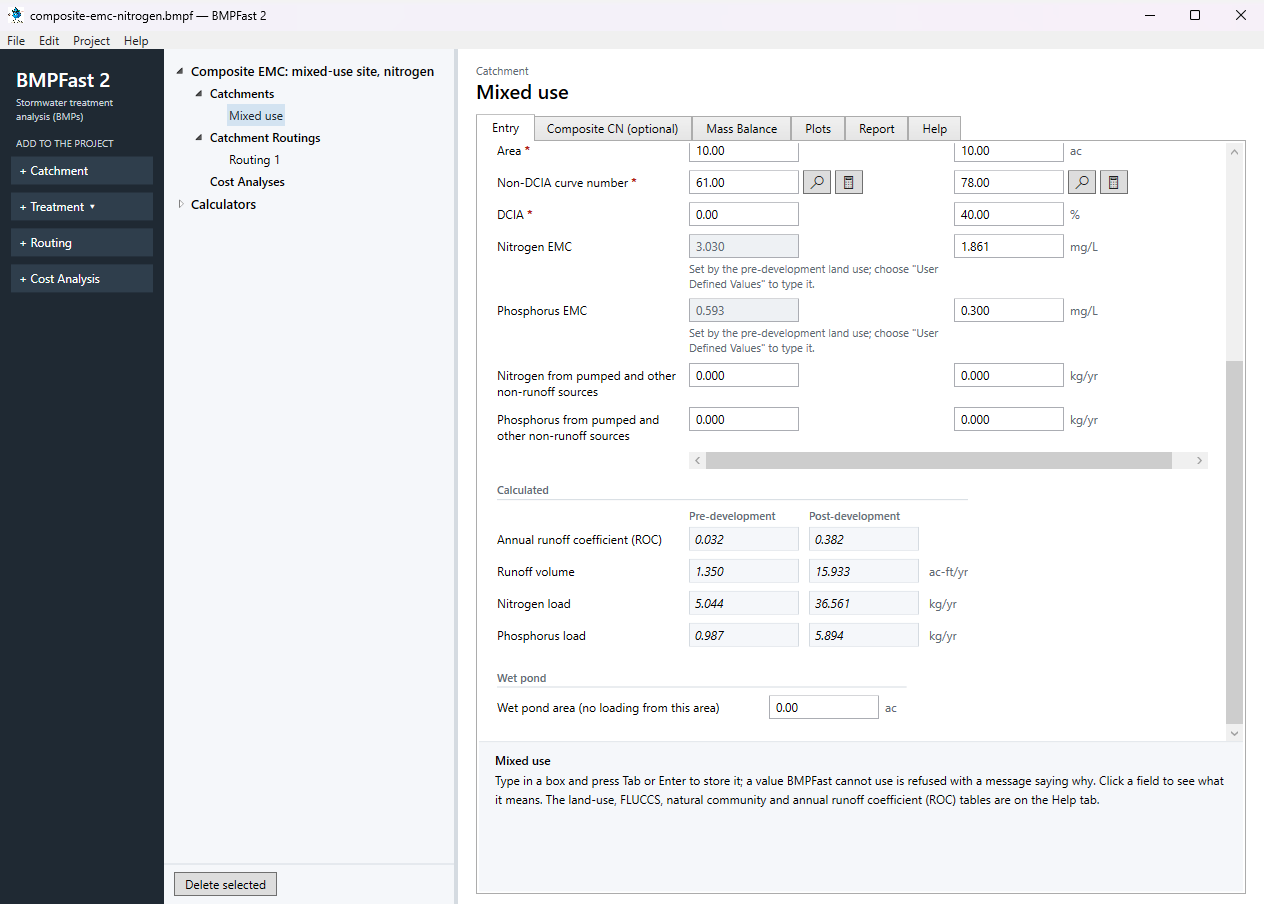
The bottom of the Entry tab: the loads with the composite EMC.
3Results
| Result | Value |
|---|---|
| Composite nitrogen EMC | 1.861 mg/L |
| Nitrogen EMC put into the Entry tab | 1.861 mg/L |
| Phosphorus EMC after Use these EMCs | 0.300 mg/L |
The catchment before and after (post-development)
| EMC typed | Composite EMC | |
|---|---|---|
| Nitrogen EMC (mg/L) | 1.500 | 1.861 |
| Runoff volume (ac-ft/yr) | 15.933 | 15.933 |
| Nitrogen load (kg/yr) | 29.469 | 36.561 |
| Phosphorus load (kg/yr) | 5.894 | 5.894 |
BMPFast 2 and BMPFast (v1)
| Result | BMPFast 2 | BMPFast (v1), its page | |
|---|---|---|---|
| Nitrogen leaving the site | 36.561 kg/yr | 36.561 kg/yr | same |
| Phosphorus leaving the site | 5.894 kg/yr | 5.894 kg/yr | same |
| Site removal, nitrogen | 0.000 % | 0.000 % | same |
| Site removal, phosphorus | 0.000 % | 0.000 % | same |
Every number BMPFast 2 gives for this problem is the same as BMPFast (v1)’s, to three decimals.
4Check
| Part | Area (ac) | Non-DCIA CN | TN EMC (mg/L) | Runoff coefficient C | Area-weighted C |
|---|---|---|---|---|---|
| Part 1 | 6 | 75 | 1.770 | 0.3710 | 0.2226 |
| Part 2 | 3 | 80 | 1.840 | 0.3900 | 0.1170 |
| Part 3 | 1 | 85 | 2.400 | 0.4200 | 0.0420 |
Method.
The composite EMC is weighted by runoff, not by area: each part’s weight is its area × its annual runoff coefficient (the area-weighted C column).
| EMC | = (1.77 × 0.2226 + 1.84 × 0.1170 + 2.4 × 0.0420) / 0.3816 |
| = 1.861 mg/L (BMPFast 2 1.861). |
A part with more runoff counts for more (AH Vol I 9.2.2 a; help page 819).
The same table is also under Calculators ▸ Composite EMC, for working out an EMC without putting it into a catchment.
5Files
- composite-emc-nitrogen.bmpf: the project, saved by BMPFast 2. Save it (your browser puts it in Downloads), then in BMPFast 2 choose File ▸ Open and open it. Opened again and calculated, it gives the numbers on this page.
- composite-emc-nitrogen.bmpt: the same project as BMPFast (v1) saved it. BMPFast 2 opens it too (File ▸ Open); saving it then makes a .bmpf and leaves the .bmpt as it was.
- Routing 1 (BMPFast 2’s report, as Open in browser on its Report tab gives it)
- Routing 1 — Summary Report (BMPFast 2’s report, as Open in browser on its Report tab gives it)
6Help and methodology
Calculated with BMPFast 2 version 2.0.0 (2026-10-20), which opens the problem’s v1 project as it is. Screen captures are of BMPFast 2’s own window and are for demonstration only.