
All programs › BMPFast › BMPFast 2 sample problems
Sizing a retention basin
BMPFast sample project Example Problem 3: the volume for 75 % and for 85 %.
Help: Sizing (help page 4637) · Download the .bmpf · Link to Solution in BMPFast Version 1
1The problem
The BMPFast sample project Example Problem 3 (11 ac, Zone 4, specified removal 75 / 75 %). Find the retention volume that meets the targets, then the volume for 85 %.
| Input | Value | Source |
|---|---|---|
| Project (General Site Information) | ||
| Meteorological zone | Florida Zone 4 | Zone map (help page 815) |
| Mean annual rainfall | 50 in | Mean annual rainfall map (help page 815) |
| Performance standard (analysis type) | Specified Removal Efficiency | BMPFast sample project |
| Specified removal: TN / TP | 75 % / 75 % | BMPFast sample project |
| Catchment 1: catchment 1 (Watershed Characteristics) | ||
| Land use, pre / post | Agricultural - Pasture / Single-Family | BMPFast sample project |
| Area, pre / post | 11 / 11 ac | BMPFast sample project |
| Non-DCIA curve number, pre / post | 50 / 65 | BMPFast sample project |
| DCIA, pre / post | 0 / 25 % | BMPFast sample project |
| EMC TN, pre / post | 3.030 / 1.770 mg/L | BMPFast land use table (AH Vol I Table 9.2) |
| EMC TP, pre / post | 0.593 / 0.327 mg/L | BMPFast land use table (AH Vol I Table 9.2) |
Find: the Retention Volume that meets the removal targets: first the targets of the performance standard, then the new targets named, and apply it.
2Steps in BMPFast 2
Start BMPFast 2, choose File ▸ Open and open
sizing-retention.bmpf(under Files below). The tree on the left opens on the project, General Site Information: Florida Zone 4, 50.0 in of rainfall, and the type of analysis Specified Removal Efficiency. The file was saved as this problem ends, with the retention already sized; the next step puts it back to where the problem starts.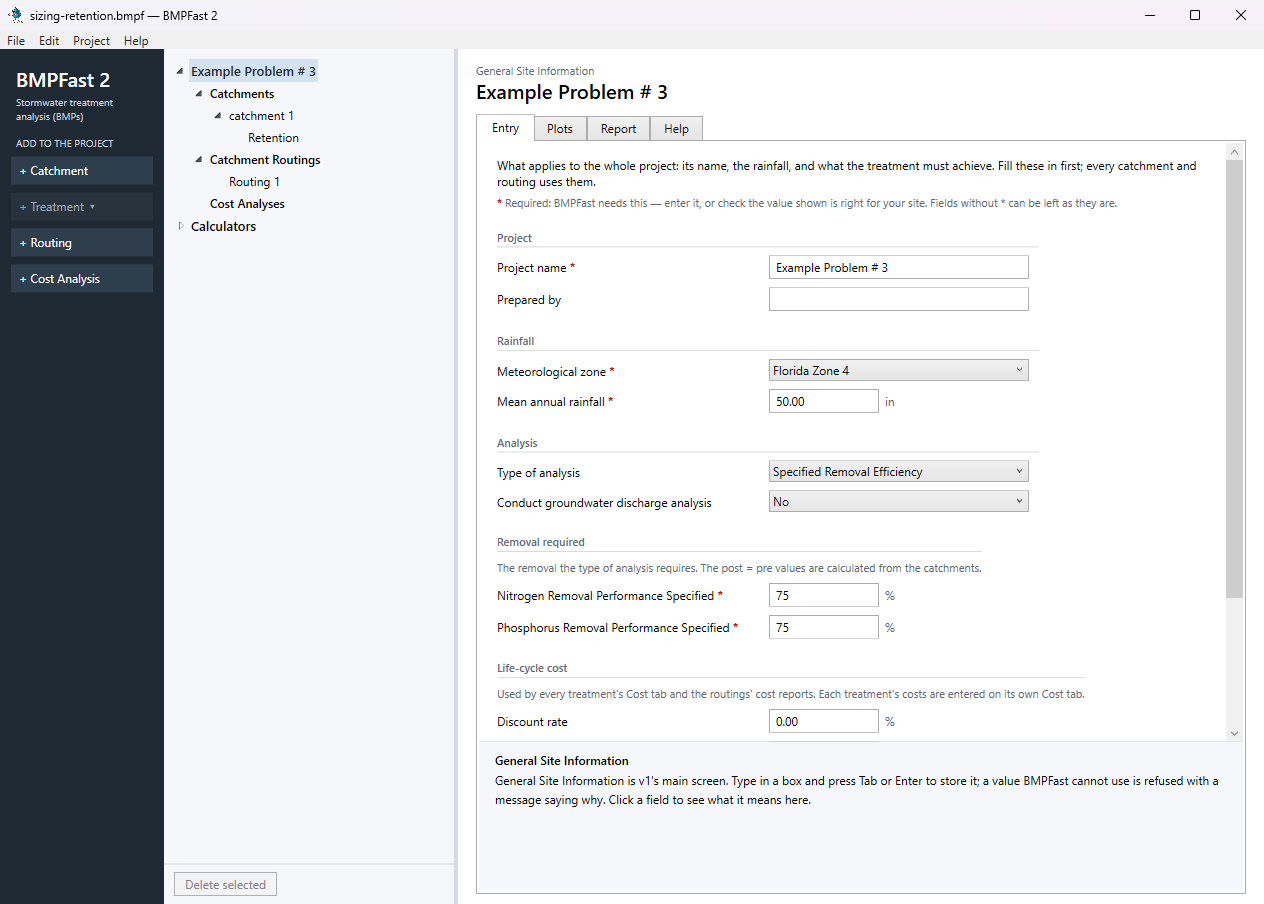
General Site Information: the project’s Entry tab. In the tree open Catchments ▸ catchment 1, select the treatment Retention and open its Sizing tab. Under Retention dimensions type 0.506 in Retention Volume (ac-ft) and press Enter: the design the problem starts from. The Targets are the project’s requirement, the greater of the type of analysis’s percentage and the removal that keeps post-development loads at pre-development: Nitrogen removal to meet 75.0 %, Phosphorus removal to meet 75.0 %. Under Results: Removal now nitrogen 75.0 %, phosphorus 75.0 %; Meets both targets Yes; Treatment depth 0.55 in over the contributing area.
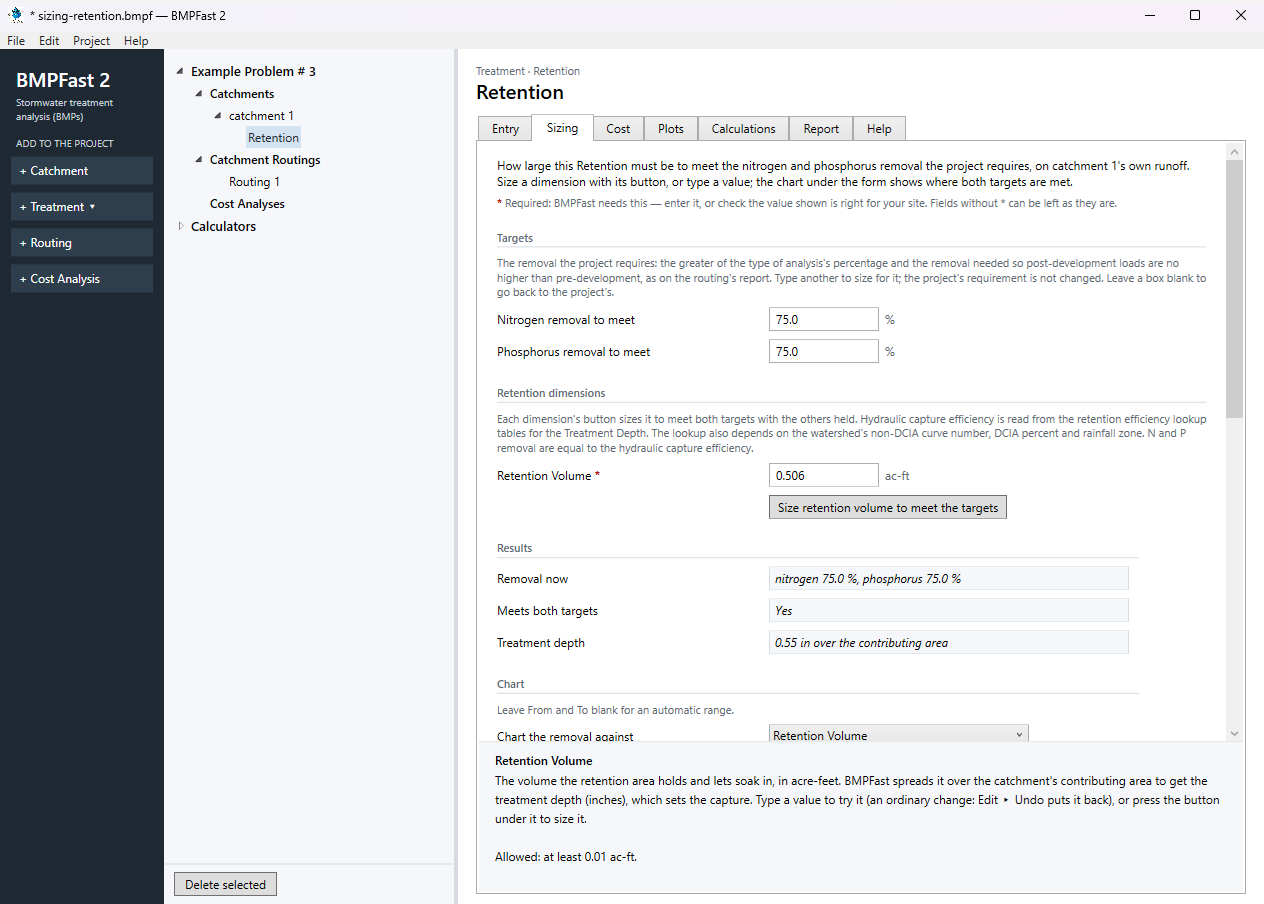
The Sizing tab at the starting design, with the project’s targets. Scroll down. Under Chart, the chart plots the nitrogen and phosphorus removal against retention volume (0.01 to 1.01 ac-ft (automatic)), with the targets dashed and this design marked. Where both targets are met: Retention Volume = 0.51.
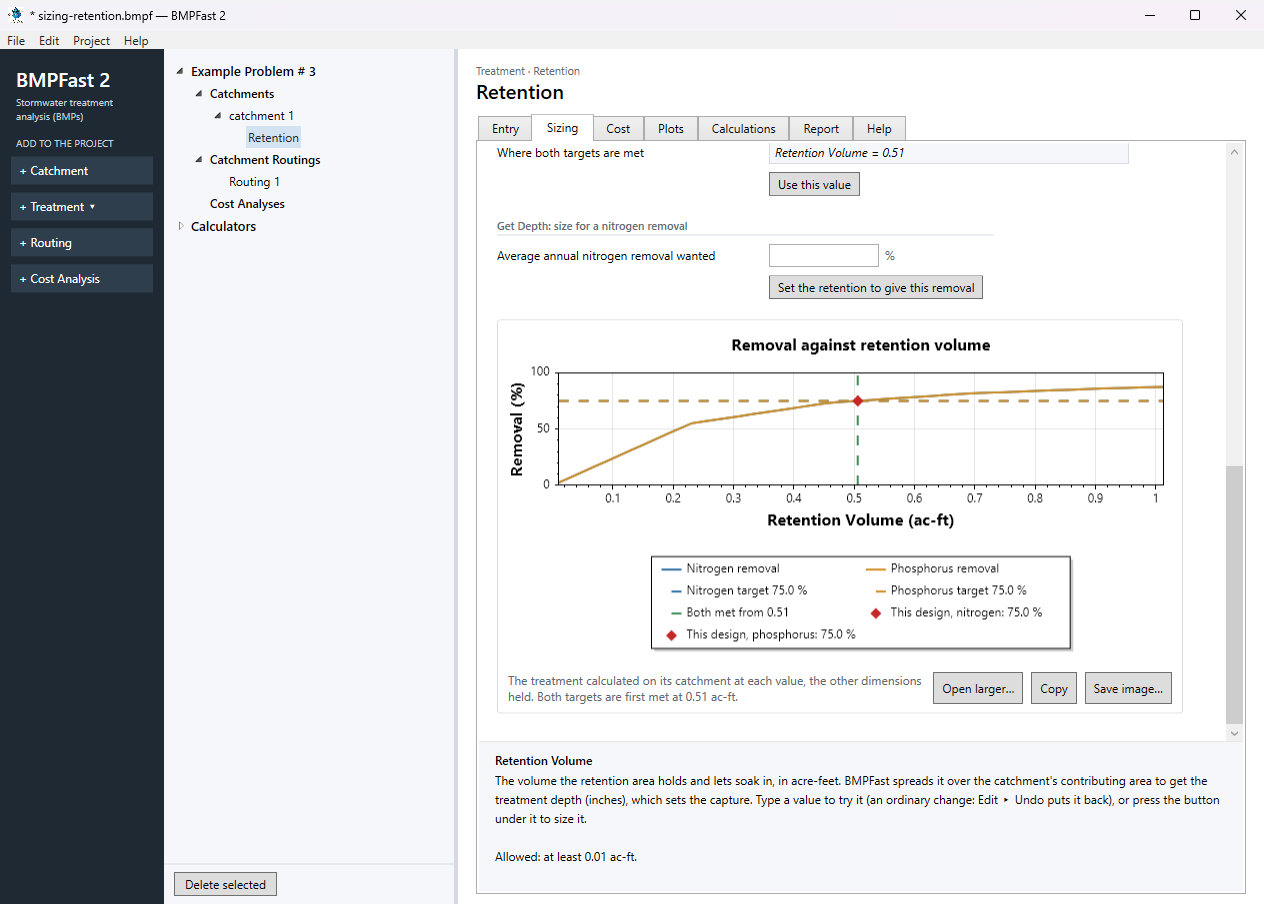
The chart under the Sizing tab: removal against the dimension, the targets dashed. Scroll back up and type the new targets: 85 in Nitrogen removal to meet and 85 in Phosphorus removal to meet. Meets both targets now reads No: nitrogen 75.0 % of 85.0 %, phosphorus 75.0 % of 85.0 %, and Where both targets are met moves to Retention Volume = 0.86. Press Use this value. BMPFast 2 sets retention volume to 0.862 ac-ft (0.8619 ac-ft before rounding) and calculates the treatment again: Removal now nitrogen 85.0 %, phosphorus 85.0 %; Meets both targets Yes; Treatment depth 0.94 in over the contributing area. (The button Size retention volume to meet the targets, under the box, sizes the same way without the chart.) Targets typed here are for this tab only and change nothing in the project; the new size is an ordinary change to the treatment, and Edit ▸ Undo puts it back.
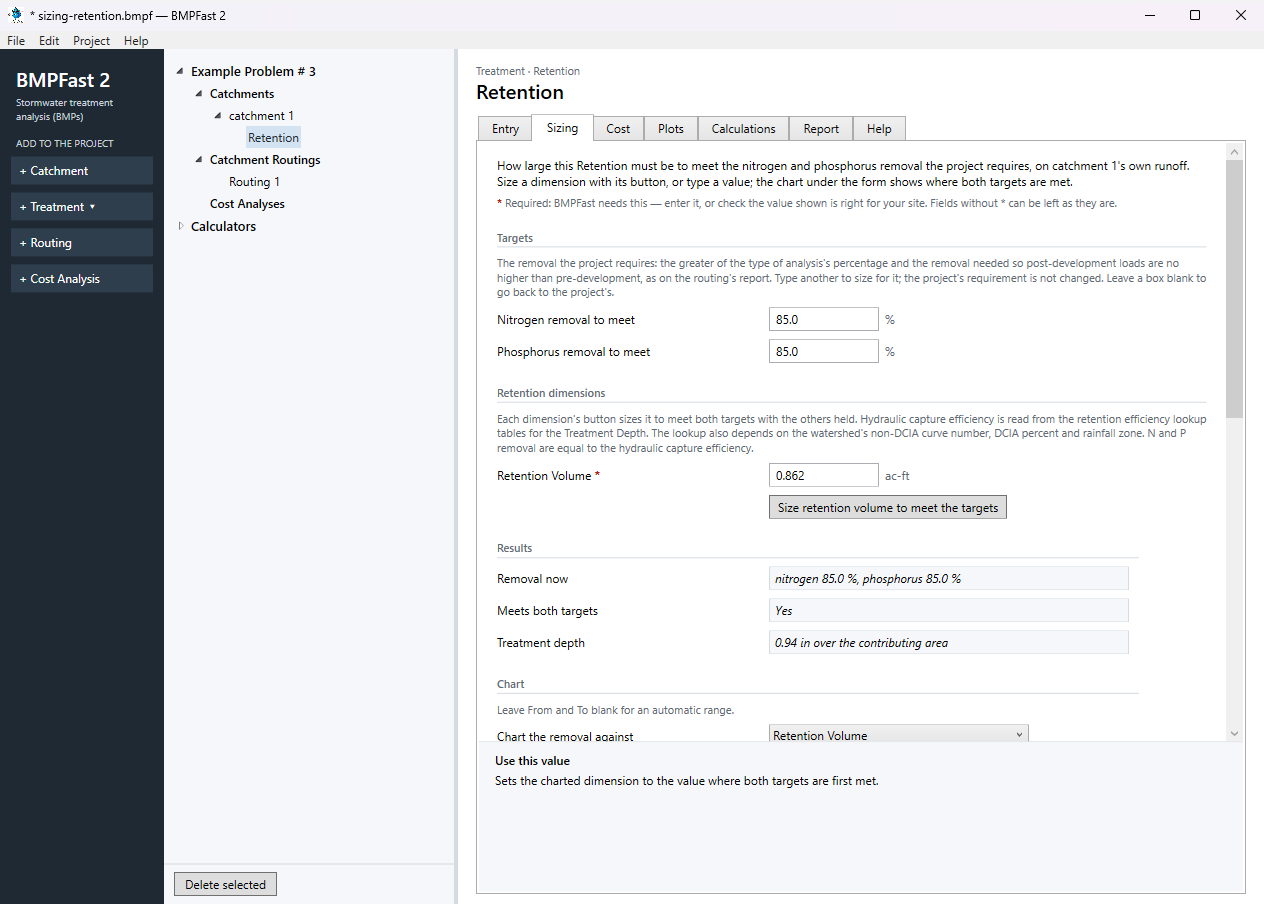
The Sizing tab after the new targets were typed and Use this value pressed. Scroll down again: the chart is drawn for the new targets (0.01 to 1.72 ac-ft (automatic)), and this design now sits where both targets are met.
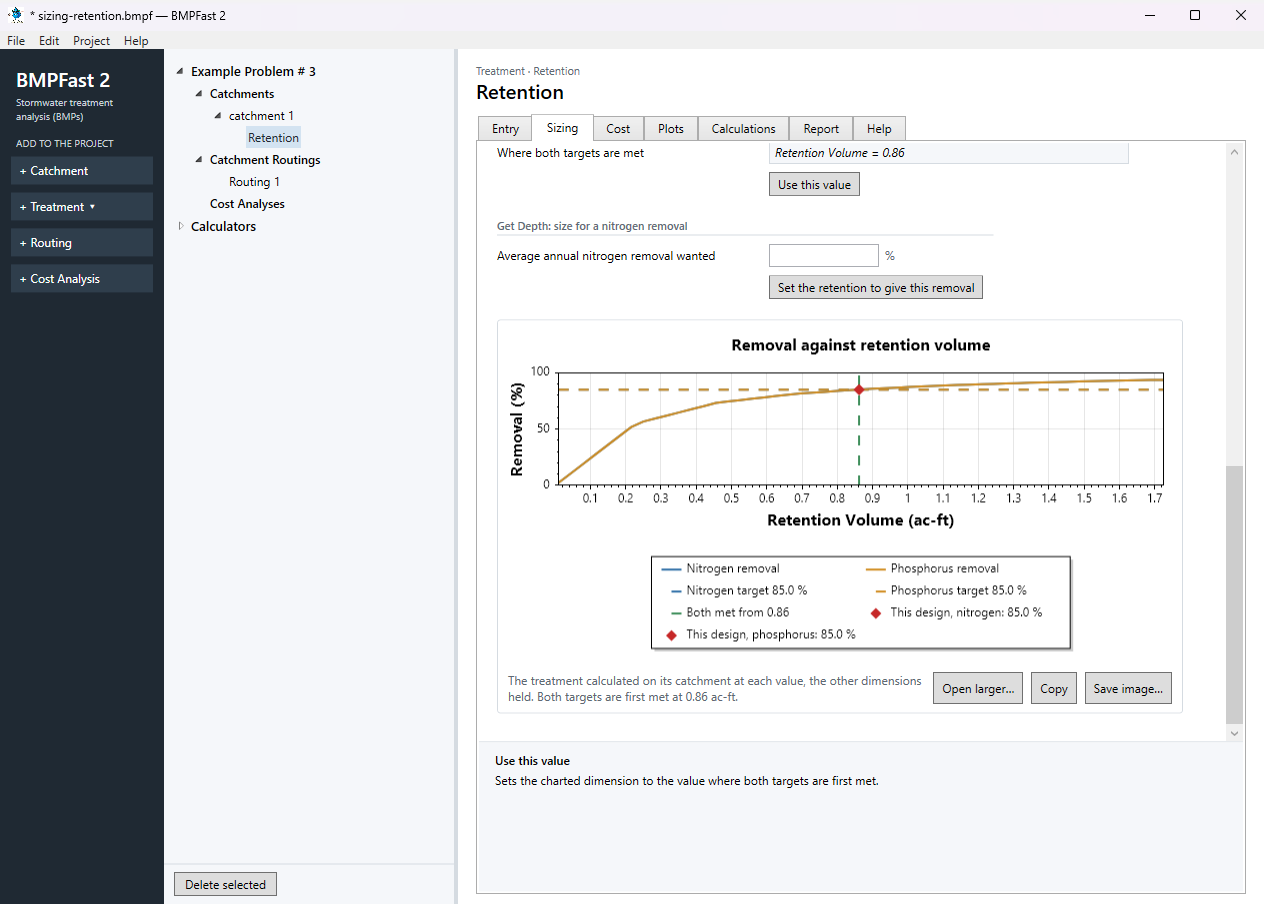
The chart for the new targets. Open the treatment’s Entry tab: Provided retention volume holds the new size and the results at the bottom are calculated with it.
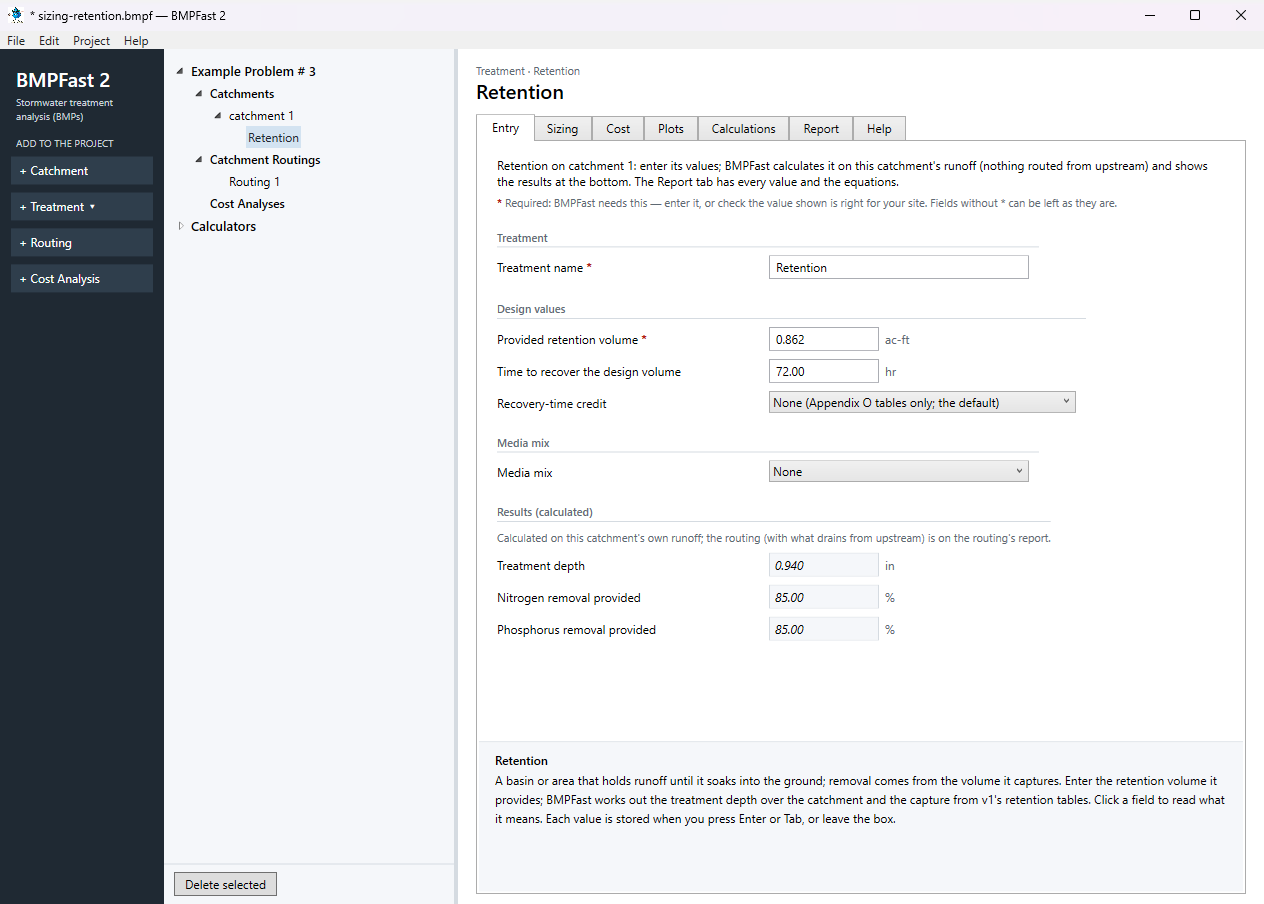
The treatment’s Entry tab with the new size. Under Catchment Routings select Routing 1 and open its Report tab. Results shows the loads leaving the site, the removal provided and required, and whether the performance standard is met. Save the project with File ▸ Save.
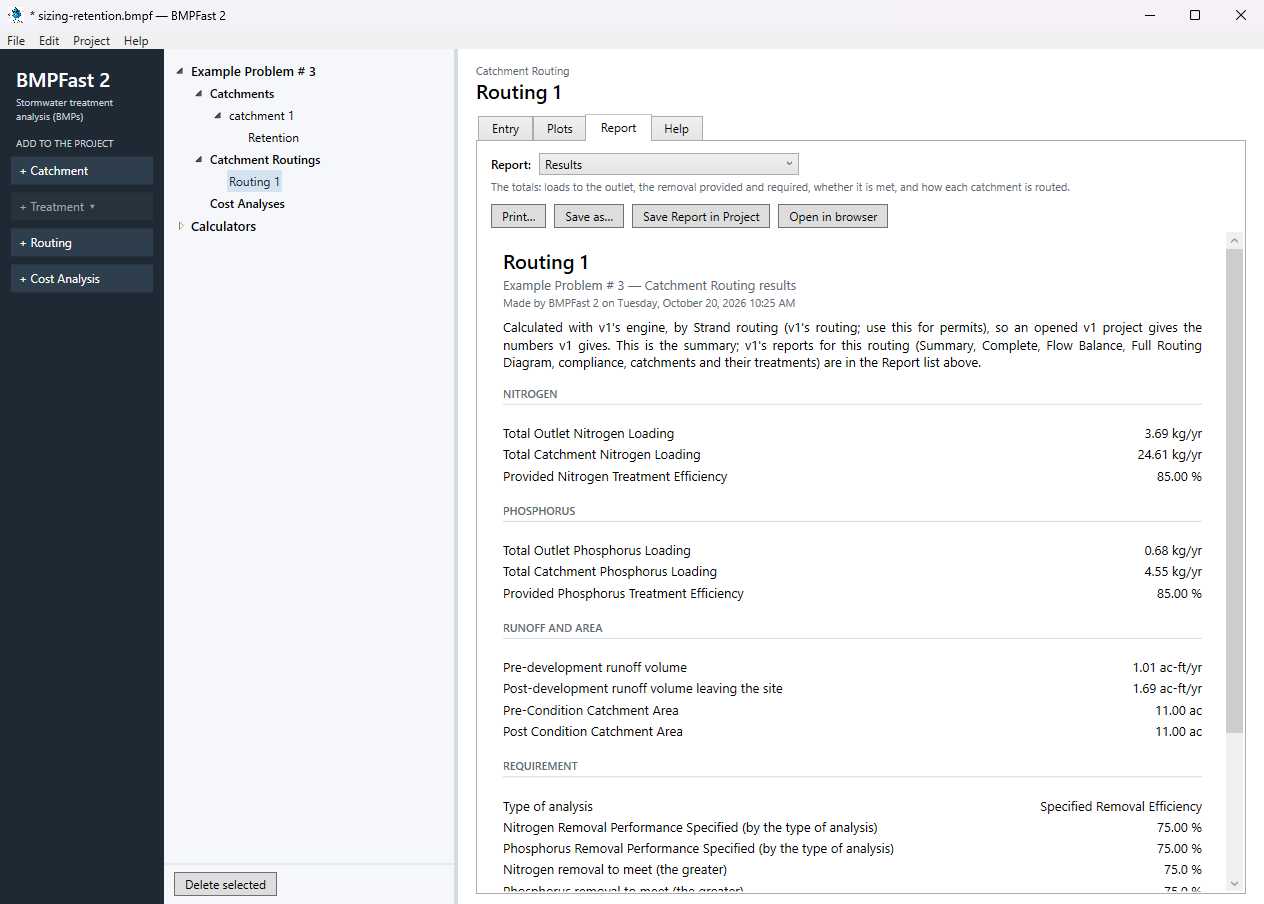
The routing’s Report tab: Results.
3Results
The Sizing tab, before and after:
| The Sizing tab | At the project’s targets | At 85 / 85 %, after Use this value |
|---|---|---|
| Nitrogen removal to meet / Phosphorus removal to meet | 75.0 % / 75.0 % | 85.0 % / 85.0 % |
| Retention Volume | 0.506 ac-ft | 0.862 ac-ft |
| Removal now | nitrogen 75.0 %, phosphorus 75.0 % | nitrogen 85.0 %, phosphorus 85.0 % |
| Meets both targets | Yes | Yes |
| Treatment depth | 0.55 in over the contributing area | 0.94 in over the contributing area |
| Where both targets are met | Retention Volume = 0.51 | Retention Volume = 0.86 |
The treatment and the site, with the new size:
| Result | Value |
|---|---|
| Retention: computed by BMPFast | |
| Treatment depth | 0.940 in |
| Hydraulic capture efficiency | 85.00 % |
| Provided TN / TP removal | 85.00 % / 85.00 % |
| TN load in → out | 24.607 → 3.691 kg/yr |
| TP load in → out | 4.546 → 0.682 kg/yr |
| Site (all catchments, at the outlet) | |
| TN load: catchments → outlet | 24.607 → 3.691 kg/yr |
| TP load: catchments → outlet | 4.546 → 0.682 kg/yr |
| Provided removal TN / TP | 85.0 % / 85.0 % |
| Required removal TN / TP (Maximum % Removal) | 75.0 % (met) / 75.0 % (met) |
Against v1’s Sizing window:
- Retention Volume after Use this value: BMPFast 2 0.8619 ac-ft; BMPFast (v1) applied 0.8619 ac-ft (the same to three decimals)
- Where both of the project’s targets are met: BMPFast (v1) 0.5058 ac-ft; BMPFast 2 shows Retention Volume = 0.51.
The routing’s Results report
Open this report on its own page.
The Summary Report (v1’s, for this routing)
Open this report on its own page.
BMPFast 2 and BMPFast (v1)
| Result | BMPFast 2 | BMPFast (v1), its page | |
|---|---|---|---|
| Nitrogen leaving the site | 3.691 kg/yr | 3.691 kg/yr | same |
| Phosphorus leaving the site | 0.682 kg/yr | 0.682 kg/yr | same |
| Site removal, nitrogen | 85.000 % | 85.000 % | same |
| Site removal, phosphorus | 85.000 % | 85.000 % | same |
| catchment 1: Retention removal, nitrogen | 85.000 % | 85.000 % | same |
| catchment 1: Retention removal, phosphorus | 85.000 % | 85.000 % | same |
Every number BMPFast 2 gives for this problem is the same as BMPFast (v1)’s, to three decimals.
4Check
Runoff and loads (Equations 9-1 and 9-2 of AH Vol I).
| Runoff | = ROC × area × rainfall / 12 |
| = 0.246 × 11.00 ac × 50.0 in / 12 | |
| = 11.275 ac-ft/yr (program 11.275). |
| TN load | = EMC × runoff × 1.233 |
| = 1.770 × 11.275 × 1.233 | |
| = 24.607 kg/yr (program 24.607) |
| TP load | = 0.327 × 11.275 × 1.233 |
| = 4.546 kg/yr (program 4.546). |
1.233 kg is 1 mg/L in 1 ac-ft.
Treatment depth.
| Depth | = retention volume × 12 / area |
| = 0.8619 ac-ft × 12 / 11.00 ac | |
| = 0.940 in (program 0.940). |
Capture. The retention efficiency tables for Florida Zone 4 at a treatment depth of 0.940 in, non-DCIA CN 65.00 and DCIA 25.0 % give a hydraulic capture of 85.00 % (AH Vol I Appendix O; read the same tables with Calculators ▸ Retention Efficiency Tables, help page 4325). Sizing found the volume whose capture meets the targets; the worksheet, calculated at that volume, gives the same removal.
Load out.
| TN out | = load in × (1 − removal) |
| = 24.607 × (1 − 85.00 / 100) | |
| = 3.691 kg/yr (program 3.691) |
| TP out | = 4.546 × (1 − 85.00 / 100) |
| = 0.682 kg/yr (program 0.682). |
5Files
- sizing-retention.bmpf: the project, saved by BMPFast 2. Save it (your browser puts it in Downloads), then in BMPFast 2 choose File ▸ Open and open it. Opened again and calculated, it gives the numbers on this page.
- sizing-retention.bmpt: the same project as BMPFast (v1) saved it. BMPFast 2 opens it too (File ▸ Open); saving it then makes a .bmpf and leaves the .bmpt as it was.
- Routing 1 (BMPFast 2’s report, as Open in browser on its Report tab gives it)
- Routing 1 — Summary Report (BMPFast 2’s report, as Open in browser on its Report tab gives it)
- Retention (BMPFast 2’s report, as Open in browser on its Report tab gives it)
- Retention — calculations (BMPFast 2’s report, as Open in browser on its Report tab gives it)
6Help and methodology
Calculated with BMPFast 2 version 2.0.0 (2026-10-20), which opens the problem’s v1 project as it is. Screen captures are of BMPFast 2’s own window and are for demonstration only.