
All programs › BMPFast › Sample problems
Mean annual rainfall: a site near Orlando
Central Florida: Zone 2, 50 in.
Help: Mean Annual Rainfall (help page 815) · Download the .bmpt · Link to Solution in BMPFast Version 2
1The problem
A 10-acre subdivision near Orlando. Which zone and rainfall go on General Site Information?
| Input | Value | Source |
|---|---|---|
| Project (General Site Information) | ||
| Meteorological zone | Florida Zone 2 | Zone map (help page 815) |
| Mean annual rainfall | 50 in | Mean annual rainfall map (help page 815) |
| Performance standard (analysis type) | BMP Analysis | Site (illustrative) |
| Catchment 1: Subdivision (Watershed Characteristics) | ||
| Land use, pre / post | Agricultural - Pasture / Single-Family | Site (illustrative) |
| Area, pre / post | 10 / 10 ac | Site (illustrative) |
| Non-DCIA curve number, pre / post | 61 / 75 | Site (illustrative) |
| DCIA, pre / post | 0 / 25 % | Site (illustrative) |
| EMC TN, pre / post | 3.030 / 1.770 mg/L | BMPFast land use table (AH Vol I Table 9.2) |
| EMC TP, pre / post | 0.593 / 0.327 mg/L | BMPFast land use table (AH Vol I Table 9.2) |
Find: the zone and mean annual rainfall to enter, and the runoff and loads they give.
2Steps in BMPFast
On General Site Information press the rainfall map button (or Help ▸ maps). Entire State shows the mean annual rainfall isopleths.
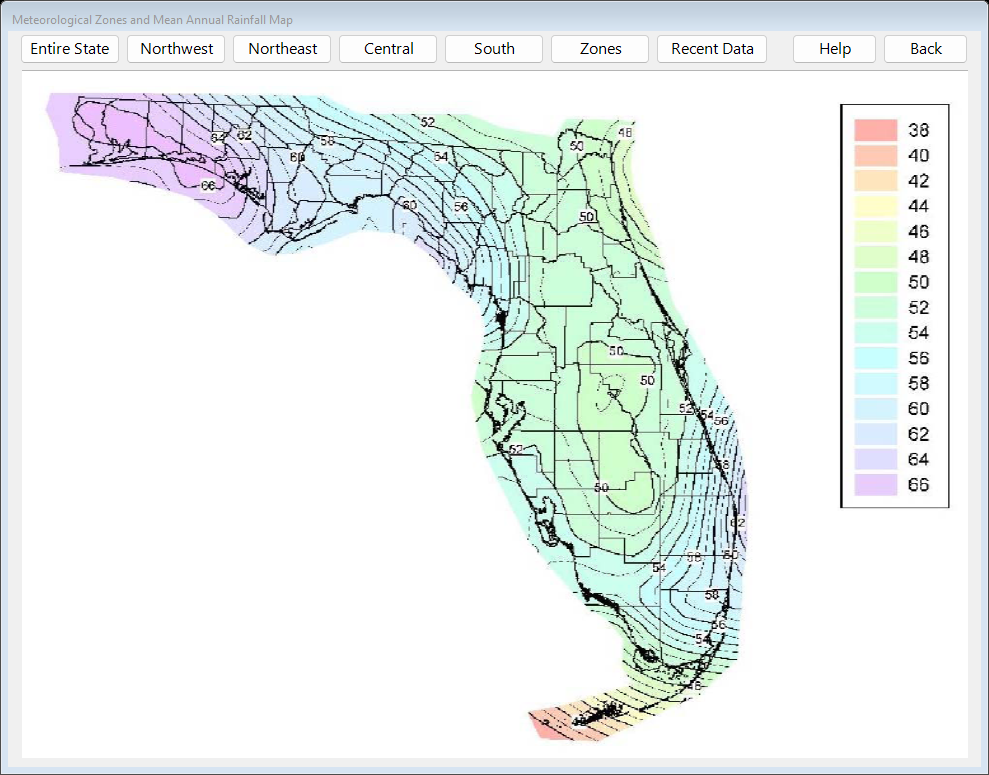
Mean annual rainfall map, entire state. Zones shows the five meteorological zones (AH Vol I Appendix M).
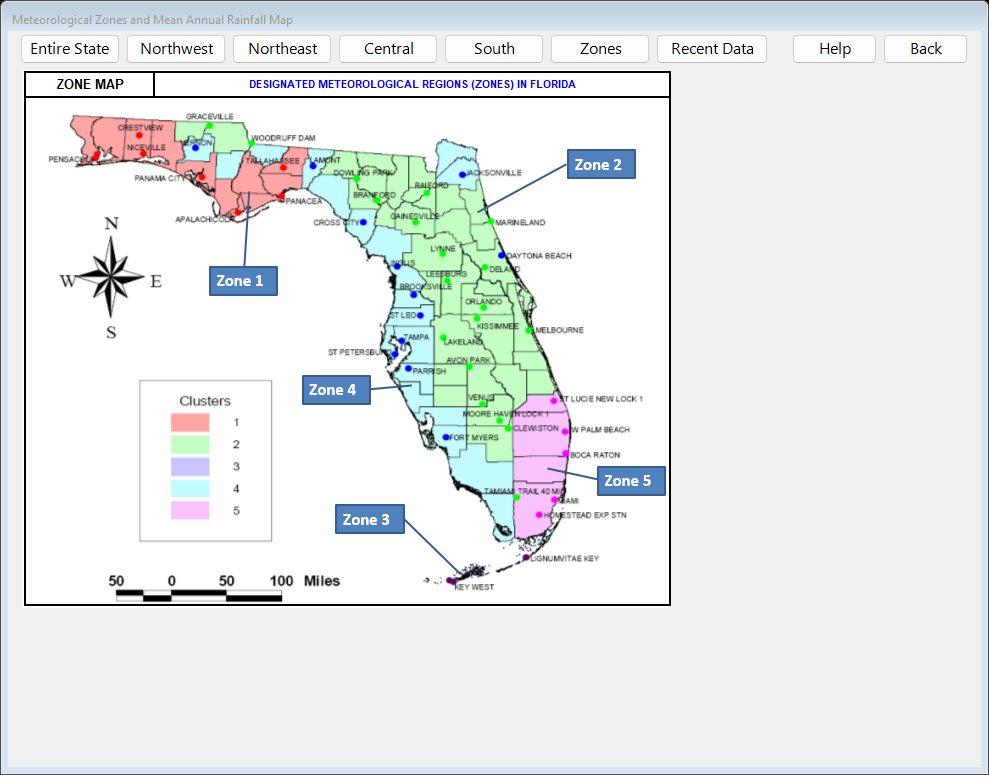
The meteorological zones. Central shows the region in more detail. Read the rainfall at the site: about 50 in, in Florida Zone 2.
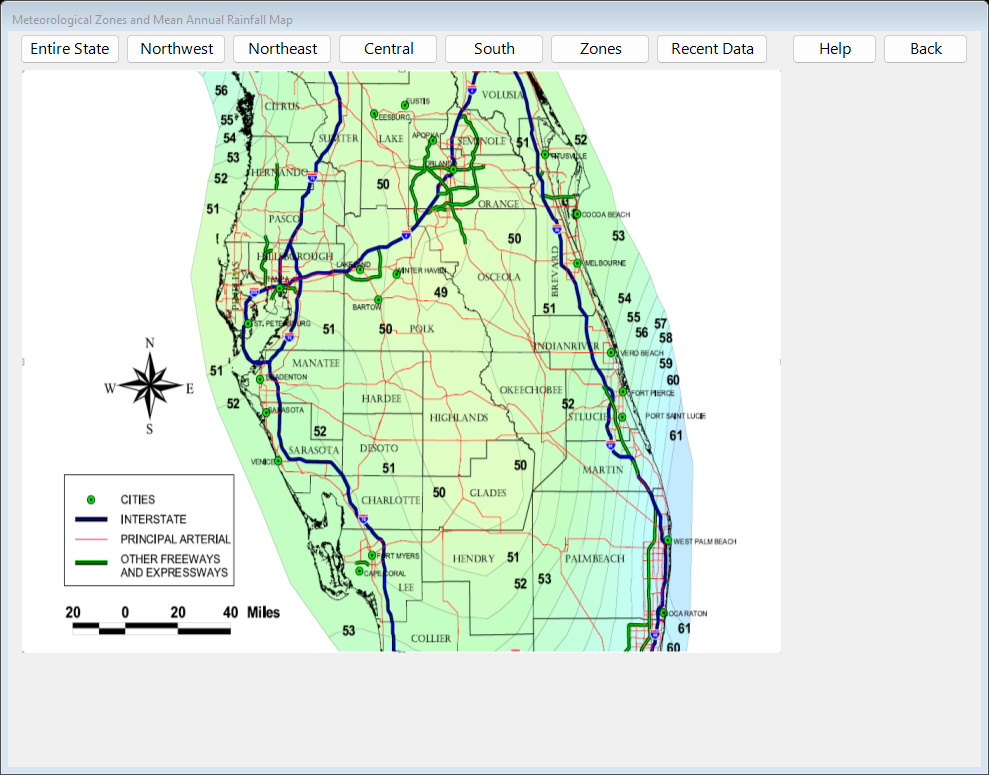
The regional rainfall map. Enter the zone and the rainfall on General Site Information.
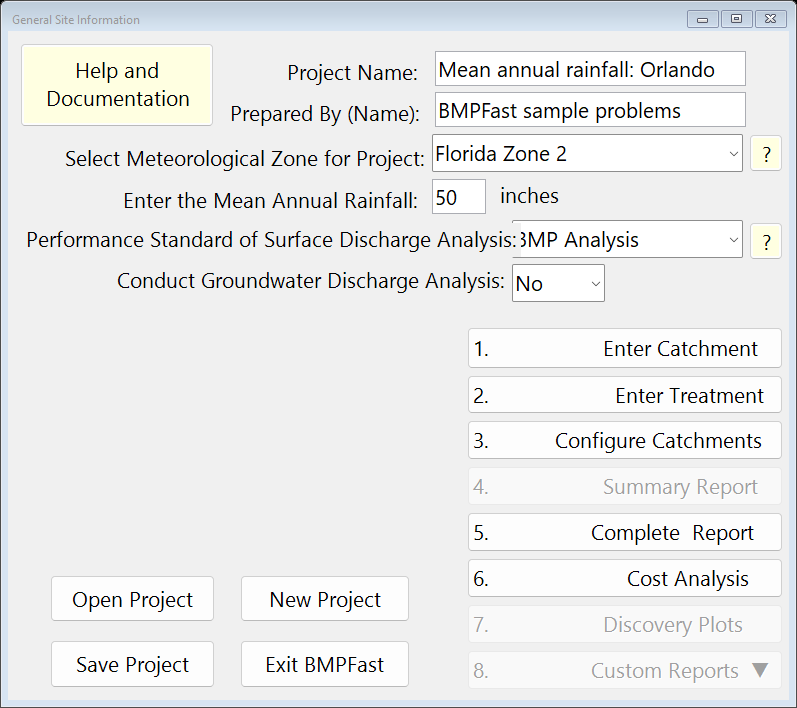
General Site Information (the main window). The catchment worksheet uses them for the runoff and the loads. Press Save Project to keep your copy; compare it with the .bmpt under Files.
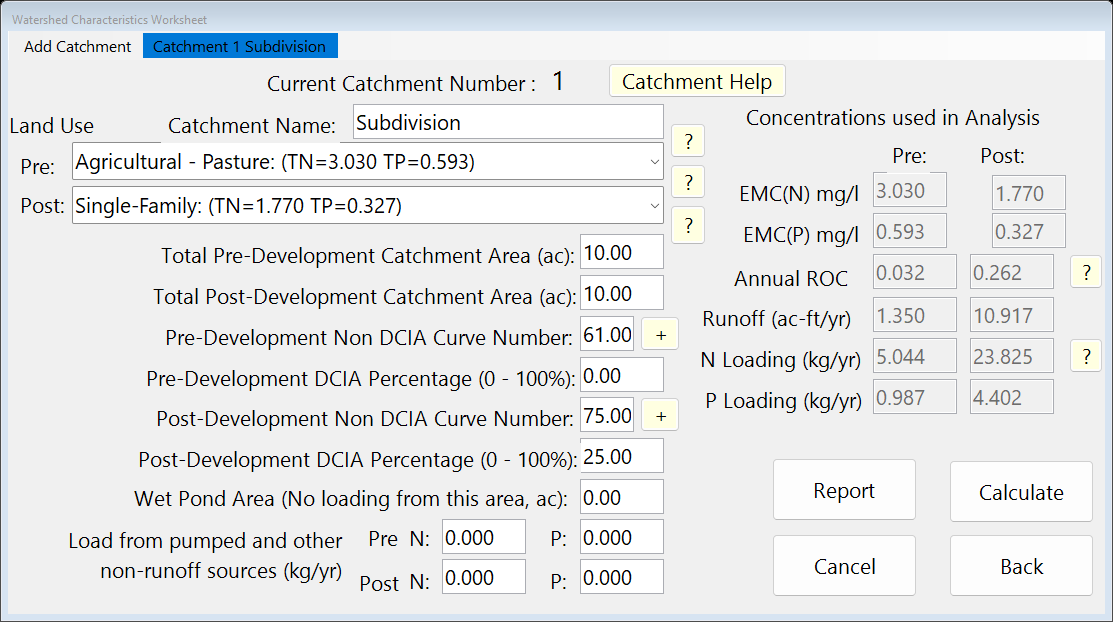
Watershed Characteristics Worksheet (1. Enter Catchment).
3Results
| Result | Value |
|---|---|
| Catchment 1: computed by BMPFast | |
| Annual runoff coefficient (ROC), pre / post | 0.032 / 0.262 |
| Runoff, pre / post | 1.350 / 10.917 ac-ft/yr |
| TN load, pre / post | 5.044 / 23.825 kg/yr |
| TP load, pre / post | 0.987 / 4.402 kg/yr |
4Check
Runoff and loads (Equations 9-1 and 9-2 of AH Vol I).
| Runoff | = ROC × area × rainfall / 12 |
| = 0.262 × 10.00 ac × 50.0 in / 12 | |
| = 10.917 ac-ft/yr (program 10.917). |
| TN load | = EMC × runoff × 1.233 |
| = 1.770 × 10.917 × 1.233 | |
| = 23.825 kg/yr (program 23.825) |
| TP load | = 0.327 × 10.917 × 1.233 |
| = 4.402 kg/yr (program 4.402). |
1.233 kg is 1 mg/L in 1 ac-ft.
The runoff is in direct proportion to the rainfall: 10 % more rain, 10 % more runoff and load for the same ROC. The zone changes the ROC (Appendix N tables) and the BMP efficiency tables (Appendix O) (help page 815).
5Files
- rainfall-orlando.bmpt: the project, saved by BMPFast. Save it (your browser puts it in Downloads). In BMPFast press Open Project, then Open Project again in the Open BMPFast Project dialog (below its Recent Projects list), and choose the file.
- Summary Report (as BMPFast shows it)
- BMP report (worksheet) (as BMPFast shows it)
6Help and methodology
Calculated with BMPFast 1.1.9 (build 6.0.0, 2026-10-16). Older versions may not have the Equations button or may give slightly different results; download the latest at bmpfast.com. Screen captures are for demonstration only.