
All programs › BMPFast › BMPFast 2 sample problems
Vegetated filter strip beside a parking lot (retention)
A 20 ft strip, 400 ft long; BMP Analysis, Zone 2.
Help: Vegetated Filter Strip (help page 304) · Download the .bmpf · Link to Solution in BMPFast Version 1
1The problem
A 1-acre parking lot sheds its runoff across a 20 ft grass filter strip, 400 ft long, that infiltrates.
| Input | Value | Source |
|---|---|---|
| Project (General Site Information) | ||
| Meteorological zone | Florida Zone 2 | Zone map (help page 815) |
| Mean annual rainfall | 50 in | Mean annual rainfall map (help page 815) |
| Performance standard (analysis type) | BMP Analysis | Site (illustrative) |
| Catchment 1: Parking (Watershed Characteristics) | ||
| Land use, pre / post | Undeveloped - Mesic Flatwoods / Low-Intensity Commercial | Site (illustrative) |
| Area, pre / post | 1 / 1 ac | Site (illustrative) |
| Non-DCIA curve number, pre / post | 70 / 80 | Site (illustrative) |
| DCIA, pre / post | 0 / 60 % | Site (illustrative) |
| EMC TN, pre / post | 1.087 / 0.930 mg/L | BMPFast land use table (AH Vol I Table 9.2) |
| EMC TP, pre / post | 0.043 / 0.190 mg/L | BMPFast land use table (AH Vol I Table 9.2) |
| Vegetated Filter Strip (worksheet) | ||
| System type | Retention | Design (illustrative) |
| VFS width | 20 ft | Design (illustrative) |
| VFS length | 400 ft | Design (illustrative) |
| VFS depth | 1 ft | Design (illustrative) |
| Width of DCIA | 109 ft | Design (illustrative) |
| VFS storage capacity | 0.2 in/in | Design (illustrative) |
| VFS slope | 2 % | Design (illustrative) |
Find: the TN and TP removal of the BMP, the loads leaving the site, and whether the performance standard is met.
2Steps in BMPFast 2
Start BMPFast 2 and choose File ▸ New project. The tree on the left opens on the project (General Site Information). On its Entry tab enter: Project name Vegetated filter strip: retention; Meteorological zone Florida Zone 2; Mean annual rainfall 50.00 in; Type of analysis BMP Analysis. (To follow along with the finished project instead, choose File ▸ Open and open
filter-strip-retention.bmpffrom Files below.)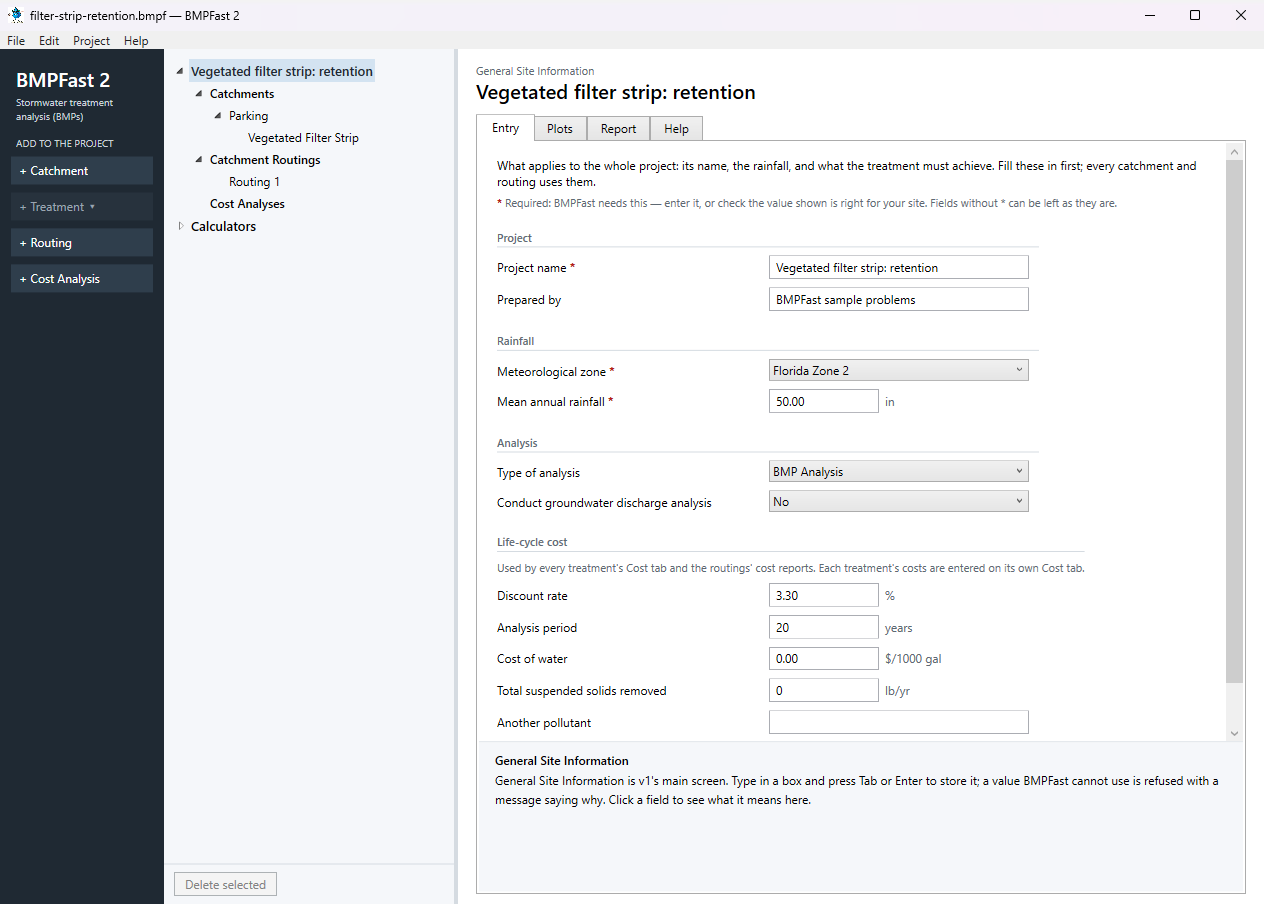
General Site Information: the project’s Entry tab. Press Add Catchment (left). Select the new catchment in the tree; on its Entry tab type the name Parking and enter: Land use (pre) Undeveloped - Mesic Flatwoods; Land use (post) Low-Intensity Commercial; Area (pre) 1.00 ac; Area (post) 1.00 ac; Non-DCIA curve number (pre) 70.00; Non-DCIA curve number (post) 80.00; DCIA (post) 60.00 %. Leave the other boxes as they are (0 or blank). BMPFast 2 calculates as you type; scroll down to Calculated for the results after development: Annual runoff coefficient (ROC) (post) 0.530; Runoff volume (post) 2.208 ac-ft/yr; Nitrogen load (post) 2.532 kg/yr; Phosphorus load (post) 0.517 kg/yr.
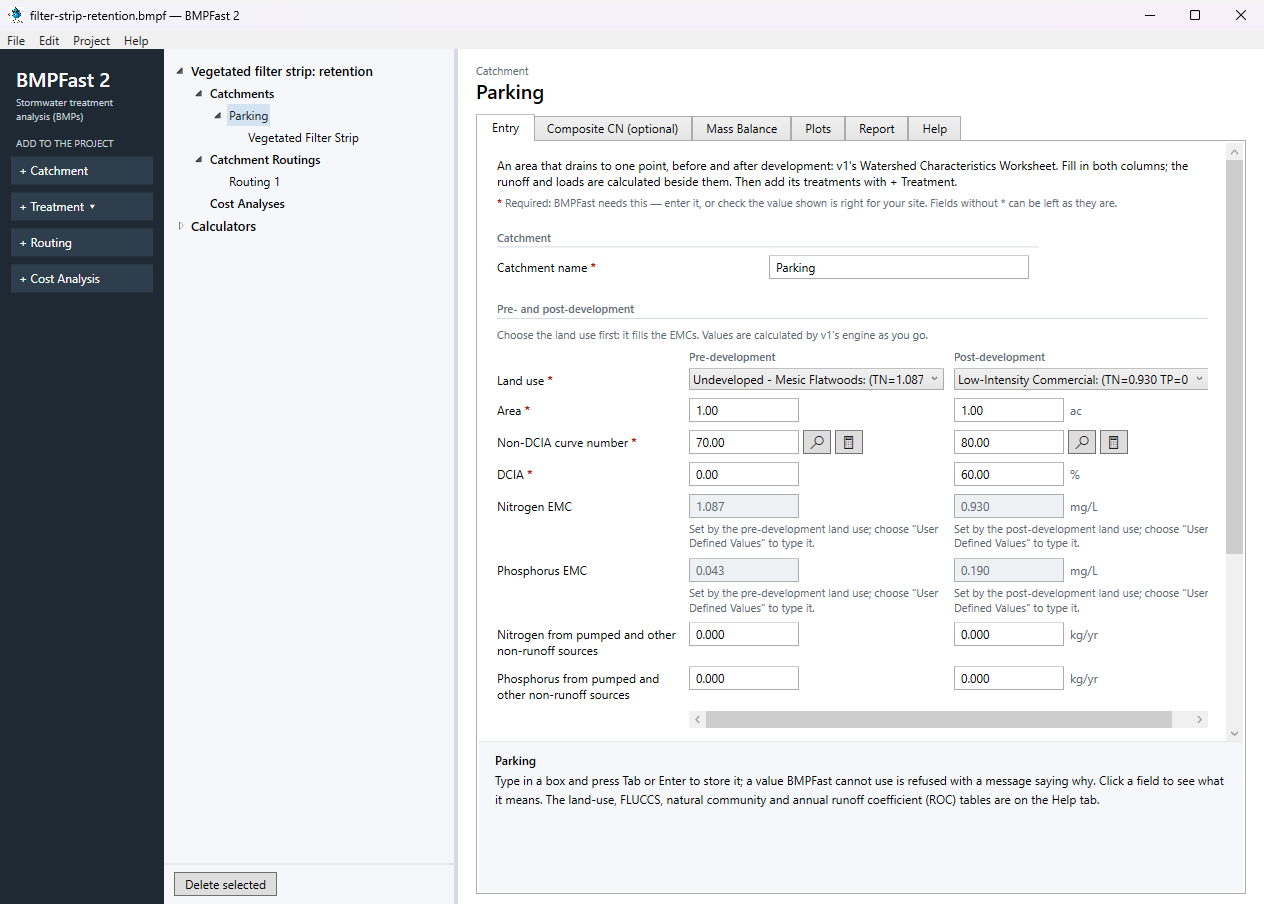
The catchment Parking: its Entry tab. With Parking selected, press Add Treatment and choose Vegetated Filter Strip. On its Entry tab type the Treatment name Vegetated Filter Strip (BMPFast 2 starts it as “Vegetated Filter Strip 1”) and enter: System type Retention; Strip width 20.00 ft; Strip length 400.00 ft; Strip depth 1.00 ft; Width of the DCIA 109.00 ft; Storage capacity 0.20 in/in; Strip slope 2.00 %. The results are calculated as you type: Runoff (feeder) area 1.001 ac; Buffer area 0.184 ac; Treatment depth 0.372 in; Nitrogen removal provided 46.50 %; Phosphorus removal provided 46.50 %.
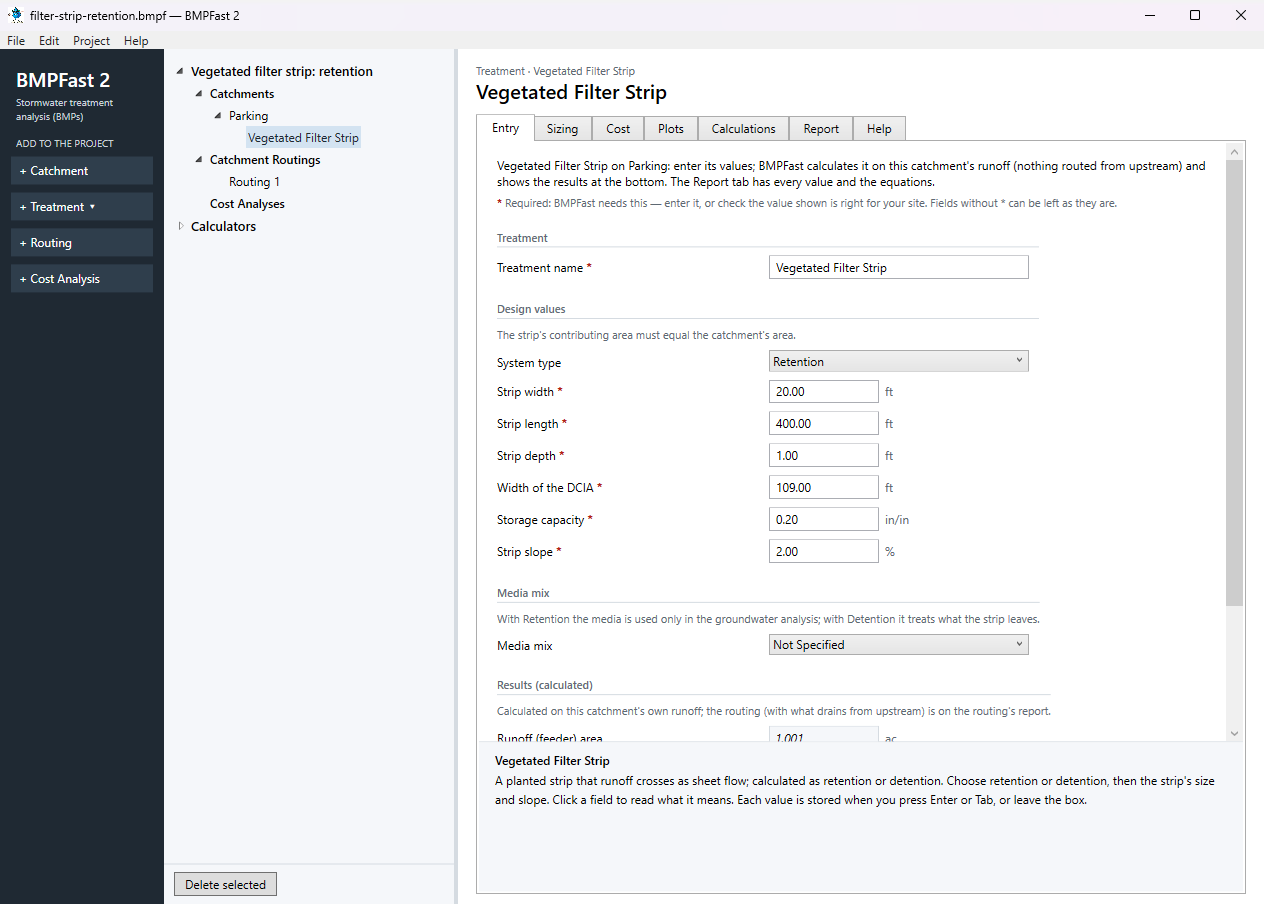
The treatment Vegetated Filter Strip: its Entry tab. Open the treatment’s Report tab: its inputs and removal, as a report to print or save.
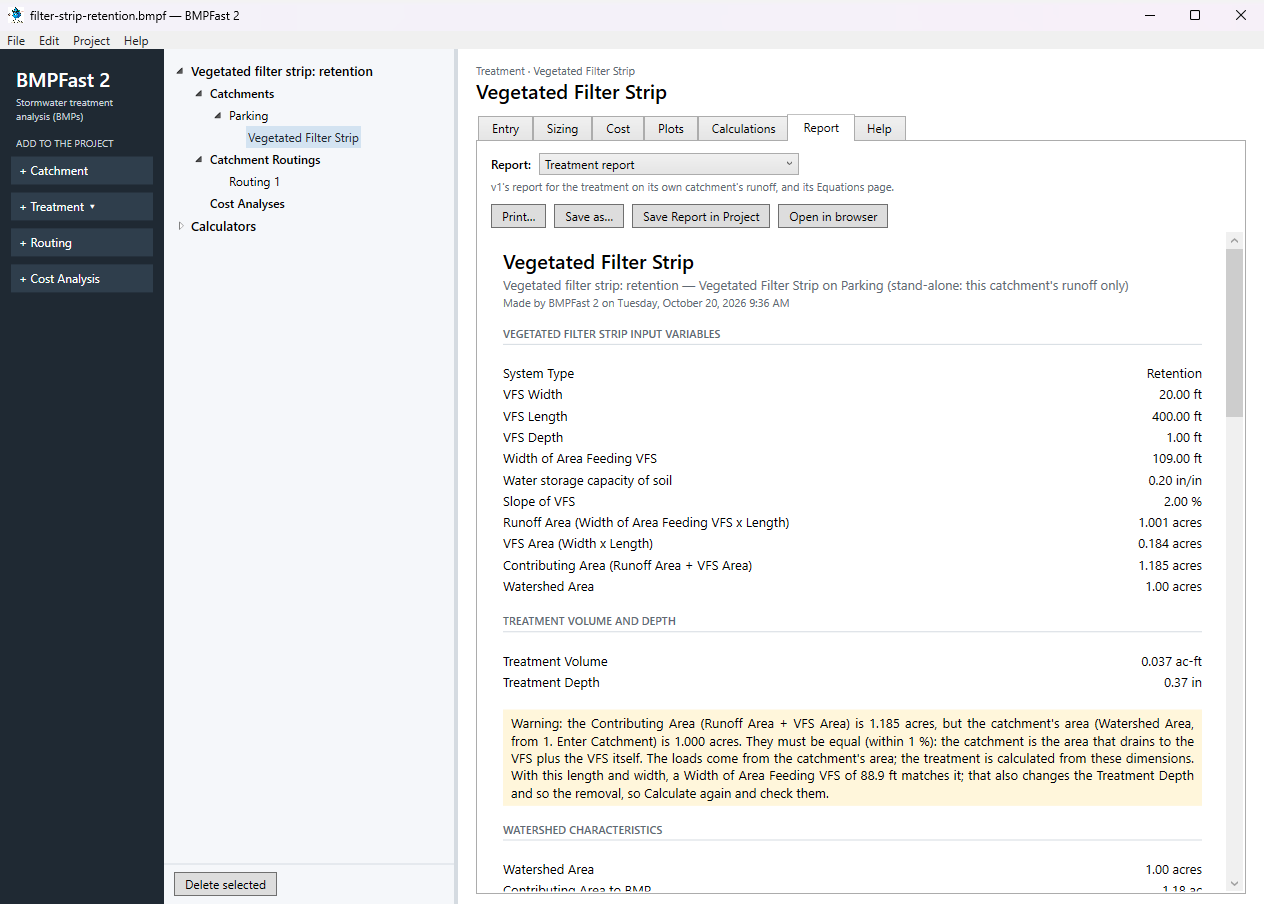
The treatment Vegetated Filter Strip: its Report tab. Press Add Routing (left). BMPFast 2 adds Routing 1 under Catchment Routings, with every catchment draining to the outlet and no treatment; a project can have several routings, compared side by side. On its Entry tab (How the routing is calculated Strand routing (v1's routing; use this for permits)) set each catchment as in this table:
Catchment Drains to Treatment used Parking Outlet Vegetated Filter Strip A catchment is treated only by the treatment its routing uses.
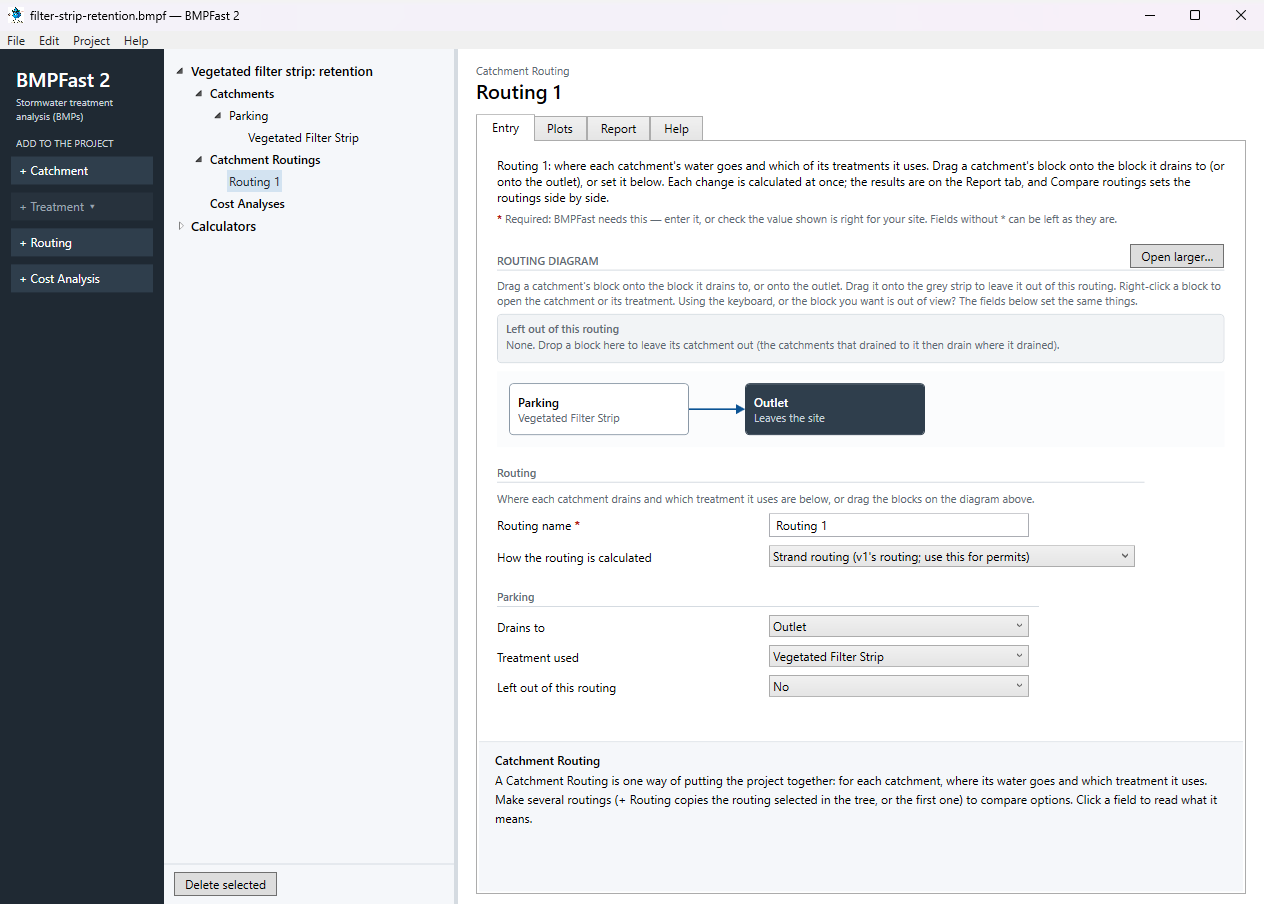
The routing’s Entry tab: where each catchment drains and the treatment it uses. Open the routing’s Report tab. Results shows the loads leaving the site, the removal provided and required, and whether the performance standard is met; the list at the top of the tab has v1’s reports for the same routing (Summary, Complete, Flow Balance, AH Vol I Sec 9 compliance). Save the project with File ▸ Save; compare it with the .bmpf under Files.
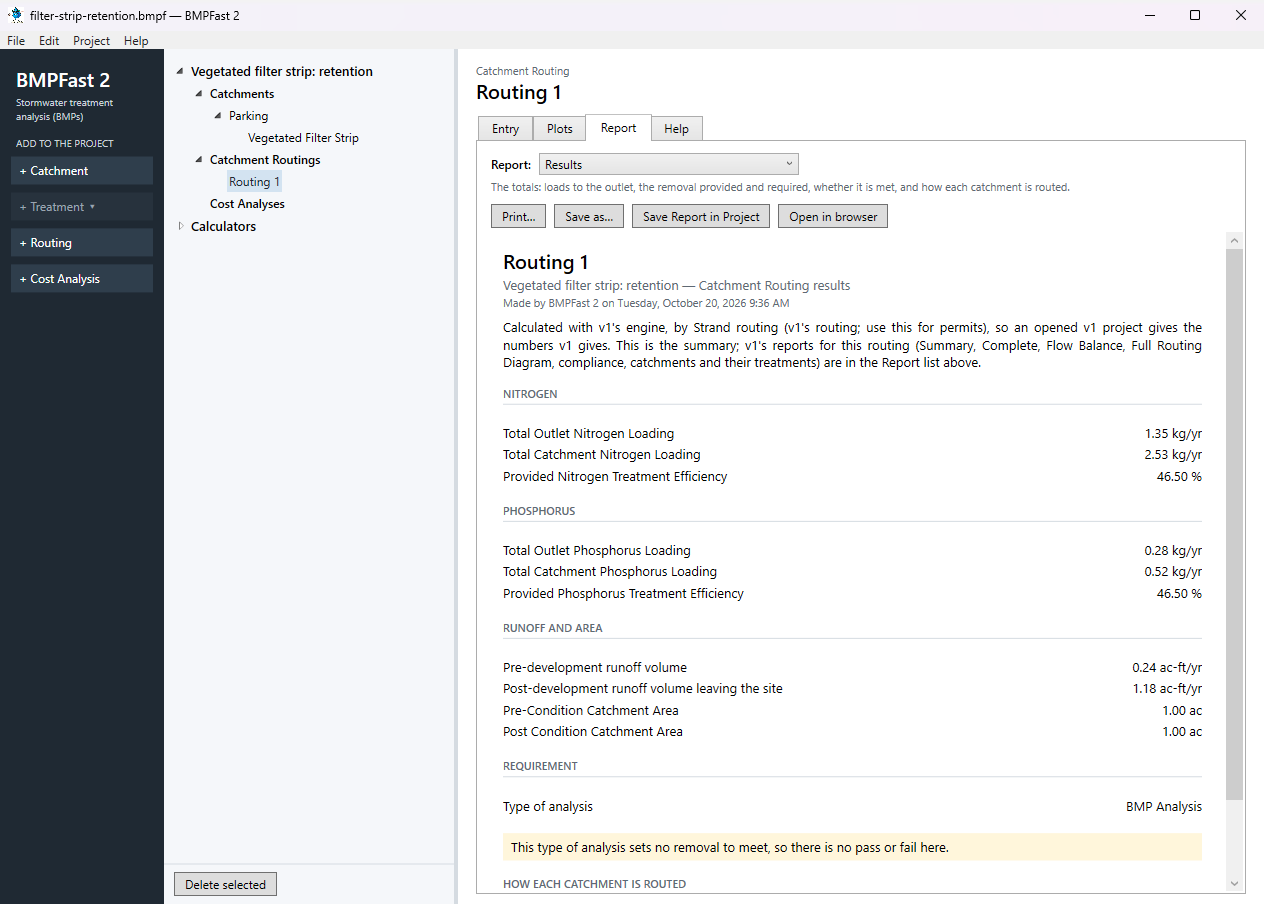
The routing’s Report tab: Results.
3Results
| Result | Value |
|---|---|
| Catchment 1: computed by BMPFast | |
| Annual runoff coefficient (ROC), pre / post | 0.057 / 0.530 |
| Runoff, pre / post | 0.238 / 2.208 ac-ft/yr |
| TN load, pre / post | 0.318 / 2.532 kg/yr |
| TP load, pre / post | 0.013 / 0.517 kg/yr |
| Vegetated Filter Strip: computed by BMPFast | |
| Treatment depth | 0.372 in |
| Hydraulic capture efficiency | 46.50 % |
| Provided TN / TP removal | 46.50 % / 46.50 % |
| TN load in → out | 2.532 → 1.355 kg/yr |
| TP load in → out | 0.517 → 0.277 kg/yr |
| Site (all catchments, at the outlet) | |
| TN load: catchments → outlet | 2.532 → 1.355 kg/yr |
| TP load: catchments → outlet | 0.517 → 0.277 kg/yr |
| Provided removal TN / TP | 46.5 % / 46.5 % |
The BMP report
Open this report on its own page.
The Summary Report
Open this report on its own page.
BMPFast 2 and BMPFast (v1)
| Result | BMPFast 2 | BMPFast (v1), its page | |
|---|---|---|---|
| Nitrogen leaving the site | 1.355 kg/yr | 1.355 kg/yr | same |
| Phosphorus leaving the site | 0.277 kg/yr | 0.277 kg/yr | same |
| Site removal, nitrogen | 46.505 % | 46.505 % | same |
| Site removal, phosphorus | 46.505 % | 46.505 % | same |
| Parking: Vegetated Filter Strip removal, nitrogen | 46.505 % | 46.505 % | same |
| Parking: Vegetated Filter Strip removal, phosphorus | 46.505 % | 46.505 % | same |
Every number BMPFast 2 gives for this problem is the same as BMPFast (v1)’s, to three decimals.
4Check
Runoff and loads (Equations 9-1 and 9-2 of AH Vol I).
| Runoff | = ROC × area × rainfall / 12 |
| = 0.530 × 1.00 ac × 50.0 in / 12 | |
| = 2.208 ac-ft/yr (program 2.208). |
| TN load | = EMC × runoff × 1.233 |
| = 0.930 × 2.208 × 1.233 | |
| = 2.532 kg/yr (program 2.532) |
| TP load | = 0.190 × 2.208 × 1.233 |
| = 0.517 kg/yr (program 0.517). |
1.233 kg is 1 mg/L in 1 ac-ft.
Treatment depth.
| Depth | = 12 × width × depth × soil storage / (width + feeder width) |
| = 12 × 20 × 1.00 × 0.20 / (20 + 109) | |
| = 0.3721 in (program 0.3721). |
Capture. The retention efficiency tables for Florida Zone 2 at a treatment depth of 0.372 in, non-DCIA CN 80.00 and DCIA 60.0 % give a hydraulic capture of 46.50 % (AH Vol I Appendix O; read the same tables with Calculators ▸ Retention Efficiency Tables, help page 4325). As a retention system the removal equals the capture.
Load out.
| TN out | = load in × (1 − removal) |
| = 2.532 × (1 − 46.50 / 100) | |
| = 1.355 kg/yr (program 1.355) |
| TP out | = 0.517 × (1 − 46.50 / 100) |
| = 0.277 kg/yr (program 0.277). |
The program’s Equations page
5Files
- filter-strip-retention.bmpf: the project, saved by BMPFast 2. Save it (your browser puts it in Downloads), then in BMPFast 2 choose File ▸ Open and open it. Opened again and calculated, it gives the numbers on this page.
- filter-strip-retention.bmpt: the same project as BMPFast (v1) saved it. BMPFast 2 opens it too (File ▸ Open); saving it then makes a .bmpf and leaves the .bmpt as it was.
- Routing 1 (BMPFast 2’s report, as Open in browser on its Report tab gives it)
- Routing 1 — Summary Report (BMPFast 2’s report, as Open in browser on its Report tab gives it)
- Vegetated Filter Strip (BMPFast 2’s report, as Open in browser on its Report tab gives it)
- Vegetated Filter Strip — calculations (BMPFast 2’s report, as Open in browser on its Report tab gives it)
6Help and methodology
Calculated with BMPFast 2 version 2.0.0 (2026-10-20), which opens the problem’s v1 project as it is. Screen captures are of BMPFast 2’s own window and are for demonstration only.