
All programs › BMPFast › BMPFast 2 sample problems
BMPs in series: tree well, exfiltration and retention
BMPFast sample project Example Problem 6: three retention BMPs in series.
Help: BMPs in Series (help page 504) · Download the .bmpf · Link to Solution in BMPFast Version 1
1The problem
The BMPFast sample project Example Problem 6: tree wells, an exfiltration trench and a retention basin in series on a 6-acre catchment.
| Input | Value | Source |
|---|---|---|
| Project (General Site Information) | ||
| Meteorological zone | Florida Zone 2 | Zone map (help page 815) |
| Mean annual rainfall | 51 in | Mean annual rainfall map (help page 815) |
| Performance standard (analysis type) | BMP Analysis | BMPFast sample project |
| Catchment 1: Road and Commercial Center (Watershed Characteristics) | ||
| Land use, pre / post | Undeveloped - Dry Prairie / Low-Intensity Commercial | BMPFast sample project |
| Area, pre / post | 6 / 6 ac | BMPFast sample project |
| Non-DCIA curve number, pre / post | 79 / 85 | BMPFast sample project |
| DCIA, pre / post | 0 / 65 % | BMPFast sample project |
| EMC TN, pre / post | 2.025 / 0.930 mg/L | BMPFast land use table (AH Vol I Table 9.2) |
| EMC TP, pre / post | 0.184 / 0.188 mg/L | BMPFast land use table (AH Vol I Table 9.2) |
| BMPs in Series | ||
| BMP 1: Tree Well | 40 wells, storage 0.098 ac-ft | BMPFast sample project |
| BMP 2: Exfiltration | storage 0.069 ac-ft | BMPFast sample project |
| BMP 3: Retention | treatment depth 1.000 in (0.500 ac-ft) | BMPFast sample project |
Find: the removal of the series as one system, and the loads leaving the site.
2Steps in BMPFast 2
Start BMPFast 2 and choose File ▸ New project. The tree on the left opens on the project (General Site Information). On its Entry tab enter: Project name Example 6 Multiple BMP _ Cost; Meteorological zone Florida Zone 2; Mean annual rainfall 51.00 in; Type of analysis BMP Analysis. (To follow along with the finished project instead, choose File ▸ Open and open
series-tree-well-exfiltration-retention.bmpffrom Files below.)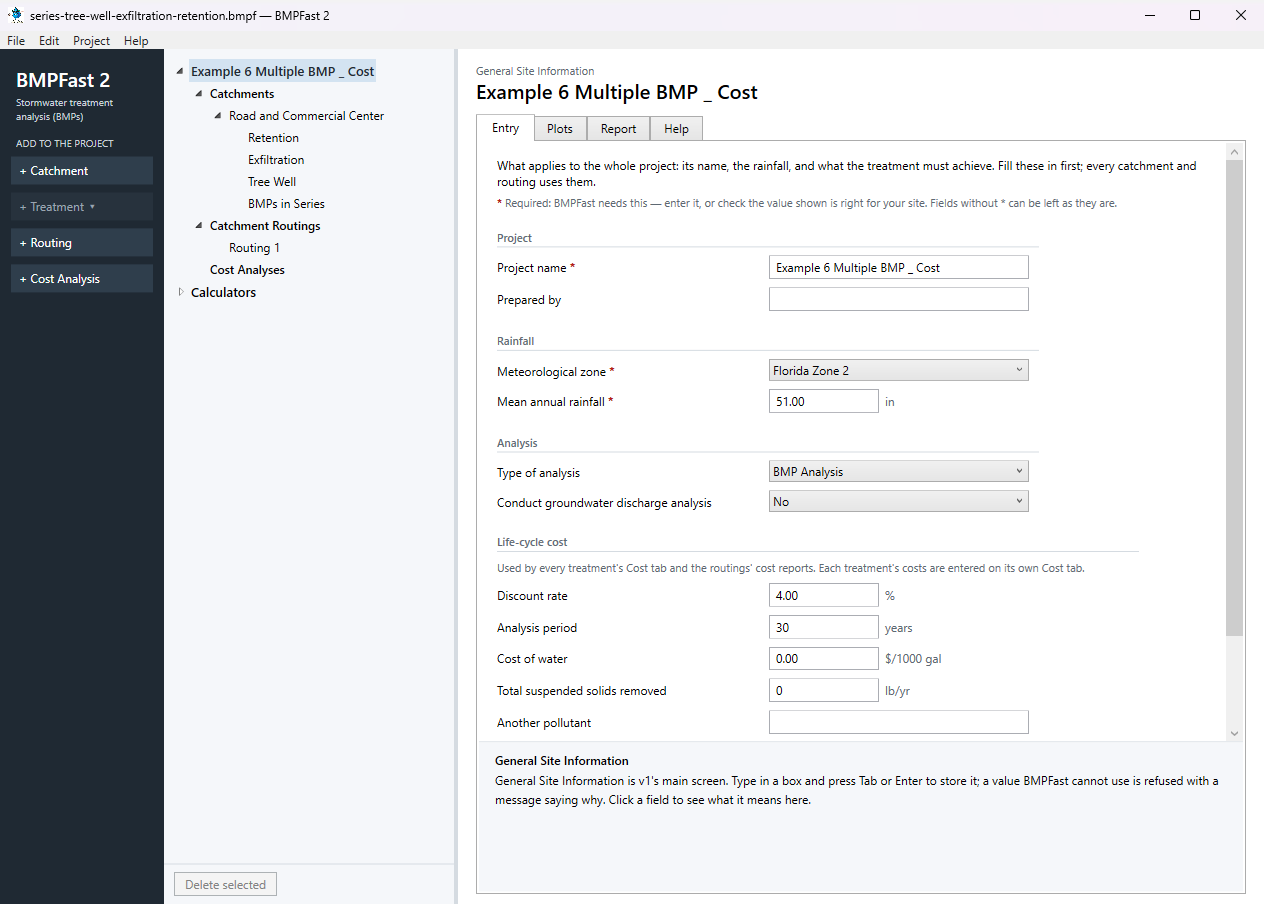
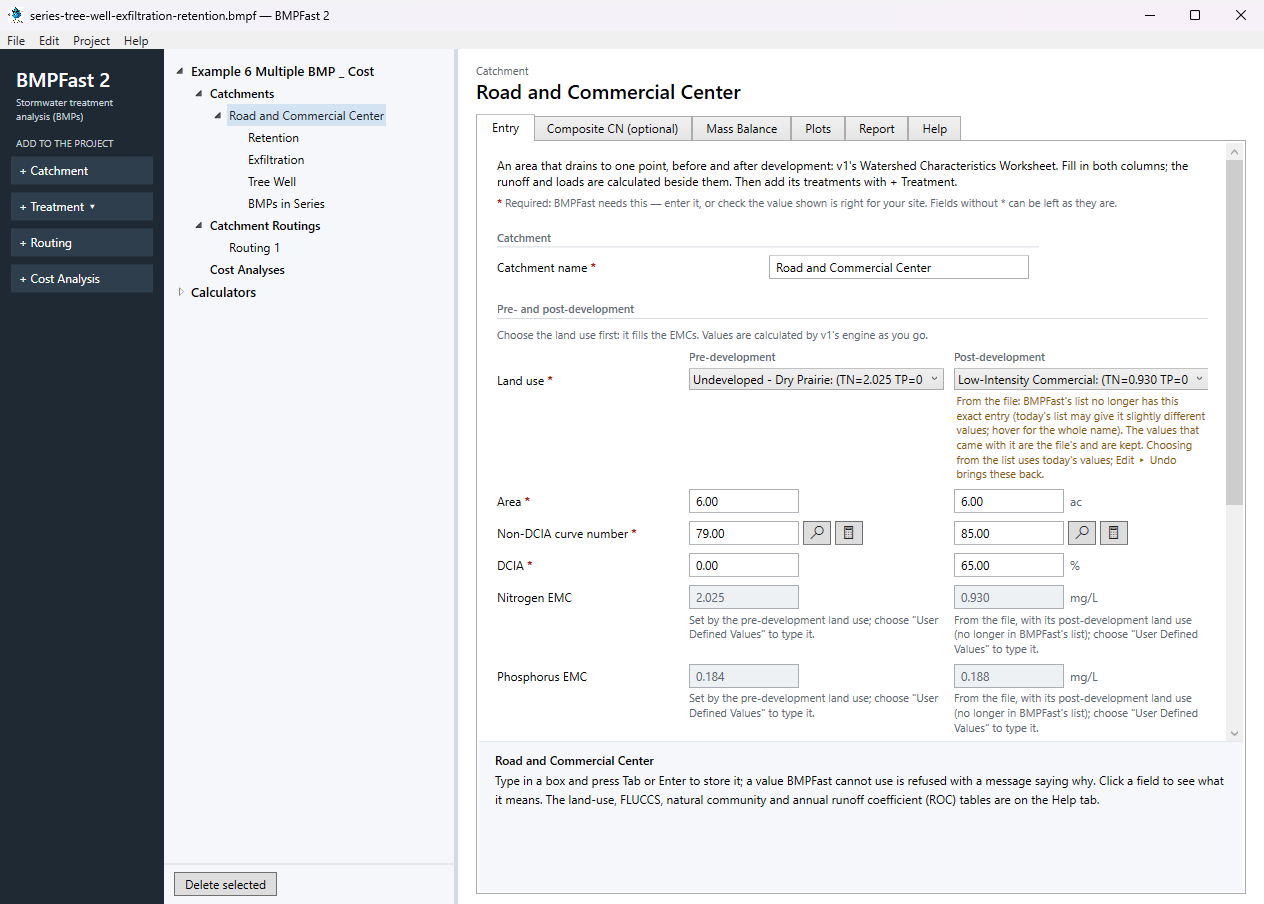
General Site Information: the project’s Entry tab. Press Add Catchment (left). Select the new catchment in the tree; on its Entry tab type the name Road and Commercial Center and enter: Land use (pre) Undeveloped - Dry Prairie; Land use (post) Low-Intensity Commercial; Area (pre) 6.00 ac; Area (post) 6.00 ac; Non-DCIA curve number (pre) 79.00; Non-DCIA curve number (post) 85.00; DCIA (post) 65.00 %. Leave the other boxes as they are (0 or blank). BMPFast 2 calculates as you type; scroll down to Calculated for the results after development: Annual runoff coefficient (ROC) (post) 0.582; Runoff volume (post) 14.841 ac-ft/yr; Nitrogen load (post) 17.018 kg/yr; Phosphorus load (post) 3.440 kg/yr.
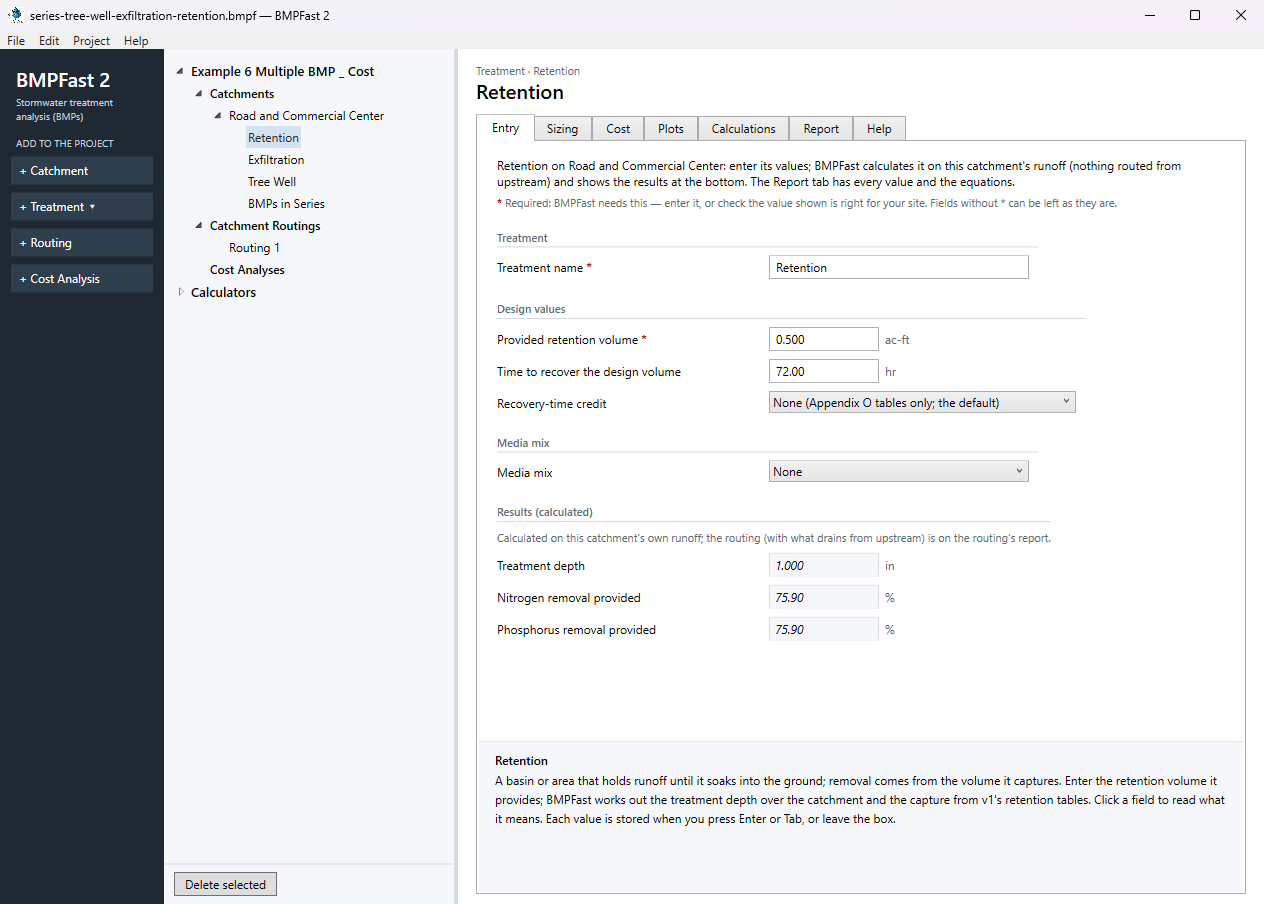
The catchment Road and Commercial Center: its Entry tab. With Road and Commercial Center selected, press Add Treatment and choose Retention. On its Entry tab type the Treatment name Retention (BMPFast 2 starts it as “Retention 1”) and enter: Provided retention volume 0.500 ac-ft; Time to recover the design volume 72.00 hr; Media mix None. The results are calculated as you type: Treatment depth 1.000 in; Nitrogen removal provided 75.90 %; Phosphorus removal provided 75.90 %.
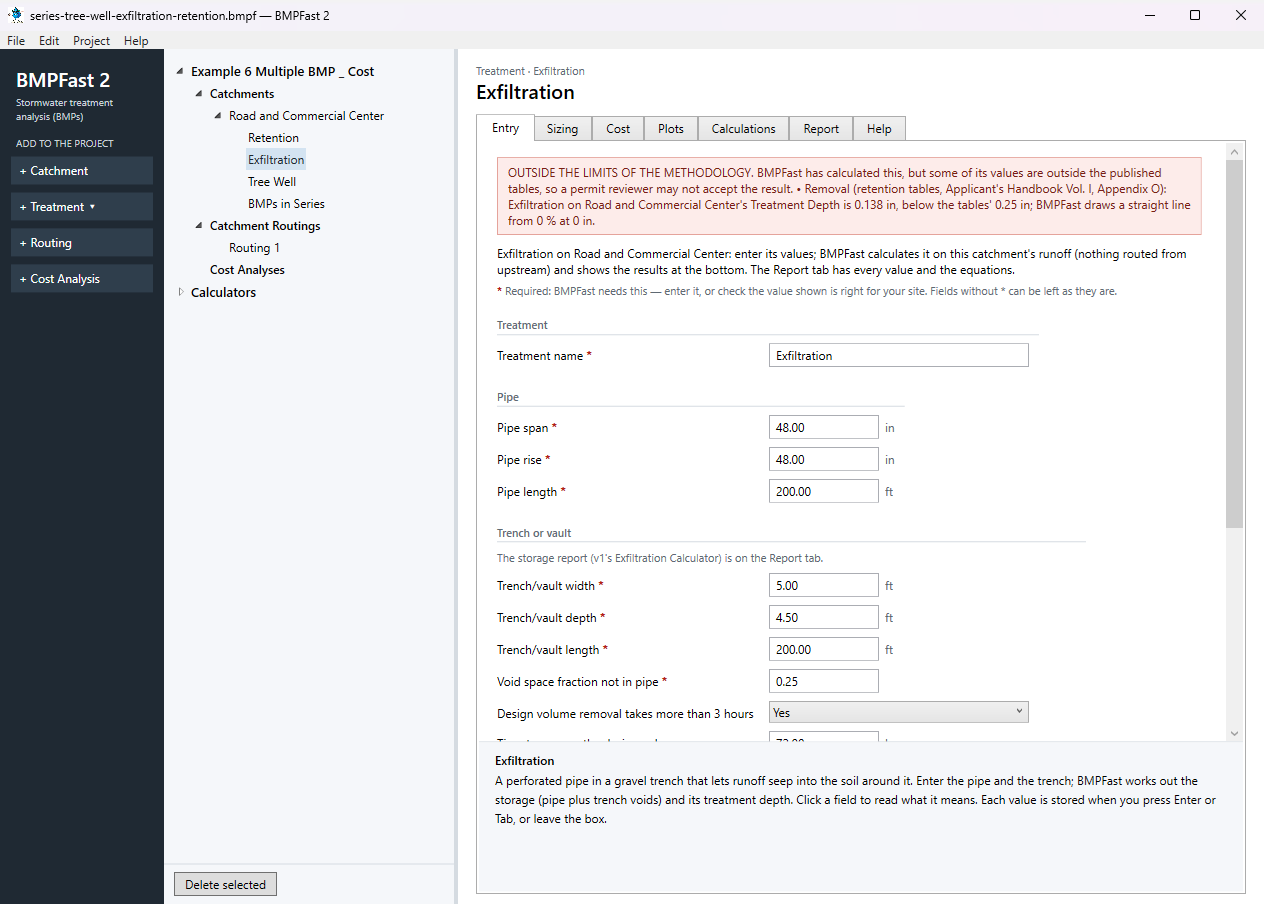
The treatment Retention: its Entry tab. With Road and Commercial Center selected, press Add Treatment and choose Exfiltration. On its Entry tab type the Treatment name Exfiltration (BMPFast 2 starts it as “Exfiltration 1”) and enter: Pipe span 48.00 in; Pipe rise 48.00 in; Pipe length 200.00 ft; Trench/vault width 5.00 ft; Trench/vault depth 4.50 ft; Trench/vault length 200.00 ft; Void space fraction not in pipe 0.25; Design volume removal takes more than 3 hours Yes; Time to recover the design volume 72.00 hr. The results are calculated as you type: Pipe volume 2,513.27 ft³; Trench/vault volume 496.68 ft³; Treatment volume 0.069 ac-ft; Treatment depth 0.138 in; Nitrogen removal provided 18.63 %; Phosphorus removal provided 18.63 %.
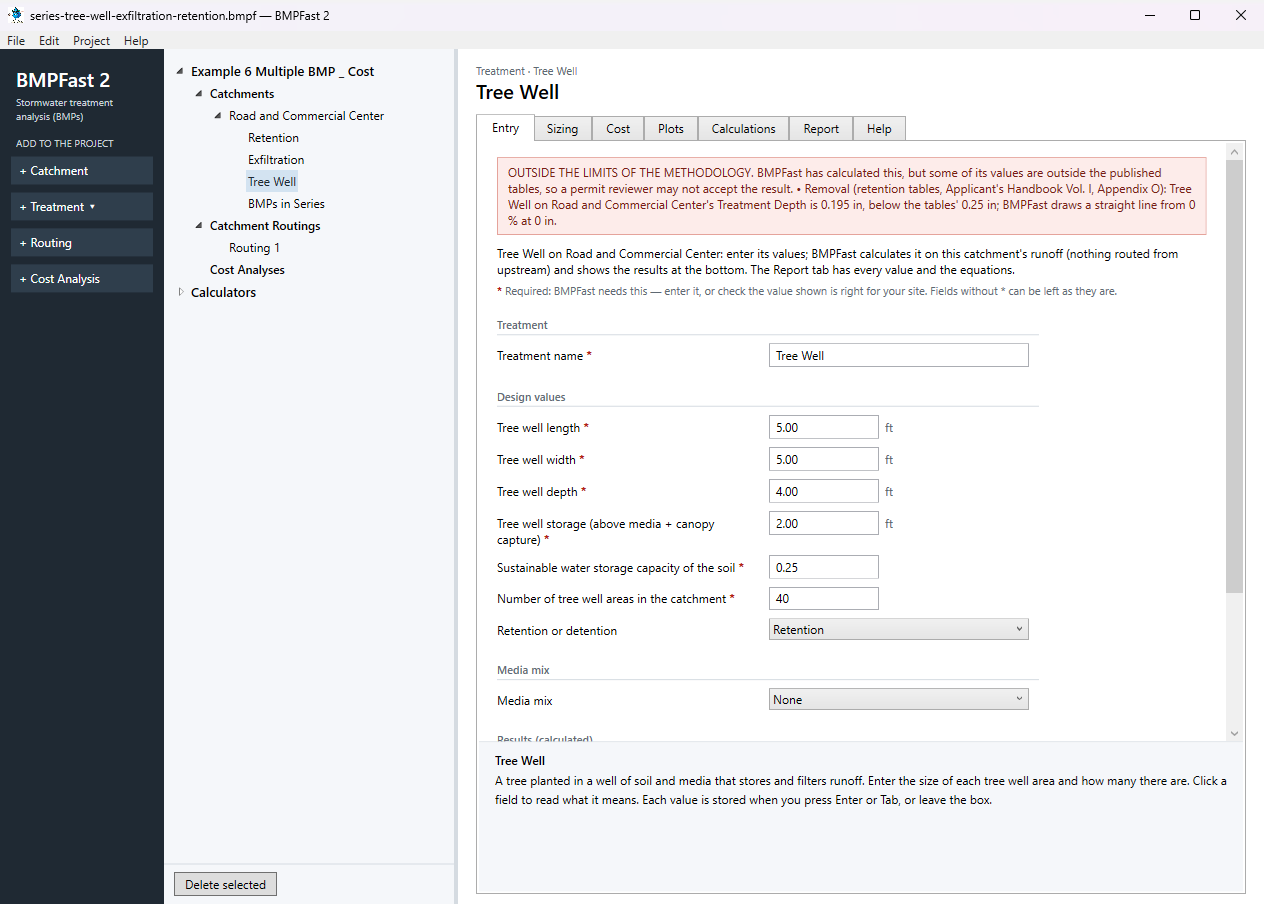
The treatment Exfiltration: its Entry tab. With Road and Commercial Center selected, press Add Treatment and choose Tree Well. On its Entry tab type the Treatment name Tree Well (BMPFast 2 starts it as “Tree Well 1”) and enter: Tree well length 5.00 ft; Tree well width 5.00 ft; Tree well depth 4.00 ft; Tree well storage (above media + canopy capture) 2.00 ft; Sustainable water storage capacity of the soil 0.25; Number of tree well areas in the catchment 40; Retention or detention Retention; Media mix None. The results are calculated as you type: Retention volume 0.098 ac-ft; Treatment depth 0.195 in; Nitrogen removal provided 26.30 %; Phosphorus removal provided 26.30 %.
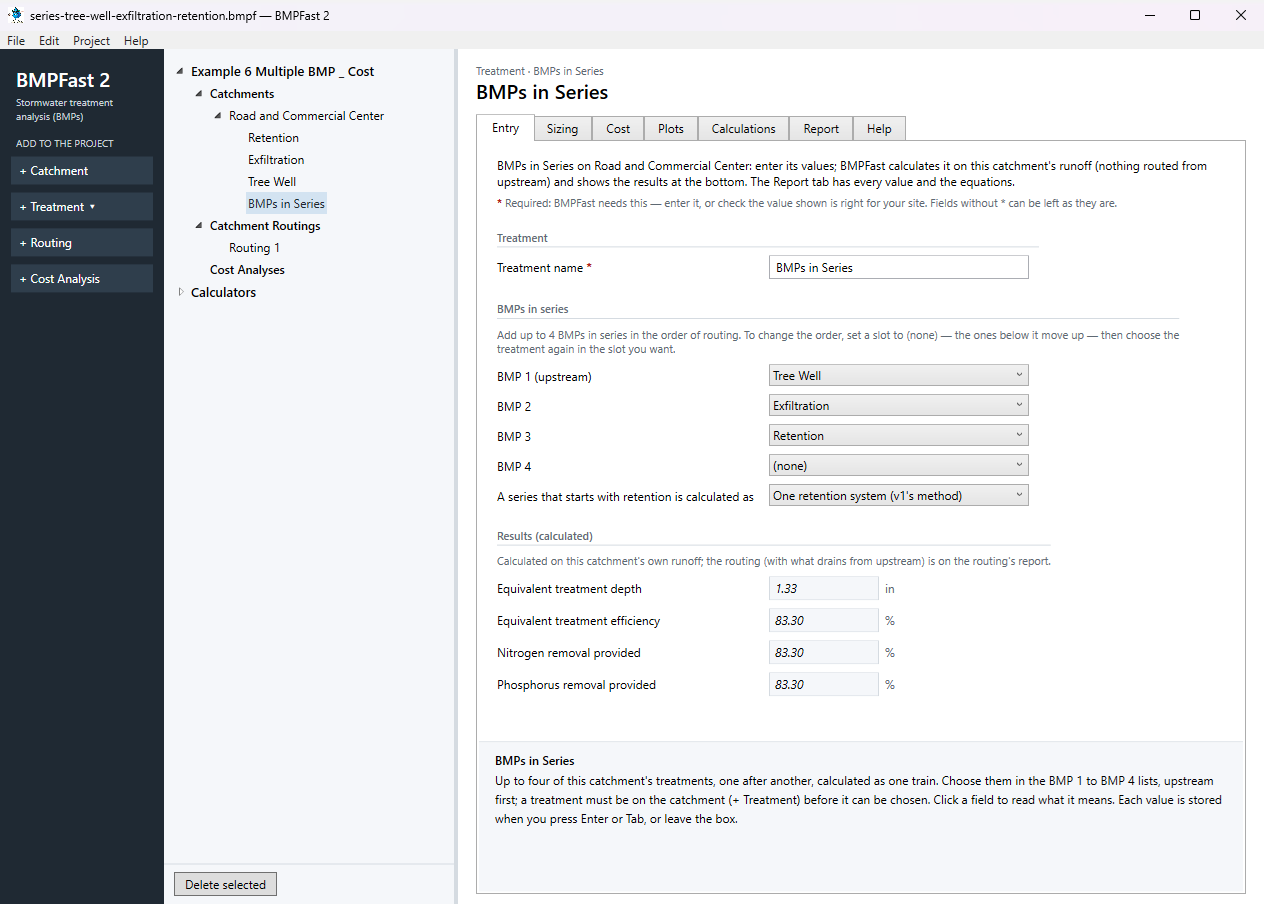
The treatment Tree Well: its Entry tab. With Road and Commercial Center selected, press Add Treatment and choose BMPs in Series. On its Entry tab type the Treatment name BMPs in Series and choose, upstream first: BMP 1 (upstream) Tree Well; BMP 2 Exfiltration; BMP 3 Retention; BMP 4 (none); A series that starts with retention is calculated as One retention system (v1's method). Each member is a treatment of this catchment (the steps above). The results are at the bottom of the tab: Equivalent treatment depth 1.33 in; Equivalent treatment efficiency 83.30 %; Nitrogen removal provided 83.30 %; Phosphorus removal provided 83.30 %.
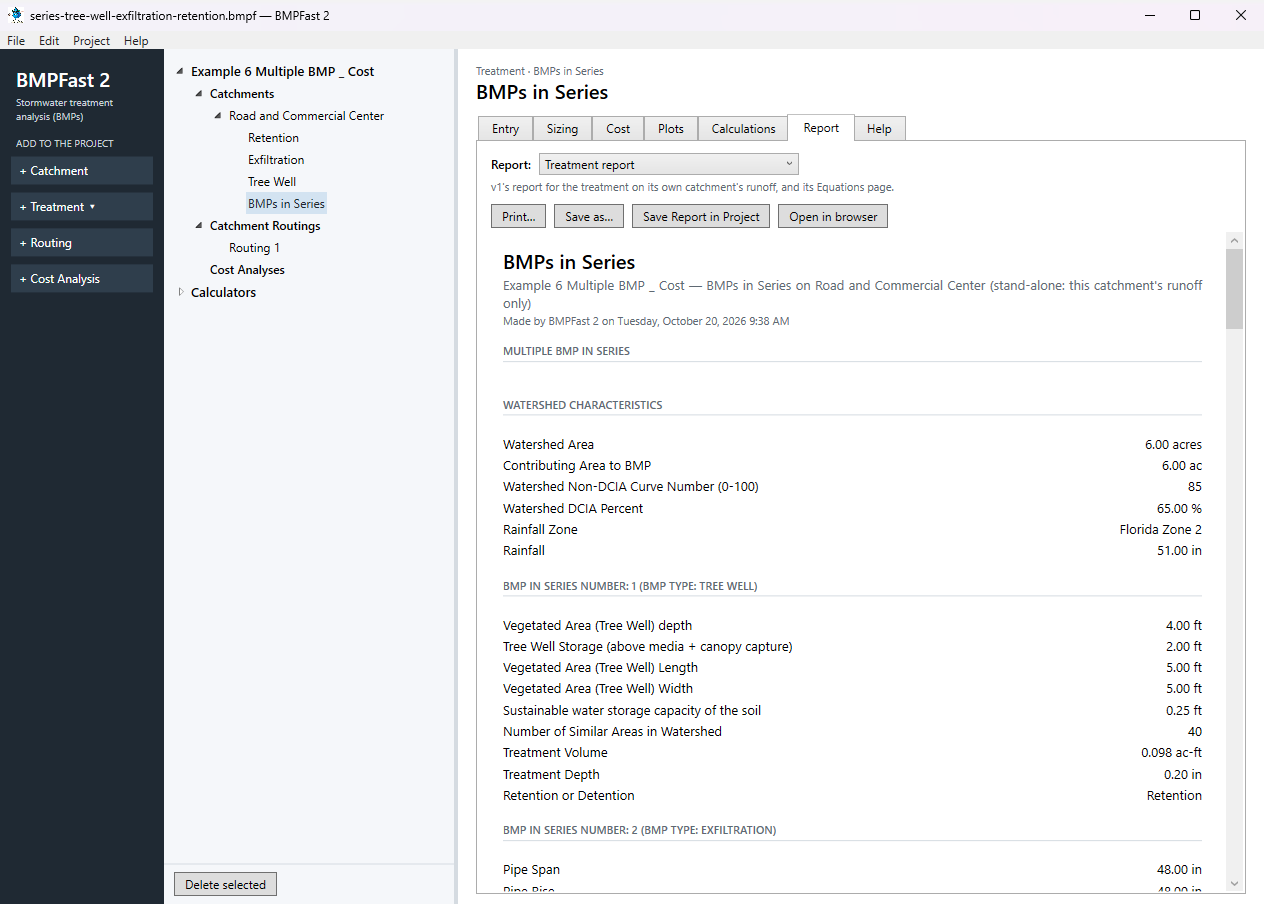
The treatment BMPs in Series: its Entry tab. Open the treatment’s Report tab: its inputs and removal, as a report to print or save.
The treatment BMPs in Series: its Report tab. Press Add Routing (left). BMPFast 2 adds Routing 1 under Catchment Routings, with every catchment draining to the outlet and no treatment; a project can have several routings, compared side by side. On its Entry tab (How the routing is calculated Strand routing (v1's routing; use this for permits)) set each catchment as in this table:
Catchment Drains to Treatment used Road and Commercial Center Outlet BMPs in Series A catchment is treated only by the treatment its routing uses.
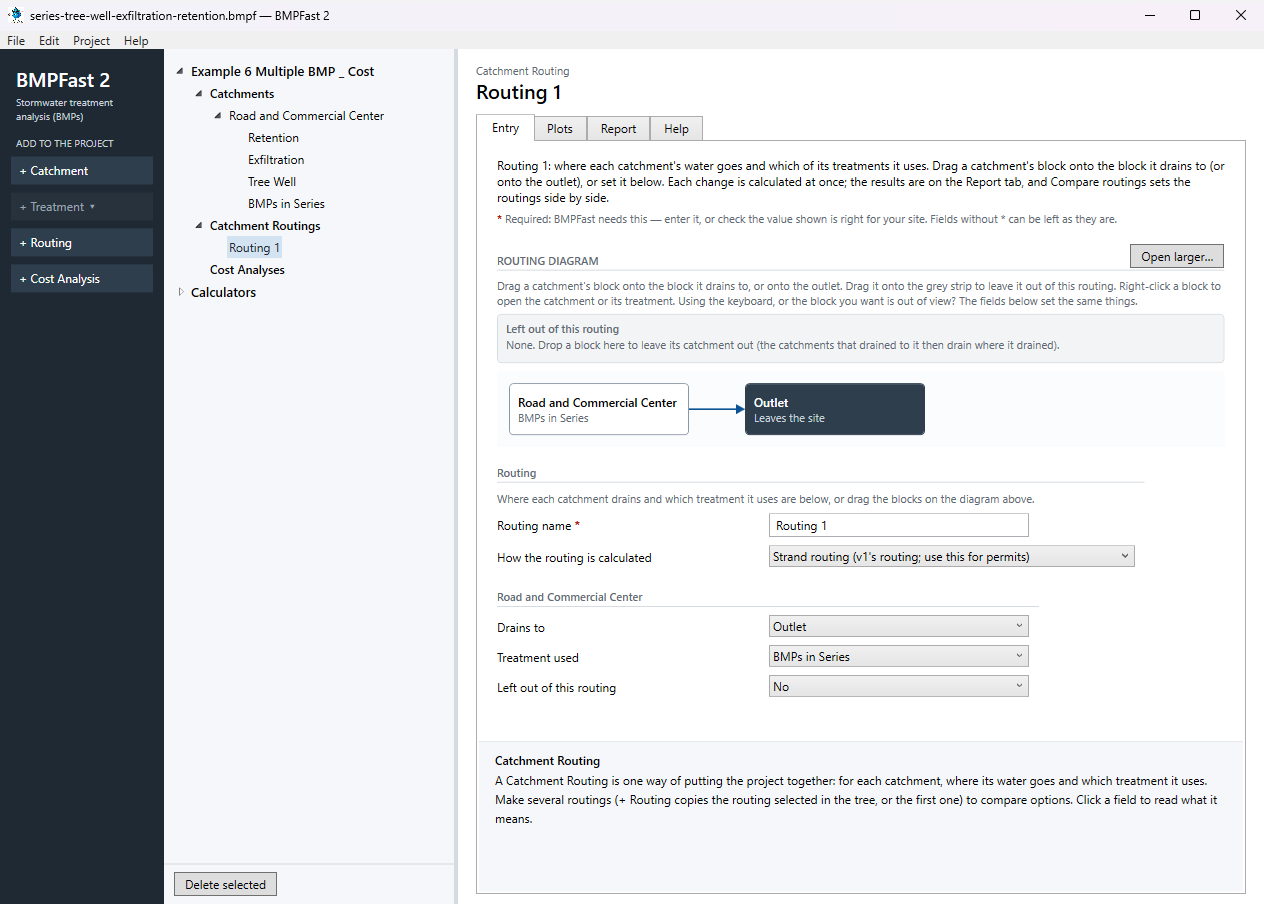
The routing’s Entry tab: where each catchment drains and the treatment it uses. Open the routing’s Report tab. Results shows the loads leaving the site, the removal provided and required, and whether the performance standard is met; the list at the top of the tab has v1’s reports for the same routing (Summary, Complete, Flow Balance, AH Vol I Sec 9 compliance). Save the project with File ▸ Save; compare it with the .bmpf under Files.
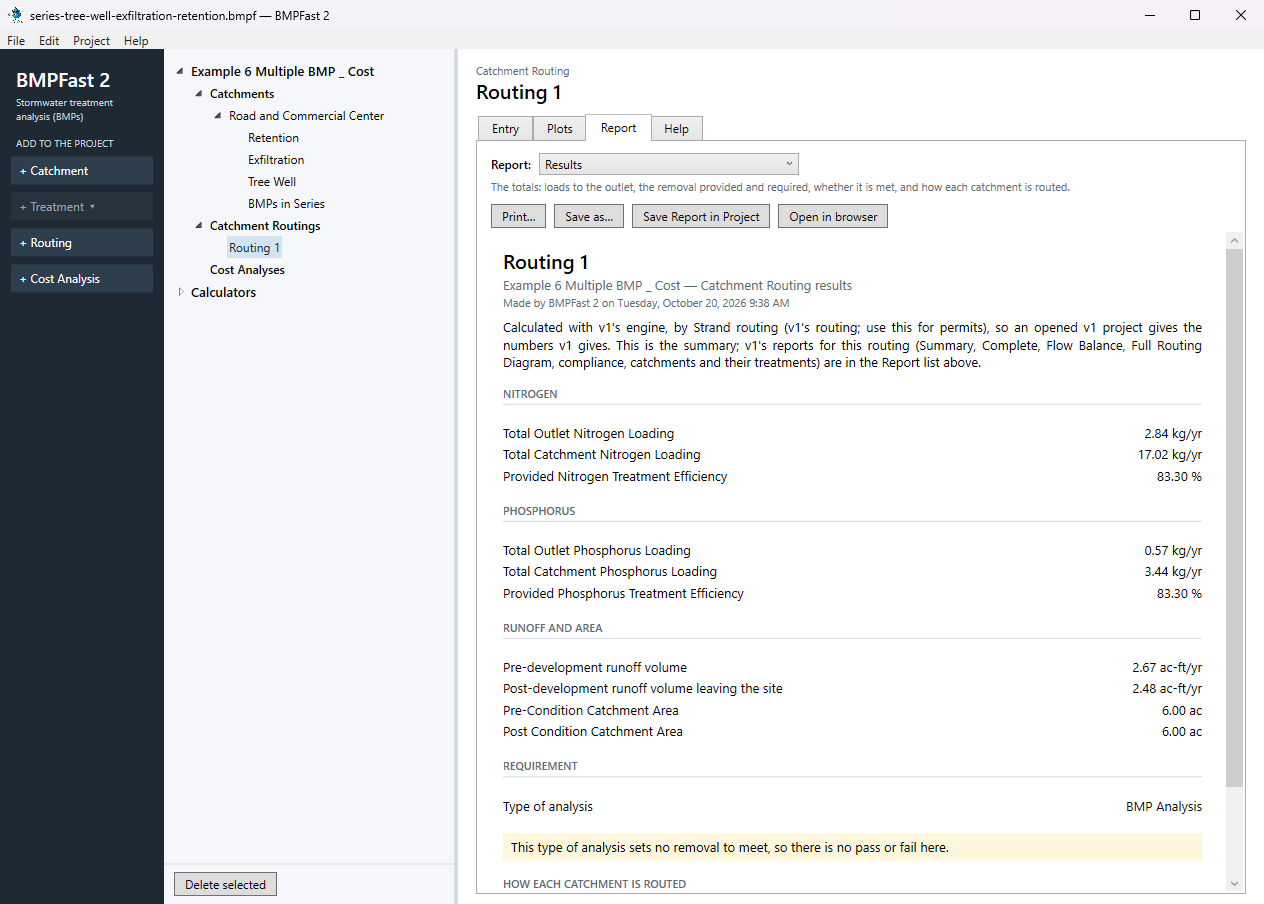
The routing’s Report tab: Results.
3Results
| Result | Value |
|---|---|
| Catchment 1: computed by BMPFast | |
| Annual runoff coefficient (ROC), pre / post | 0.105 / 0.582 |
| Runoff, pre / post | 2.667 / 14.841 ac-ft/yr |
| TN load, pre / post | 6.660 / 17.018 kg/yr |
| TP load, pre / post | 0.605 / 3.440 kg/yr |
| BMPs in Series: computed by BMPFast | |
| Equivalent Treatment Depth / Efficiency | 1.333 in / 83.30 % |
| Treatment depth | 1.333 in |
| Hydraulic capture efficiency | 83.30 % |
| Provided TN / TP removal | 83.30 % / 83.30 % |
| TN load in → out | 17.018 → 2.842 kg/yr |
| TP load in → out | 3.440 → 0.575 kg/yr |
| Site (all catchments, at the outlet) | |
| TN load: catchments → outlet | 17.018 → 2.842 kg/yr |
| TP load: catchments → outlet | 3.440 → 0.575 kg/yr |
| Provided removal TN / TP | 83.3 % / 83.3 % |
The BMPs in Series Equations report
Open this report on its own page.
The Summary Report
Open this report on its own page.
BMPFast 2 and BMPFast (v1)
| Result | BMPFast 2 | BMPFast (v1), its page | |
|---|---|---|---|
| Nitrogen leaving the site | 2.842 kg/yr | 2.842 kg/yr | same |
| Phosphorus leaving the site | 0.575 kg/yr | 0.575 kg/yr | same |
| Site removal, nitrogen | 83.300 % | 83.300 % | same |
| Site removal, phosphorus | 83.300 % | 83.300 % | same |
| Road and Commercial Center: Multiple BMP removal, nitrogen | 83.300 % | 83.300 % | same |
| Road and Commercial Center: Multiple BMP removal, phosphorus | 83.300 % | 83.300 % | same |
Every number BMPFast 2 gives for this problem is the same as BMPFast (v1)’s, to three decimals.
4Check
Runoff and loads (Equations 9-1 and 9-2 of AH Vol I).
| Runoff | = ROC × area × rainfall / 12 |
| = 0.582 × 6.00 ac × 51.0 in / 12 | |
| = 14.841 ac-ft/yr (program 14.841). |
| TN load | = EMC × runoff × 1.233 |
| = 0.930 × 14.841 × 1.233 | |
| = 17.018 kg/yr (program 17.018) |
| TP load | = 0.188 × 14.841 × 1.233 |
| = 3.440 kg/yr (program 3.440). |
1.233 kg is 1 mg/L in 1 ac-ft.
Retention in series. Retention BMPs in a row are one system: their treatment depths add to the Equivalent Treatment Depth of 1.333 in, and the retention tables at that depth give the system’s capture, 83.30 % (program TN removal 83.30 %). Adding each basin’s removal as a treatment train would overstate it, because the second basin sees only the larger storms the first one passes (Strand Based Routing for Retention in Series).
Load out.
| TN out | = load in × (1 − removal) |
| = 17.018 × (1 − 83.30 / 100) | |
| = 2.842 kg/yr (program 2.842) |
| TP out | = 3.440 × (1 − 83.30 / 100) |
| = 0.575 kg/yr (program 0.575). |
5Files
- series-tree-well-exfiltration-retention.bmpf: the project, saved by BMPFast 2. Save it (your browser puts it in Downloads), then in BMPFast 2 choose File ▸ Open and open it. Opened again and calculated, it gives the numbers on this page.
- series-tree-well-exfiltration-retention.bmpt: the same project as BMPFast (v1) saved it. BMPFast 2 opens it too (File ▸ Open); saving it then makes a .bmpf and leaves the .bmpt as it was.
- Routing 1 (BMPFast 2’s report, as Open in browser on its Report tab gives it)
- Routing 1 — Summary Report (BMPFast 2’s report, as Open in browser on its Report tab gives it)
- BMPs in Series (BMPFast 2’s report, as Open in browser on its Report tab gives it)
- BMPs in Series — calculations (BMPFast 2’s report, as Open in browser on its Report tab gives it)
6Help and methodology
- BMPs in Series (help page 504)
- Strand Based Routing for Retention in Series (help page 4824)
- Comparison of Methods for Wet Detention Ponds in Series (help page 4869)
- Comparison of Methods for Filters in Series (help page 4825)
- Retention Methodology (help page 4537)
- Wet Detention Methodology (help page 4590)
- Link to Solution in BMPFast Version 1
- All BMPFast 2 sample problems
Calculated with BMPFast 2 version 2.0.0 (2026-10-20), which opens the problem’s v1 project as it is. Screen captures are of BMPFast 2’s own window and are for demonstration only.