
All programs › BMPFast › Sample problems
Retention for a specified removal of 75 %
BMPFast sample project Example Problem 3: 11 ac, Zone 4, Specified Removal Efficiency 75 / 75 %.
Help: Retention (help page 207) · Download the .bmpt · Link to Solution in BMPFast Version 2
1The problem
The BMPFast sample project Example Problem 3: an 11-acre pasture becomes single-family homes in Zone 4. The permit asks for a specified removal of 75 % TN and 75 % TP. The retention volume is the one the program’s Get Depth gives for 75 %: a treatment depth of 0.552 in, or 0.506 ac-ft over 11 ac.
| Input | Value | Source |
|---|---|---|
| Project (General Site Information) | ||
| Meteorological zone | Florida Zone 4 | Zone map (help page 815) |
| Mean annual rainfall | 50 in | Mean annual rainfall map (help page 815) |
| Performance standard (analysis type) | Specified Removal Efficiency | BMPFast sample project |
| Specified removal: TN / TP | 75 % / 75 % | BMPFast sample project |
| Catchment 1: catchment 1 (Watershed Characteristics) | ||
| Land use, pre / post | Agricultural - Pasture / Single-Family | BMPFast sample project |
| Area, pre / post | 11 / 11 ac | BMPFast sample project |
| Non-DCIA curve number, pre / post | 50 / 65 | BMPFast sample project |
| DCIA, pre / post | 0 / 25 % | BMPFast sample project |
| EMC TN, pre / post | 3.030 / 1.770 mg/L | BMPFast land use table (AH Vol I Table 9.2) |
| EMC TP, pre / post | 0.593 / 0.327 mg/L | BMPFast land use table (AH Vol I Table 9.2) |
| Retention System (worksheet) | ||
| Provided Retention Volume | 0.506 ac-ft | BMPFast sample project |
| Time to recover design volume | 72 hr | BMPFast sample project |
Find: the TN and TP removal of the BMP, the loads leaving the site, and whether the performance standard is met.
2Steps in BMPFast
Press Open Project and open
retention-specified-removal.bmpt(the file under Files; it is the BMPFast sample project Example Problem 3.bmpt). General Site Information (the main window; its title bar reads General Site Information and your license key) shows Florida Zone 4, 50.0 in of rainfall and the performance standard Specified Removal Efficiency.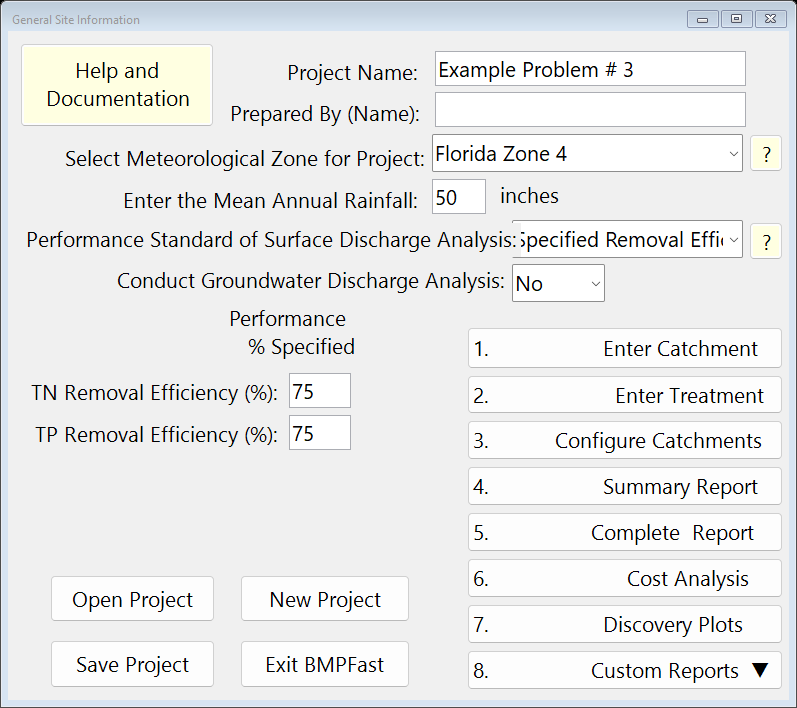
General Site Information (the main window). Press 1. Enter Catchment. For Catchment 1 type the name catchment 1, choose the land uses Agricultural - Pasture (pre) and Single-Family (post), enter the areas 11 and 11 ac, the non-DCIA curve numbers 50 and 65 and the DCIA 0 and 25 %, then press Calculate. BMPFast shows the annual runoff coefficient, the runoff and the TN and TP loads. Press Back.
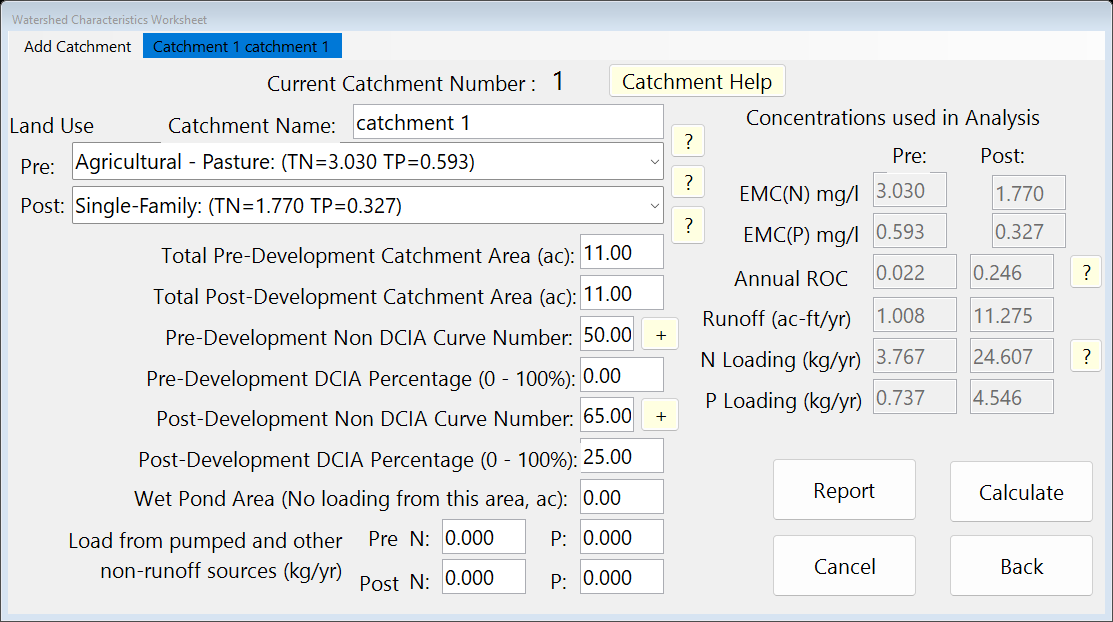
Watershed Characteristics Worksheet (1. Enter Catchment). Press 2. Enter Treatment and then Retention Basin. On the Retention System worksheet: Provided Retention Volume 0.506 ac-ft; Time to recover design volume 72 hr. Press Calculate. The report on the worksheet shows the inputs and the results.
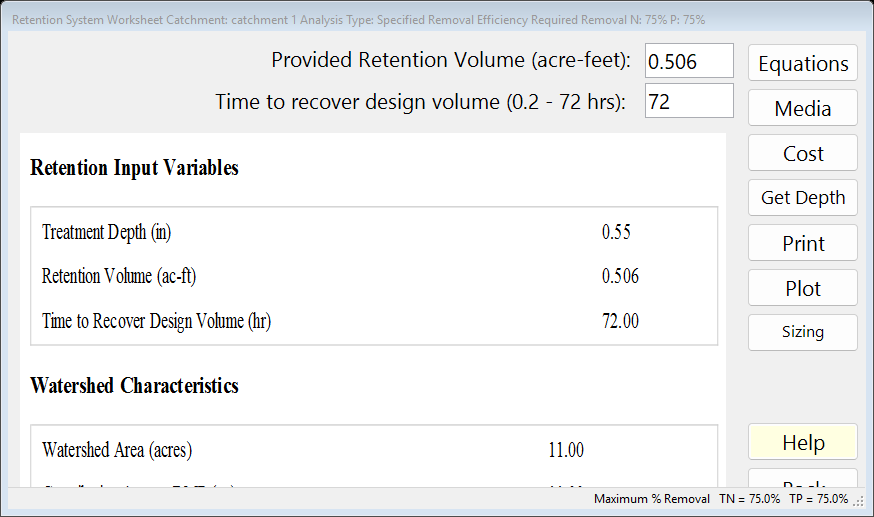
The BMP worksheet after Calculate: the report on the left. Press the same button again, now labelled Equations: the worksheet shows each equation with this problem’s values. Press Back to return to the treatment options.
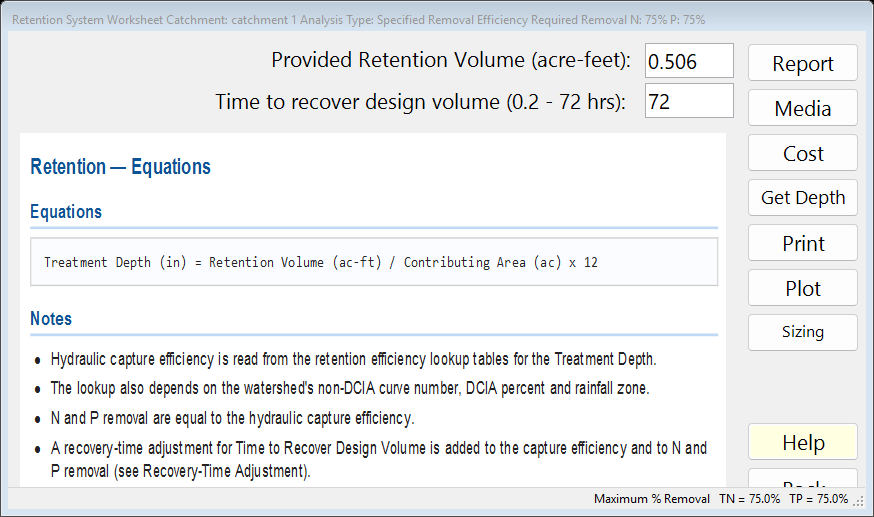
The same worksheet showing Equations: each equation with this problem’s values. On the main window press 3. Configure Catchments and double-click Catchment 1. Choose Retention as the BMP used in routing and the Outlet as where it goes. Press Back twice. (A catchment’s BMP is only used once it is chosen here.)
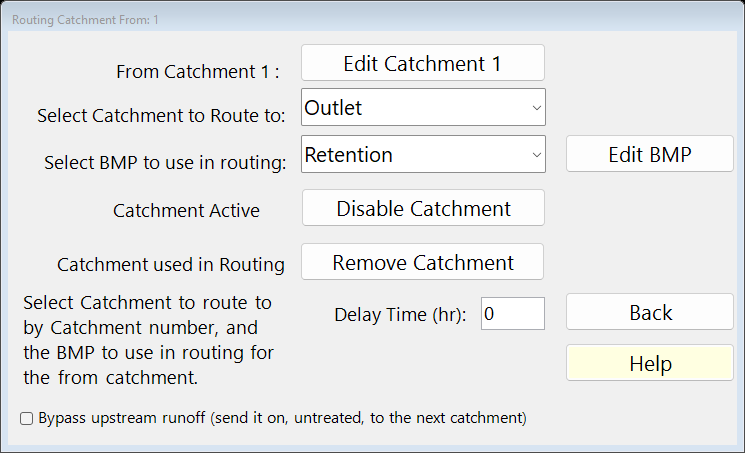
Routing for Catchment 1 (3. Configure Catchments): the BMP used and where the catchment goes. Press 4. Summary Report. The Report Viewer shows the loads, the removal and whether the performance standard is met. Press Save Project to keep your copy; compare it with the .bmpt under Files.
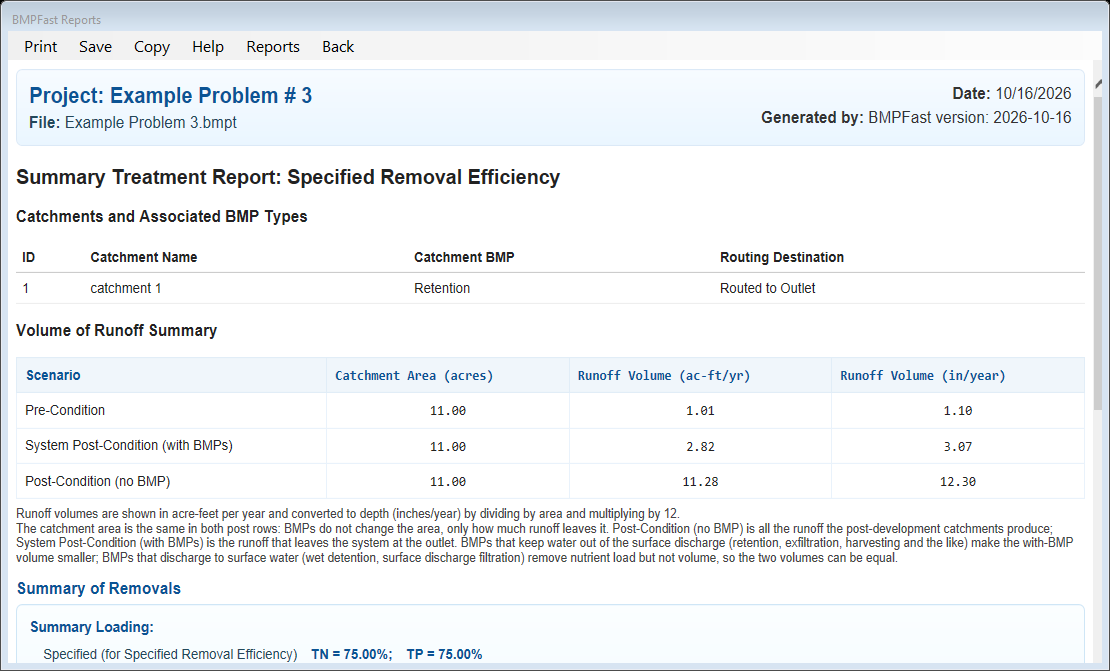
The Summary Report (4. Summary Report) in the Report Viewer.
3Results
| Result | Value |
|---|---|
| Catchment 1: computed by BMPFast | |
| Annual runoff coefficient (ROC), pre / post | 0.022 / 0.246 |
| Runoff, pre / post | 1.008 / 11.275 ac-ft/yr |
| TN load, pre / post | 3.767 / 24.607 kg/yr |
| TP load, pre / post | 0.737 / 4.546 kg/yr |
| Retention: computed by BMPFast | |
| Treatment depth | 0.552 in |
| Hydraulic capture efficiency | 75.01 % |
| Provided TN / TP removal | 75.01 % / 75.01 % |
| TN load in → out | 24.607 → 6.150 kg/yr |
| TP load in → out | 4.546 → 1.136 kg/yr |
| Site (all catchments, at the outlet) | |
| TN load: catchments → outlet | 24.607 → 6.150 kg/yr |
| TP load: catchments → outlet | 4.546 → 1.136 kg/yr |
| Provided removal TN / TP | 75.0 % / 75.0 % |
| Required removal TN / TP (Maximum % Removal) | 75.0 % (met) / 75.0 % (met) |
The BMP report
Open this report on its own page.
The Summary Report
4Check
Runoff and loads (Equations 9-1 and 9-2 of AH Vol I).
| Runoff | = ROC × area × rainfall / 12 |
| = 0.246 × 11.00 ac × 50.0 in / 12 | |
| = 11.275 ac-ft/yr (program 11.275). |
| TN load | = EMC × runoff × 1.233 |
| = 1.770 × 11.275 × 1.233 | |
| = 24.607 kg/yr (program 24.607) |
| TP load | = 0.327 × 11.275 × 1.233 |
| = 4.546 kg/yr (program 4.546). |
1.233 kg is 1 mg/L in 1 ac-ft.
Treatment depth.
| Depth | = retention volume × 12 / area |
| = 0.5060 ac-ft × 12 / 11.00 ac | |
| = 0.552 in (program 0.552). |
Capture. The retention efficiency tables for Florida Zone 4 at a treatment depth of 0.552 in, non-DCIA CN 65.00 and DCIA 25.0 % give a hydraulic capture of 75.01 % (AH Vol I Appendix O; read the same tables with Tools › Retention Efficiency Lookup Tables, help page 4325). For retention every pollutant in the captured water stays on site, so the TN and TP removal equal the capture.
Load out.
| TN out | = load in × (1 − removal) |
| = 24.607 × (1 − 75.01 / 100) | |
| = 6.150 kg/yr (program 6.150) |
| TP out | = 4.546 × (1 − 75.01 / 100) |
| = 1.136 kg/yr (program 1.136). |
The program’s Equations page
5Files
- retention-specified-removal.bmpt: the project, saved by BMPFast. Save it (your browser puts it in Downloads). In BMPFast press Open Project, then Open Project again in the Open BMPFast Project dialog (below its Recent Projects list), and choose the file.
- Equations page (worksheet) (as BMPFast shows it)
- Summary Report (as BMPFast shows it)
- BMP report (worksheet) (as BMPFast shows it)
6Help and methodology
Calculated with BMPFast 1.1.9 (build 6.0.0, 2026-10-16). Older versions may not have the Equations button or may give slightly different results; download the latest at bmpfast.com. Screen captures are for demonstration only.