
All programs › BMPFast › Sample problems
BMPs in series: two retention basins
BMPFast sample project Example Problem 5: retention → retention.
Help: BMPs in Series (help page 504) · Download the .bmpt · Link to Solution in BMPFast Version 2
1The problem
The same catchment as Example Problem 5 with two retention basins in series.
| Input | Value | Source |
|---|---|---|
| Project (General Site Information) | ||
| Meteorological zone | Florida Zone 5 | Zone map (help page 815) |
| Mean annual rainfall | 61 in | Mean annual rainfall map (help page 815) |
| Performance standard (analysis type) | Specified Removal Efficiency | BMPFast sample project |
| Specified removal: TN / TP | 55 % / 80 % | BMPFast sample project |
| Catchment 1: Highway Section 206 (Watershed Characteristics) | ||
| Land use, pre / post | Undeveloped - Wet Flatwoods / Highway | BMPFast sample project |
| Area, pre / post | 6 / 6 ac | BMPFast sample project |
| Non-DCIA curve number, pre / post | 80 / 80 | BMPFast sample project |
| DCIA, pre / post | 0 / 60 % | BMPFast sample project |
| EMC TN, pre / post | 1.213 / 1.250 mg/L | BMPFast land use table (AH Vol I Table 9.2) |
| EMC TP, pre / post | 0.021 / 0.173 mg/L | BMPFast land use table (AH Vol I Table 9.2) |
| Wet pond area (no loading) | 1.00 ac | BMPFast sample project |
| BMPs in Series (Multiple BMP) | ||
| BMP 1: Permeable Pavement | 1.00 ac, storage 0.275 ac-ft | BMPFast sample project |
| BMP 2: Retention | treatment depth 0.751 in (0.313 ac-ft) | BMPFast sample project |
Find: the removal of the series as one system, and the loads leaving the site.
2Steps in BMPFast
Press Open Project and open
series-retention-retention.bmpt(the file under Files; it is the BMPFast sample project Example Problem 5 one catch ret + ret.bmpt). General Site Information (the main window; its title bar reads General Site Information and your license key) shows Florida Zone 5, 61.0 in of rainfall and the performance standard Specified Removal Efficiency.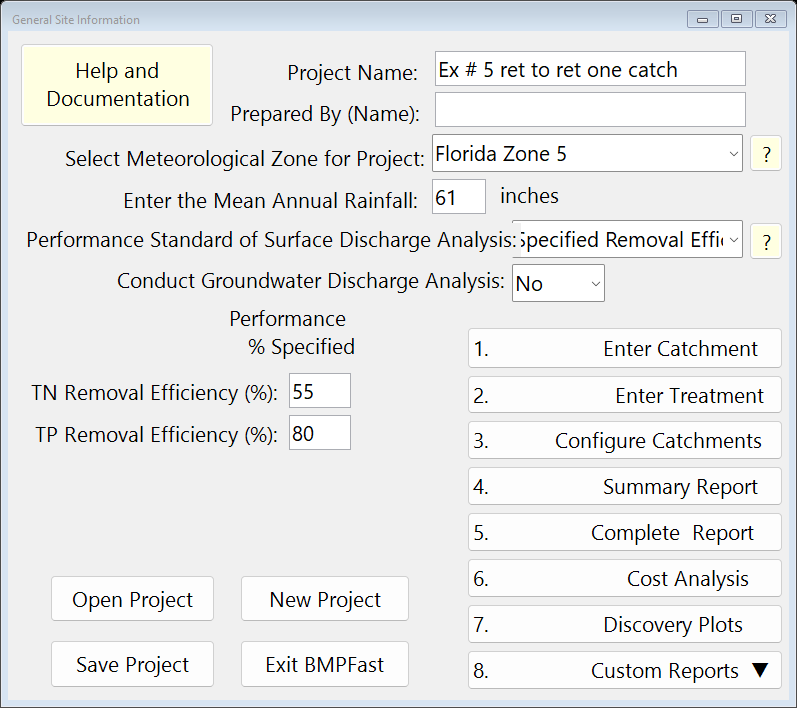
General Site Information (the main window). Press 1. Enter Catchment to see the catchment (nothing to change). Press Back.
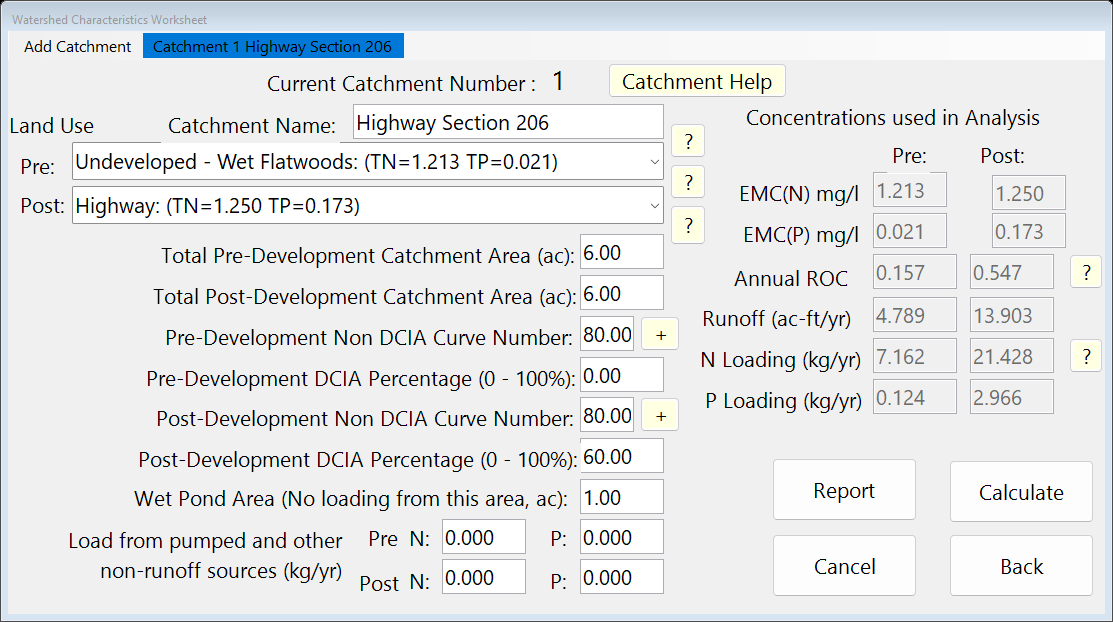
Watershed Characteristics Worksheet (1. Enter Catchment). Press 2. Enter Treatment and open Permeable Pavement: BMP 1 of the series is defined on its own worksheet. Press Calculate, then Back.
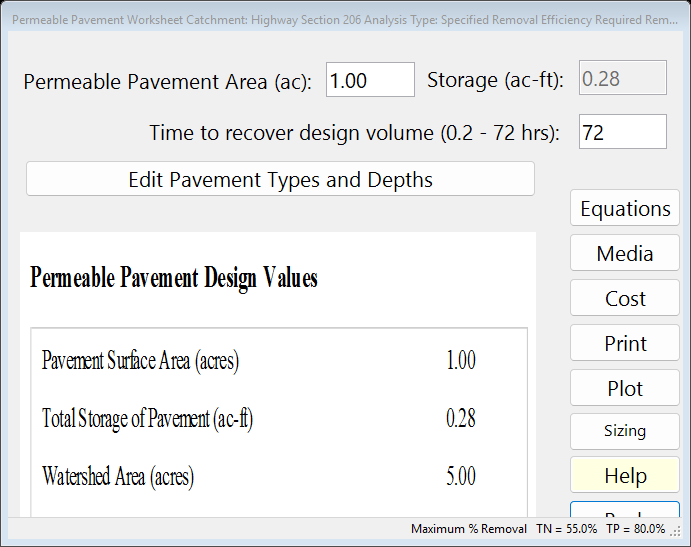
BMP 1 of the series on its own worksheet. Press 2. Enter Treatment and open Retention: BMP 2 of the series is defined on its own worksheet. Press Calculate, then Back.
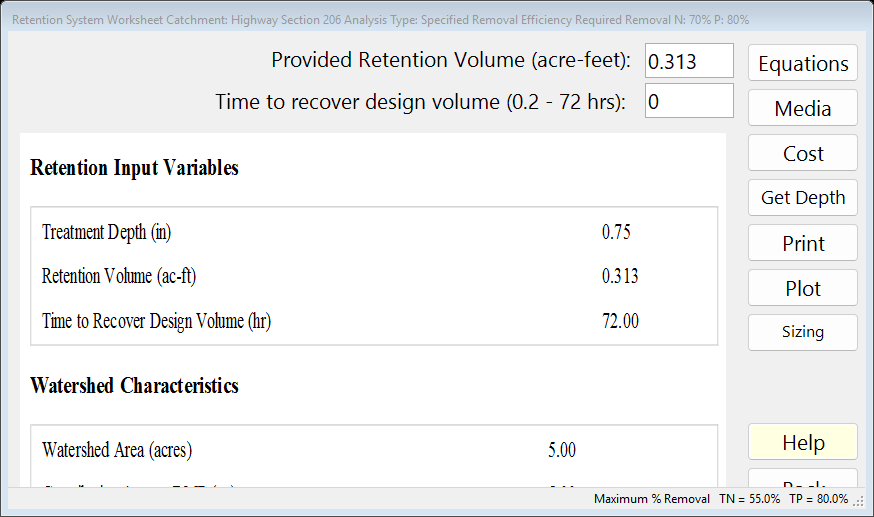
BMP 2 of the series on its own worksheet. On Treatment Options press BMPs in Series. BMP 1 to BMP 2 read Permeable Pavement → Retention. Press Calculate.
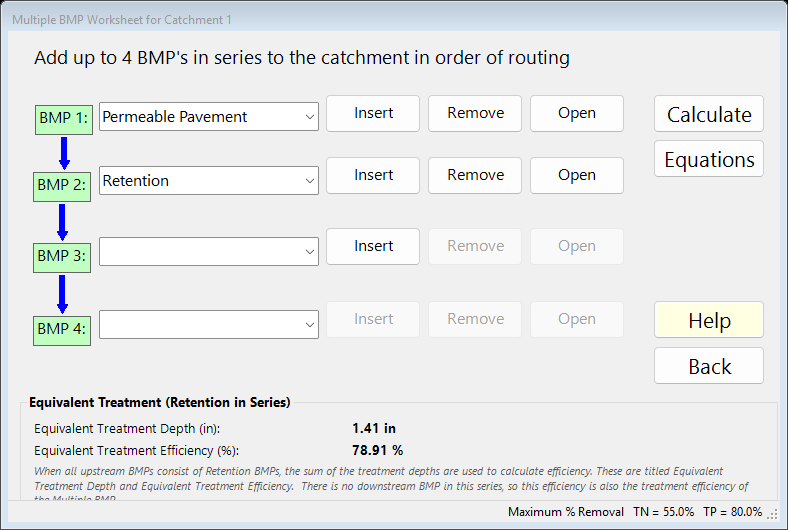
BMPs in Series (Multiple BMP) worksheet. Calculate opens the series report: each BMP’s inputs and the system’s removal.
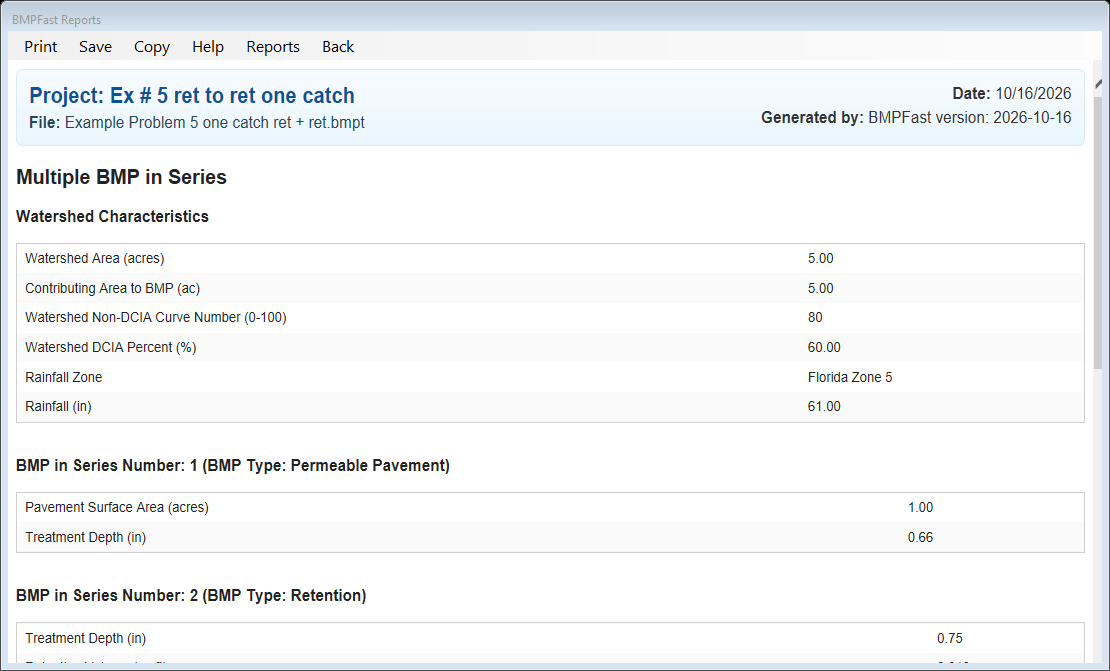
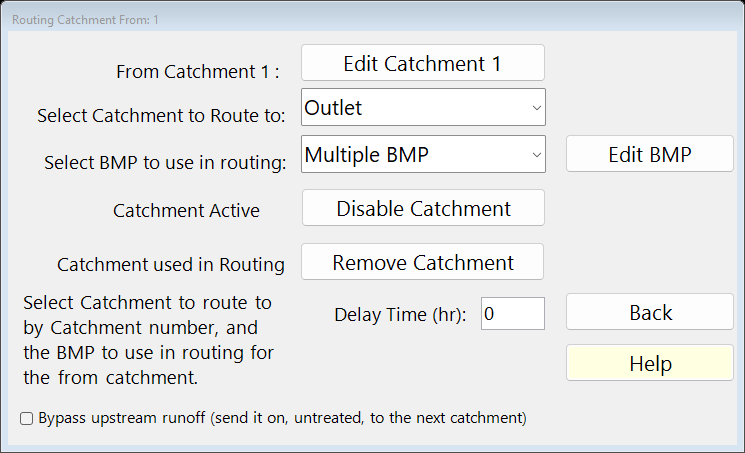
The BMPs in Series report that Calculate opens. On the main window press 3. Configure Catchments and double-click Catchment 1. Choose Multiple BMP as the BMP used in routing and the Outlet as where it goes. Press Back twice. (A catchment’s BMP is only used once it is chosen here.)
Routing for Catchment 1 (3. Configure Catchments): the BMP used and where the catchment goes. Press 4. Summary Report. The Report Viewer shows the loads, the removal and whether the performance standard is met. Press Save Project to keep your copy; compare it with the .bmpt under Files.
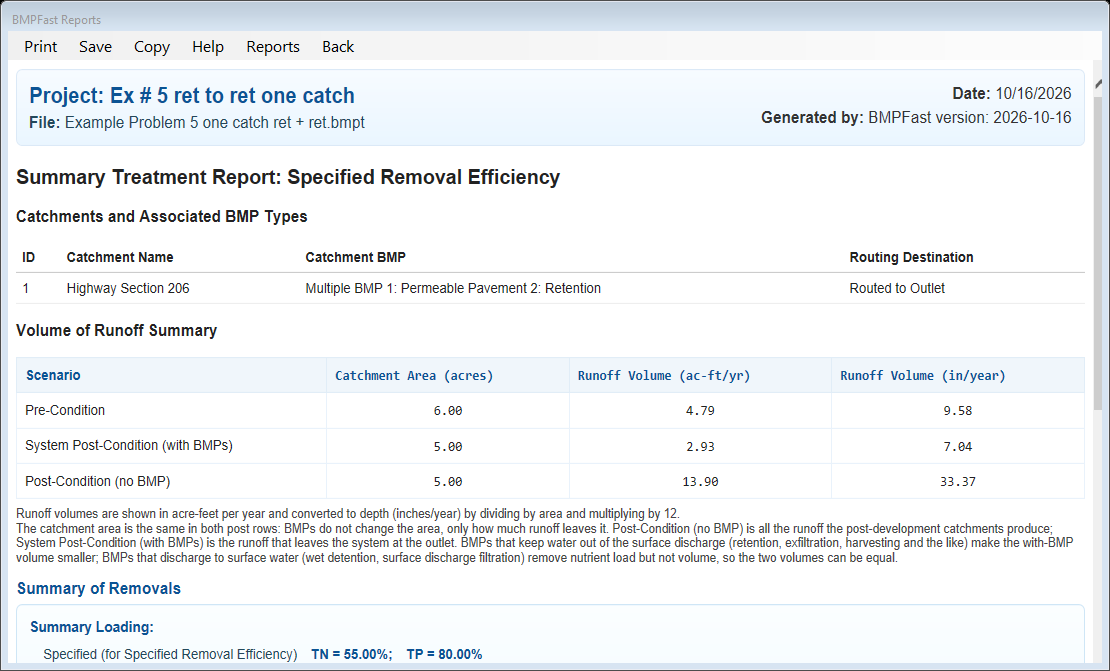
The Summary Report (4. Summary Report) in the Report Viewer.
3Results
| Result | Value |
|---|---|
| Catchment 1: computed by BMPFast | |
| Annual runoff coefficient (ROC), pre / post | 0.157 / 0.547 |
| Runoff, pre / post | 4.788 / 13.903 ac-ft/yr |
| TN load, pre / post | 7.162 / 21.428 kg/yr |
| TP load, pre / post | 0.124 / 2.966 kg/yr |
| Multiple BMP: computed by BMPFast | |
| Equivalent Treatment Depth / Efficiency | 1.411 in / 78.91 % |
| Treatment depth | 1.411 in |
| Hydraulic capture efficiency | 78.91 % |
| Provided TN / TP removal | 78.91 % / 78.91 % |
| TN load in → out | 21.428 → 4.520 kg/yr |
| TP load in → out | 2.966 → 0.626 kg/yr |
| Site (all catchments, at the outlet) | |
| TN load: catchments → outlet | 21.428 → 4.520 kg/yr |
| TP load: catchments → outlet | 2.966 → 0.626 kg/yr |
| Provided removal TN / TP | 78.9 % / 78.9 % |
| Required removal TN / TP (Maximum % Removal) | 55.0 % (met) / 80.0 % (not met) |
The BMPs in Series Equations report
Open this report on its own page.
The Summary Report
4Check
Runoff and loads (Equations 9-1 and 9-2 of AH Vol I).
| Runoff | = ROC × area × rainfall / 12 |
| = 0.547 × 5.00 ac × 61.0 in / 12 | |
| = 13.903 ac-ft/yr (program 13.903). |
| TN load | = EMC × runoff × 1.233 |
| = 1.250 × 13.903 × 1.233 | |
| = 21.428 kg/yr (program 21.428) |
| TP load | = 0.173 × 13.903 × 1.233 |
| = 2.966 kg/yr (program 2.966). |
1.233 kg is 1 mg/L in 1 ac-ft.
Retention in series. Retention BMPs in a row are one system: their treatment depths add to the Equivalent Treatment Depth of 1.411 in, and the retention tables at that depth give the system’s capture, 78.91 % (program TN removal 78.91 %). Adding each basin’s removal as a treatment train would overstate it, because the second basin sees only the larger storms the first one passes (Strand Based Routing for Retention in Series).
Load out.
| TN out | = load in × (1 − removal) |
| = 21.428 × (1 − 78.91 / 100) | |
| = 4.520 kg/yr (program 4.520) |
| TP out | = 2.966 × (1 − 78.91 / 100) |
| = 0.626 kg/yr (program 0.626). |
The standard is not met, and that is expected. “Specified Removal Efficiency” requires the TN and TP percentages entered for the project, for example a TMDL or BMAP criterion (AH Vol I 8.3.4(b), or as the Agency directs). The post = pre removal (Equation 9-3, (post load − pre load) / post load) is TN 66.6 % and TP 95.8 %. BMPFast takes the larger of the standard’s percentage and the post = pre removal as the Maximum % Removal, shown on every worksheet’s status bar and in the Summary Report: here TN 55.0 % and TP 80.0 %. This problem shows what this design removes (78.9 % / 78.9 %), which is less. To meet it, add BMPs in series or downstream catchments (see BMPs in Series and Routing), or size the BMP (see Sizing).
5Files
- series-retention-retention.bmpt: the project, saved by BMPFast. Save it (your browser puts it in Downloads). In BMPFast press Open Project, then Open Project again in the Open BMPFast Project dialog (below its Recent Projects list), and choose the file.
- BMPs in Series: Equations (as BMPFast shows it)
- Summary Report (as BMPFast shows it)
- BMP report (worksheet) (as BMPFast shows it)
6Help and methodology
- BMPs in Series (help page 504)
- Strand Based Routing for Retention in Series (help page 4824)
- Comparison of Methods for Wet Detention Ponds in Series (help page 4869)
- Comparison of Methods for Filters in Series (help page 4825)
- Retention Methodology (help page 4537)
- Wet Detention Methodology (help page 4590)
- All sample problems
Calculated with BMPFast 1.1.9 (build 6.0.0, 2026-10-16). Older versions may not have the Equations button or may give slightly different results; download the latest at bmpfast.com. Screen captures are for demonstration only.