
All programs › BMPFast › Sample problems
Roadside swale with swale blocks
A 1,000 ft swale with 8 blocks along a two-lane road; Redevelopment + OFW, Zone 2.
Help: Swale (help page 324) · Download the .bmpt · Link to Solution in BMPFast Version 2
1The problem
A two-lane road (36 ft of pavement and shoulders, 1,000 ft long) drains to a 1,000 ft roadside swale with eight swale blocks 0.5 ft high.
| Input | Value | Source |
|---|---|---|
| Project (General Site Information) | ||
| Meteorological zone | Florida Zone 2 | Zone map (help page 815) |
| Mean annual rainfall | 50 in | Mean annual rainfall map (help page 815) |
| Performance standard (analysis type) | Redevelopment + OFW | Site (illustrative) |
| Catchment 1: Road and shoulders (Watershed Characteristics) | ||
| Land use, pre / post | Undeveloped - Mesic Flatwoods / Highway | Site (illustrative) |
| Area, pre / post | 2.75 / 2.75 ac | Site (illustrative) |
| Non-DCIA curve number, pre / post | 70 / 80 | Site (illustrative) |
| DCIA, pre / post | 0 / 45 % | Site (illustrative) |
| EMC TN, pre / post | 1.087 / 1.250 mg/L | BMPFast land use table (AH Vol I Table 9.2) |
| EMC TP, pre / post | 0.043 / 0.173 mg/L | BMPFast land use table (AH Vol I Table 9.2) |
| Swale (worksheet) | ||
| Swale top width for flood conditions [W] | 20 ft | Design (illustrative) |
| Swale bottom width [B] | 4 ft | Design (illustrative) |
| Swale length [L] | 1000 ft | Design (illustrative) |
| Average catchment length | 1000 ft | Design (illustrative) |
| Average impervious width (including shoulder) | 36 ft | Design (illustrative) |
| Average width of pervious area including swale | 84 ft | Design (illustrative) |
| Swale slope [S] | 0.005 ft/ft | Design (illustrative) |
| Manning's n | 0.2 | Design (illustrative) |
| Soil infiltration rate | 2.0 in/hr | Design (illustrative) |
| Side slope [Z] | 4 H:V | Design (illustrative) |
| Average height of the swale blocks [H] | 0.5 ft | Design (illustrative) |
| Length of the berm upstream of the crest | 10 ft | Design (illustrative) |
| Number of swale blocks | 8 | Design (illustrative) |
Find: the TN and TP removal of the BMP, the loads leaving the site, and whether the performance standard is met.
2Steps in BMPFast
Press New Project. On General Site Information (the main window; its title bar reads General Site Information and your license key) type the project name Swale with blocks: two-lane road, choose Florida Zone 2, enter 50 in of mean annual rainfall and choose the performance standard Redevelopment + OFW.
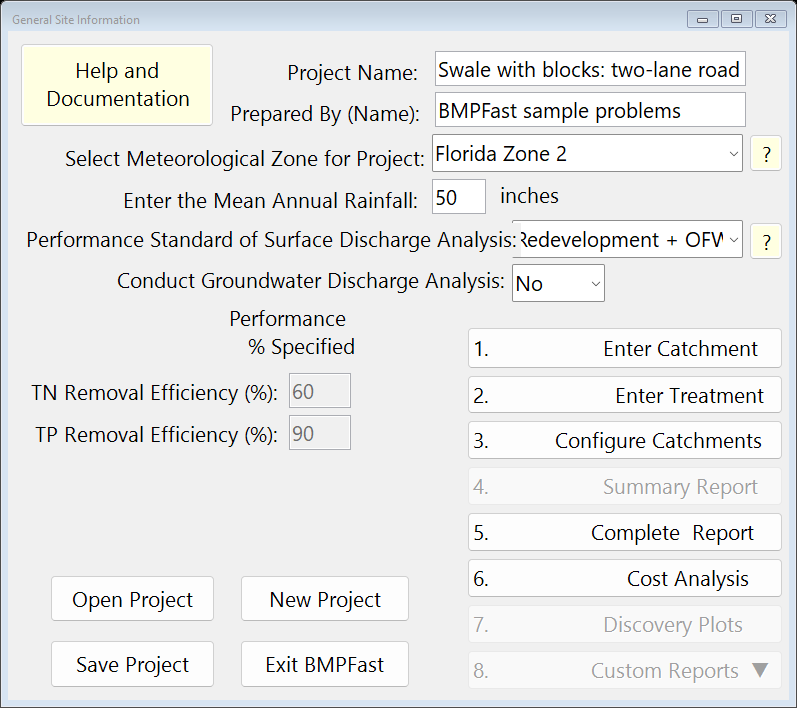
General Site Information (the main window). Press 1. Enter Catchment. For Catchment 1 type the name Road and shoulders, choose the land uses Undeveloped - Mesic Flatwoods (pre) and Highway (post), enter the areas 2.75 and 2.75 ac, the non-DCIA curve numbers 70 and 80 and the DCIA 0 and 45 %, then press Calculate. BMPFast shows the annual runoff coefficient, the runoff and the TN and TP loads. Press Back.
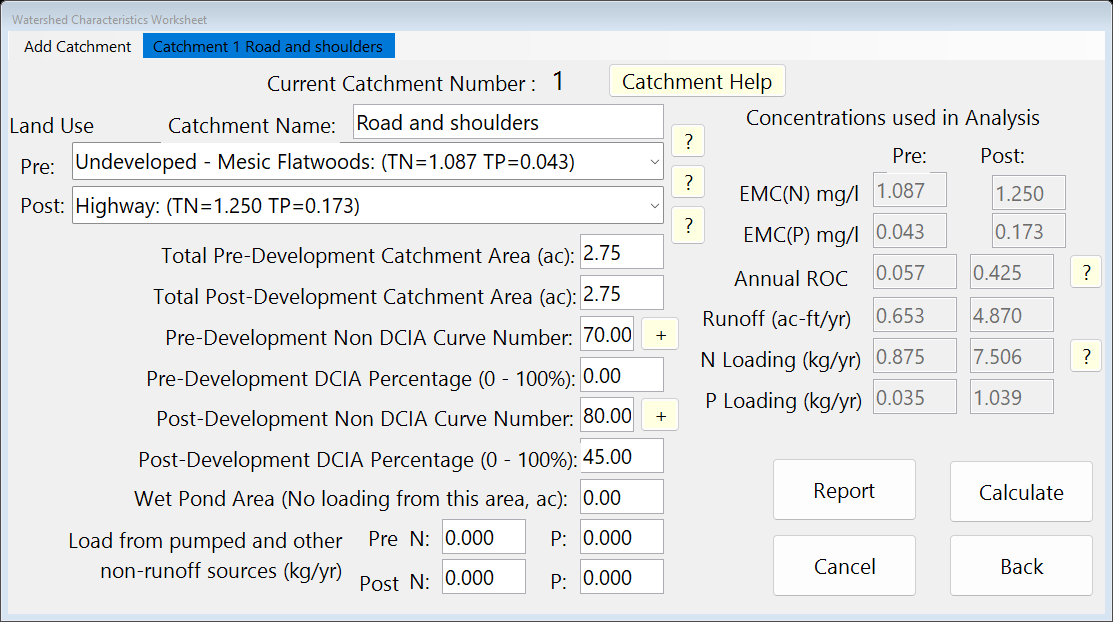
Watershed Characteristics Worksheet (1. Enter Catchment). Press 2. Enter Treatment and then Swale. On the Swale worksheet: Swale top width for flood conditions [W] 20 ft; Swale bottom width [B] 4 ft; Swale length [L] 1000 ft; Average catchment length 1000 ft; Average impervious width (including shoulder) 36 ft; Average width of pervious area including swale 84 ft; Swale slope [S] 0.005 ft/ft; Manning's n 0.2; Soil infiltration rate 2.0 in/hr; Side slope [Z] 4 H:V; Average height of the swale blocks [H] 0.5 ft; Length of the berm upstream of the crest 10 ft; Number of swale blocks 8. Press Calculate. The report on the worksheet shows the inputs and the results.
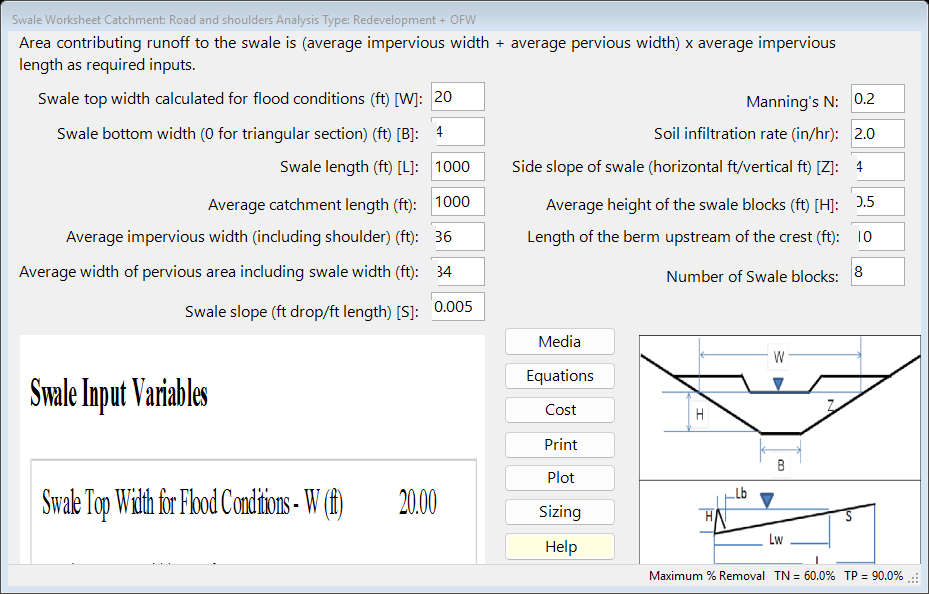
The BMP worksheet after Calculate: the report on the left. Press the same button again, now labelled Equations: the worksheet shows each equation with this problem’s values. Press Back to return to the treatment options.
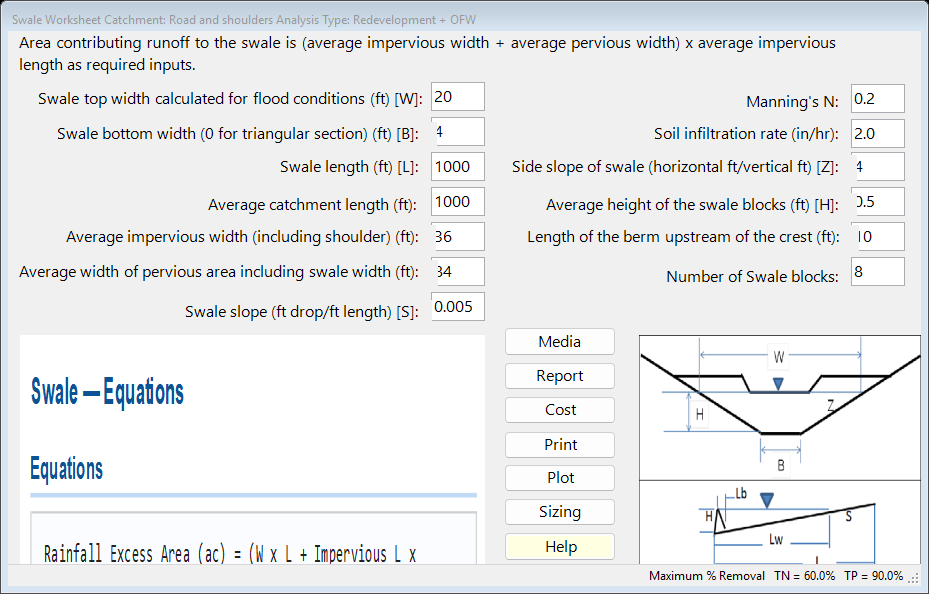
The same worksheet showing Equations: each equation with this problem’s values. On the main window press 3. Configure Catchments and double-click Catchment 1. Choose Swale as the BMP used in routing and the Outlet as where it goes. Press Back twice. (A catchment’s BMP is only used once it is chosen here.)
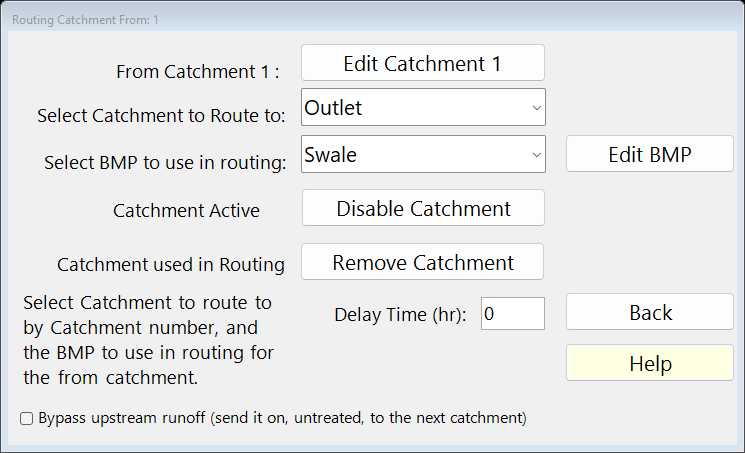
Routing for Catchment 1 (3. Configure Catchments): the BMP used and where the catchment goes. Press 4. Summary Report. The Report Viewer shows the loads, the removal and whether the performance standard is met. Press Save Project to keep your copy; compare it with the .bmpt under Files.
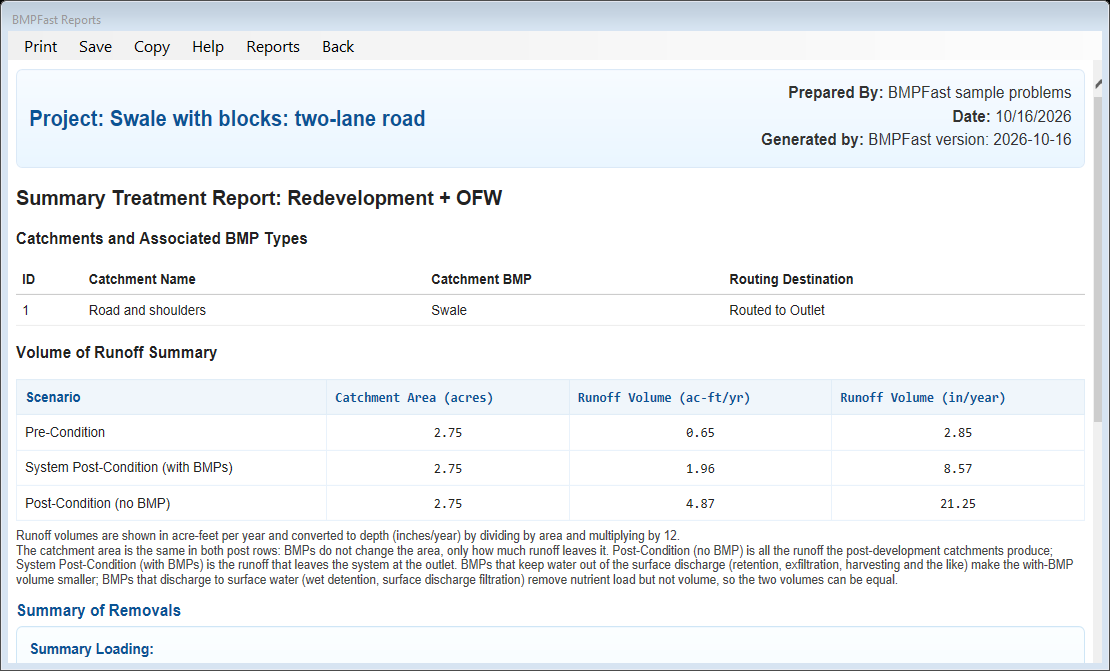
The Summary Report (4. Summary Report) in the Report Viewer.
3Results
| Result | Value |
|---|---|
| Catchment 1: computed by BMPFast | |
| Annual runoff coefficient (ROC), pre / post | 0.057 / 0.425 |
| Runoff, pre / post | 0.653 / 4.870 ac-ft/yr |
| TN load, pre / post | 0.875 / 7.506 kg/yr |
| TP load, pre / post | 0.035 / 1.039 kg/yr |
| Swale: computed by BMPFast | |
| Treatment depth | 0.466 in |
| Hydraulic capture efficiency | 59.67 % |
| Provided TN / TP removal | 59.67 % / 59.67 % |
| TN load in → out | 7.506 → 3.027 kg/yr |
| TP load in → out | 1.039 → 0.419 kg/yr |
| Site (all catchments, at the outlet) | |
| TN load: catchments → outlet | 7.506 → 3.027 kg/yr |
| TP load: catchments → outlet | 1.039 → 0.419 kg/yr |
| Provided removal TN / TP | 59.7 % / 59.7 % |
| Required removal TN / TP (Maximum % Removal) | 60.0 % (not met) / 90.0 % (not met) |
The BMP report
Open this report on its own page.
The Summary Report
4Check
Runoff and loads (Equations 9-1 and 9-2 of AH Vol I).
| Runoff | = ROC × area × rainfall / 12 |
| = 0.425 × 2.75 ac × 50.0 in / 12 | |
| = 4.870 ac-ft/yr (program 4.870). |
| TN load | = EMC × runoff × 1.233 |
| = 1.250 × 4.870 × 1.233 | |
| = 7.506 kg/yr (program 7.506) |
| TP load | = 0.173 × 4.870 × 1.233 |
| = 1.039 kg/yr (program 1.039). |
1.233 kg is 1 mg/L in 1 ac-ft.
| Rainfall excess area | = (W × L + impervious L × impervious W) / 43,560 |
| = (20 × 1,000 + 1,000 × 36) / 43,560 | |
| = 1.2856 ac (program 1.2856). |
Swale blocks.
| w | = B + 2ZH |
| = 8.00 ft |
| sl | = min(H/S, L/Nb) |
| = 100.0 ft |
| storage | = (w × H / 6) × (sl − Lb) × Nb |
| = 480.0 cf, 0.1029 in over the rainfall excess area. |
With the infiltrated depth of 0.3633 in the treatment depth is 0.4661 in (program 0.4661).
Capture. The retention efficiency tables for Florida Zone 2 at a treatment depth of 0.466 in, non-DCIA CN 80.00 and DCIA 45.0 % give a hydraulic capture of 59.67 % (AH Vol I Appendix O; read the same tables with Tools › Retention Efficiency Lookup Tables, help page 4325). A swale is a retention BMP: the removal equals the capture.
Load out.
| TN out | = load in × (1 − removal) |
| = 7.506 × (1 − 59.67 / 100) | |
| = 3.027 kg/yr (program 3.027) |
| TP out | = 1.039 × (1 − 59.67 / 100) |
| = 0.419 kg/yr (program 0.419). |
The standard is not met, and that is expected. “Redevelopment + OFW” requires 60 % TN and 90 % TP of the post-development load (AH Vol I 8.3.5(b)). The post = pre removal (Equation 9-3, (post load − pre load) / post load) is TN 88.3 % and TP 96.7 %. BMPFast takes the larger of the standard’s percentage and the post = pre removal as the Maximum % Removal, shown on every worksheet’s status bar and in the Summary Report: here TN 60.0 % and TP 90.0 %. This problem shows what this design removes (59.7 % / 59.7 %), which is less. To meet it, add BMPs in series or downstream catchments (see BMPs in Series and Routing), or size the BMP (see Sizing).
The program’s Equations page
5Files
- swale-blocks.bmpt: the project, saved by BMPFast. Save it (your browser puts it in Downloads). In BMPFast press Open Project, then Open Project again in the Open BMPFast Project dialog (below its Recent Projects list), and choose the file.
- Equations page (worksheet) (as BMPFast shows it)
- Summary Report (as BMPFast shows it)
- BMP report (worksheet) (as BMPFast shows it)
6Help and methodology
Calculated with BMPFast 1.1.9 (build 6.0.0, 2026-10-16). Older versions may not have the Equations button or may give slightly different results; download the latest at bmpfast.com. Screen captures are for demonstration only.