Energy equation
Bernoulli's equation with a head-loss term between two points along a pipe: finds the one elevation, pressure, velocity or head loss you leave blank from the rest.
What it is for
The Energy equation calculator works any problem between two points along a pipeline where elevation, pressure and velocity trade against one another: the pressure at a hydrant below a tank, the velocity of the jet from a nozzle or an outfall, the elevation water will rise to, or the head lost between two pressure gauges. It is Bernoulli's equation for steady, incompressible flow with a loss term: elevation plus pressure head plus velocity head at point 1 equals the same at point 2 plus the head lost between them.
At each point you enter the elevation, the pressure (as feet of water or as psi, at 2.3077 ft per psi: 144 / 62.4), and the velocity, either directly or as a flow through a pipe diameter. You also enter the head loss between the points. Leave exactly one term blank — an elevation, a pressure, a velocity, or the head loss — and SMADA finds it from the rest. Enter 0 for a still reservoir surface or a free surface open to the air.
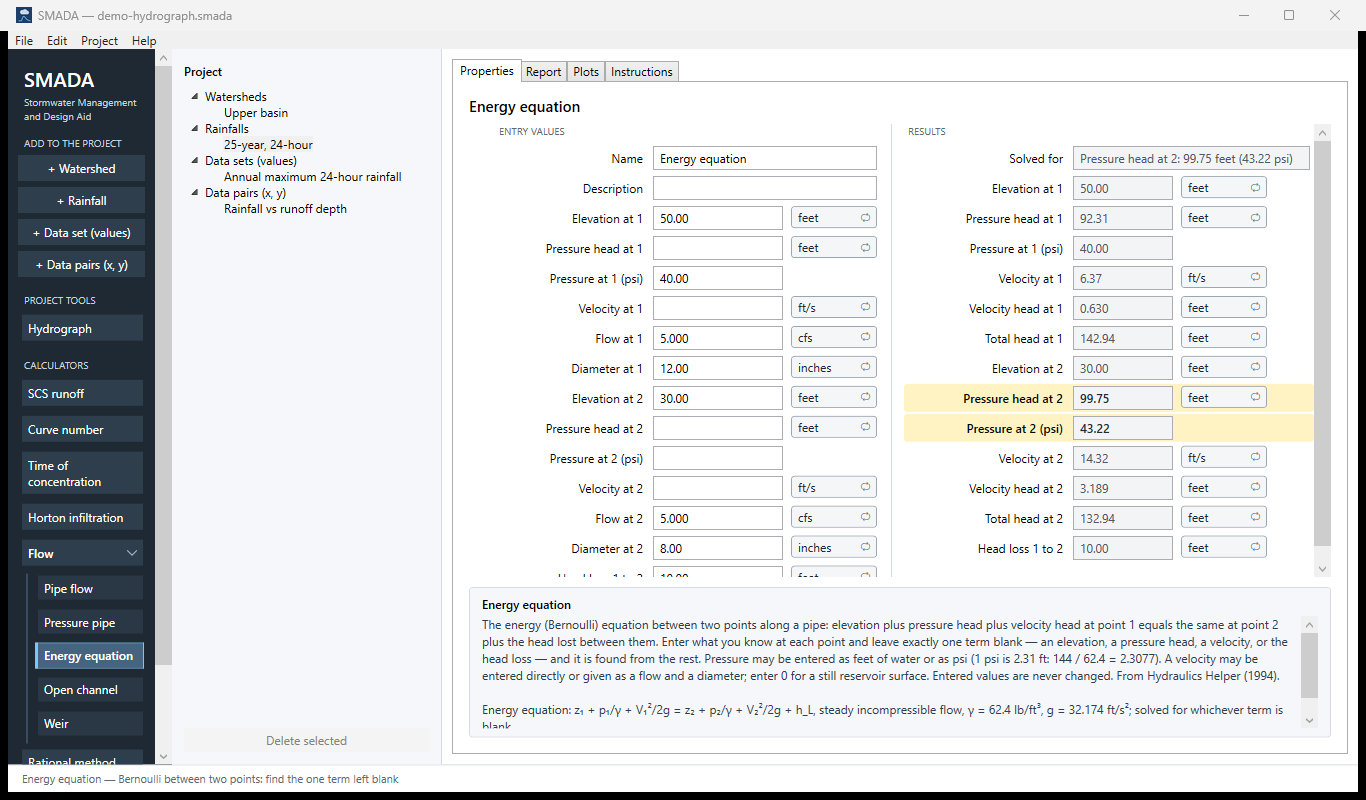
You get back the full ledger at both points: elevation, pressure head in feet and in psi, velocity, velocity head and total head (the energy grade line), plus the head loss and a line naming the term that was found. If you fill in every term, SMADA tells you whether the two sides balance, which is a check on a set of field readings.
The friction part of the head loss comes from the Pressure pipe calculator; add the minor losses at bends, valves and fittings before entering it here.
The Energy equation tabs
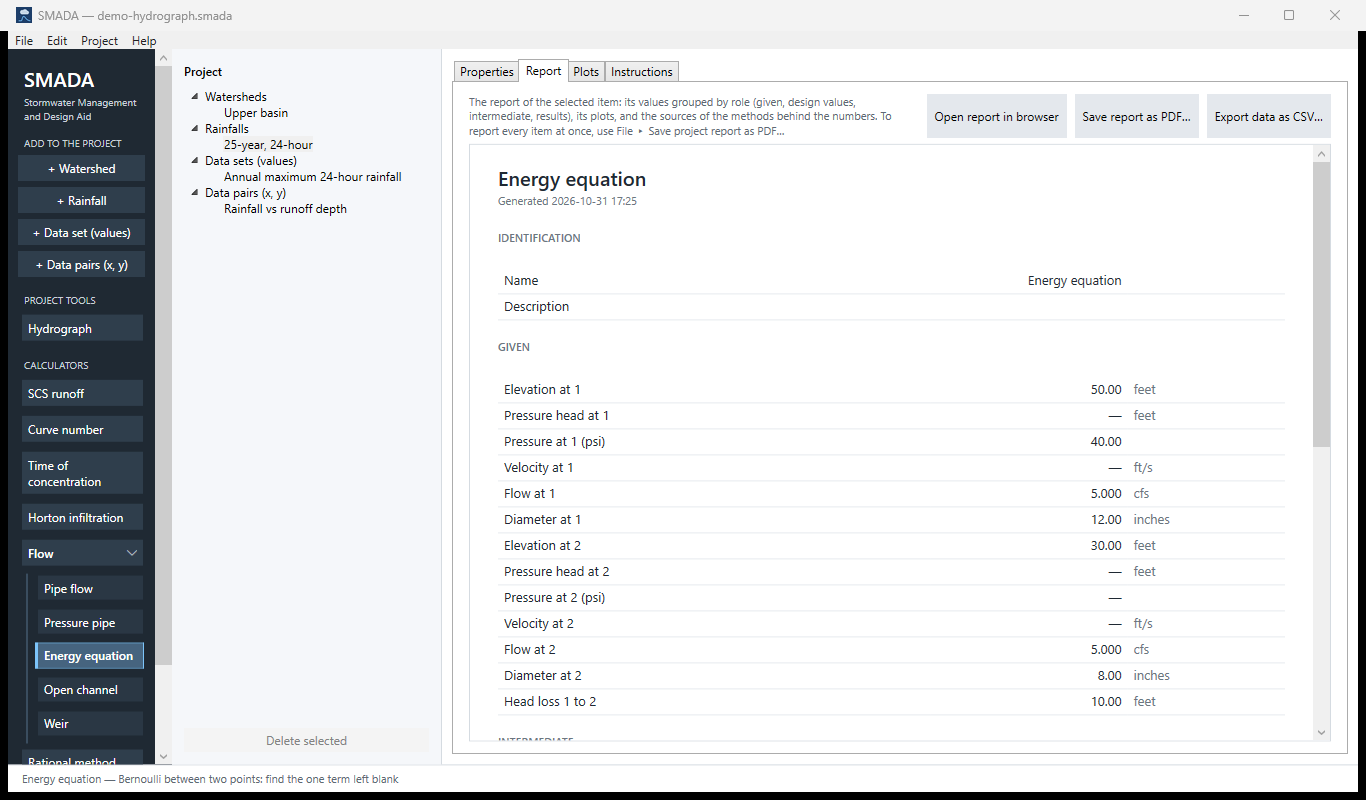
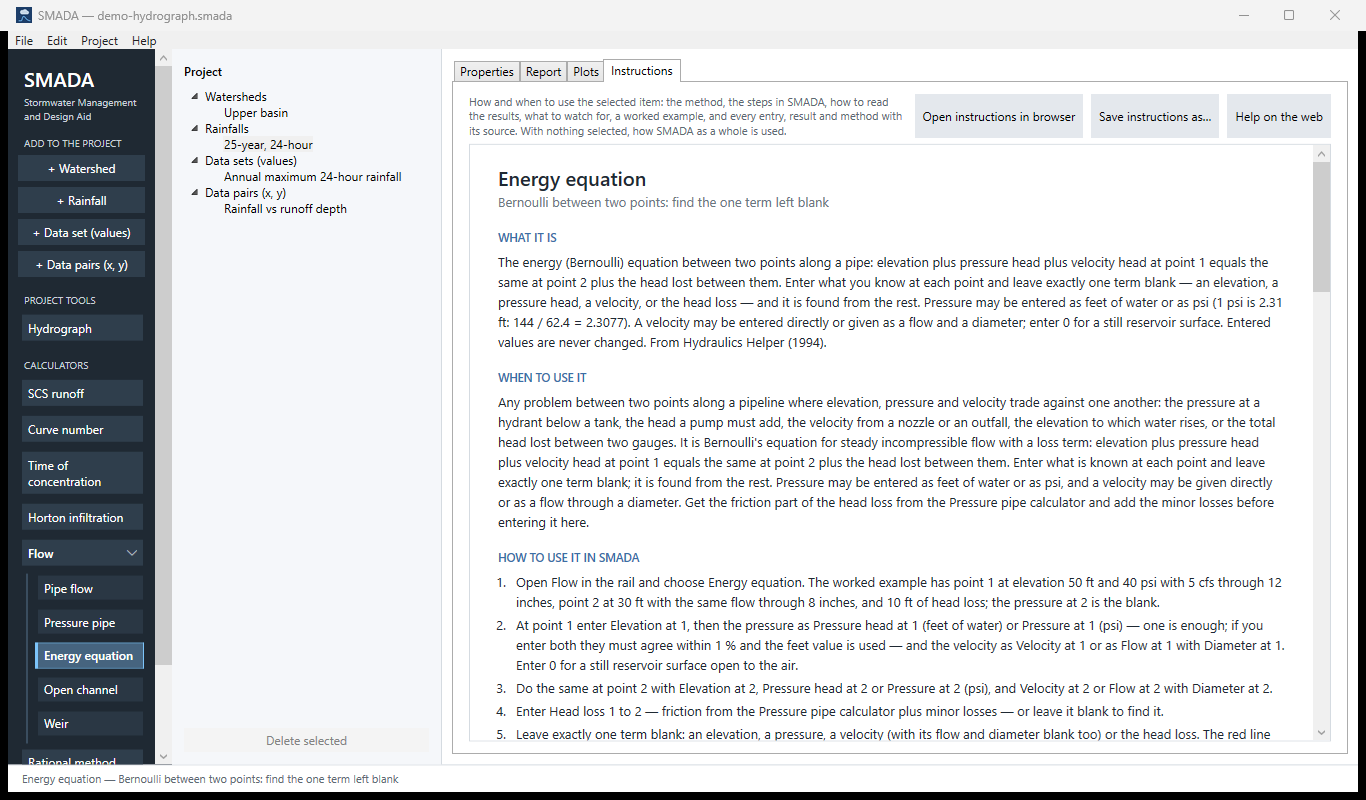
Every item in SMADA has the same four tabs. These are captured from the program with the example values it opens with; select a picture to see it full size.
Energy equation has nothing to draw, so its Plots tab is empty and is not shown.
Properties tab — where you enter values and read the results
Report tab — the same values as a report, ready for HTML, PDF or CSV
Instructions tab — the manual page in the program
How it calculates
All calculations are in US customary units: elevations, pressure heads and head loss in feet, velocity in ft/s, flow in cfs, and diameters stored in inches (with their own Pipe size unit button, inches or millimetres) and divided by 12. Each value has its own unit button, and every message is written in the units on display. SMADA uses g = 32.174 ft/s² and a unit weight of water γ = 62.4 lb/ft³. Pressures are gauge pressures. A blank entry is the unknown; a zero is a value.
The equation
Between point 1 upstream and point 2 downstream, for steady incompressible flow:
z1 + p1/γ + V12/2g = z2 + p2/γ + V22/2g + hL
- z1, z2
- elevation of the pipe centreline (or the water surface) at each point, above a common datum, ft
- p1/γ, p2/γ
- pressure head at each point, ft of water
- V1, V2
- mean velocity at each point, ft/s
- V2/2g
- velocity head, ft
- hL
- head lost between the points (friction plus minor losses), ft
- g
- 32.174 ft/s²
Each side, taken at its own point, is the total head H = z + p/γ + V2/2g, the height of the energy grade line there.
Step 1: pressure as feet or psi
You may enter each pressure as a head in feet or in psi. SMADA converts psi with
p/γ = 2.3077 × ppsi, since 144 / 62.4 = 2.3077 ft per psi
That is the 2.31 ft per psi of the usual tables, carried to 2.3077. If you enter both at one point they must agree within 1 % of the head (or 0.001 ft near zero), and the value in feet is the one used. If they disagree, SMADA gives both values in feet (the head entered, and what the psi entered comes to) and asks you to clear one or make them agree. Results show every pressure both ways, the psi value being the head divided by 2.3077.
Step 2: velocity from flow and diameter
At each point the velocity, flow and diameter fill each other in by continuity:
A = π D2 / 4
Q = V A
- D
- inside diameter at the point, ft
- A
- pipe area at the point, sq ft
- Q
- flow at the point, cfs
- Flow and diameter given: V = Q / A.
- Velocity and diameter given: Q = V A.
- Velocity and flow given (velocity above zero): D = √(4Q / (πV)).
- All three given: V A must be within 0.5 % of Q, or SMADA stops and quotes V A.
A velocity or flow may not be negative, and a diameter must be greater than zero. So a velocity counts as blank only when the velocity, the flow and the diameter at that point leave it undetermined.
Step 3: find the one blank term
After steps 1 and 2 there are seven terms: the head loss, the two pressure heads, the two velocities and the two elevations. Exactly one must be blank. With two or more blank SMADA lists them and stops. With none blank it reports the residual left side minus right side, and says the equation balances when that is under 0.0005 ft.
Writing L for the known terms on the left side and Rt for those on the right (a blank term counted as zero), the unknown is found in closed form:
hL = L − Rt
p1/γ = Rt − L
p2/γ = L − Rt
z1 = Rt − L
z2 = L − Rt
V1 = √(2g (Rt − L))
V2 = √(2g (L − Rt))
The velocity forms are Torricelli's √(2gh) with h the head left over for velocity. If that head is negative there is no real velocity, and SMADA asks you to check the values. A velocity found this way also fills in the flow from the diameter at that point, or the diameter from the flow if only the flow was entered.
The Solved for line names the term and its value — a pressure in feet and in psi, a velocity with the flow and diameter behind it — and the row holding it (for a pressure, both the feet and the psi rows) is highlighted among the results.
Checks on the result
- A head loss that comes out negative means energy would be gained between 1 and 2; SMADA refuses it and asks you to check the values (or the direction of flow).
- A negative pressure head is allowed and reported: the point is below atmospheric pressure, as at the crown of a siphon. Water boils at about −33 ft of gauge head at sea level, and dissolved air comes out well before that, so the help advises keeping a siphon above about −20 to −25 ft; lower than that the design is not workable. SMADA reports the number and leaves that judgement to you.
- SMADA does not require the flow at 1 and 2 to be equal; enter different flows if water enters or leaves between the points.
Checking the example by hand
Point 1: z1 = 50 ft, 40 psi 40 psi = 92.31 ft, V1times; 2.3077 = 92.31 ft, V1 = 5 / (π(1)2/4) = 6.37 ft/s, so V12/2g = 0.630 ft and H1 = 142.94 ft. Point 2: z2 = 30 ft, V2 = 5 / (π(0.667)2/4) = 14.32 ft/s, V22/2g = 3.189 ft, hL = 10 ft. Then p2/γ = 142.94 − 30 − 3.189 − 10 = 99.75 ft, or 99.75 / 2.3077 = 43.22 psi, and H2 = 132.94 ft, 10 ft below H1. Solved for reads "Pressure head at 2: 99.75 feet (43.22 psi)", with both pressure rows at 2 highlighted.
Sources
- Streeter, V. L. and Wylie, E. B., Fluid Mechanics, 8th ed., McGraw-Hill, 1985, Chapter 3.
- Eaglin, R., Hydraulics Helper 1.0, 1994.
All SMADA calculators · Get SMADA free for Windows from the Microsoft Store