Pressure pipe
For a circular pipe flowing full, finds whichever of diameter, flow, velocity, friction coefficient and friction slope you leave blank from the ones you enter, by Darcy-Weisbach, Hazen-Williams or Manning, plus the head loss over a length.
What it is for
Pressure pipe is for a circular pipe flowing full and under pressure — a force main, a water main, a siphon under a road, or a storm sewer that has surcharged. The engineering question is head loss by friction: how much head does the pipe lose per foot, and over its whole length? Or, turned around, what diameter keeps the loss or the velocity within a limit, what flow does a pipe pass under a given gradient, or how rough has an existing pipe become?
Five quantities are tied together by continuity and one friction relation: the diameter, the flow, the velocity, the friction coefficient and the friction slope (head lost per foot of pipe). You choose the relation — Darcy–Weisbach with a friction factor f, Hazen–Williams with a coefficient C, or Manning's n — enter any three of the five, and leave the others blank. With four entered, the blank one is found and the extra one is checked against the rest. Entered values are never changed.
You get back all five quantities filled in, a Solved for line naming the ones found (their rows are highlighted, so your numbers and SMADA's are easy to tell apart), the velocity head V²/2g, the flow area and hydraulic radius, and, if you give a length, the total friction head loss along it. Minor losses at bends, valves and fittings are not included.
For a pipe running part-full use Pipe flow. To carry the head loss into a balance of elevations and pressures between two points, use the Energy equation calculator.
The Pressure pipe tabs
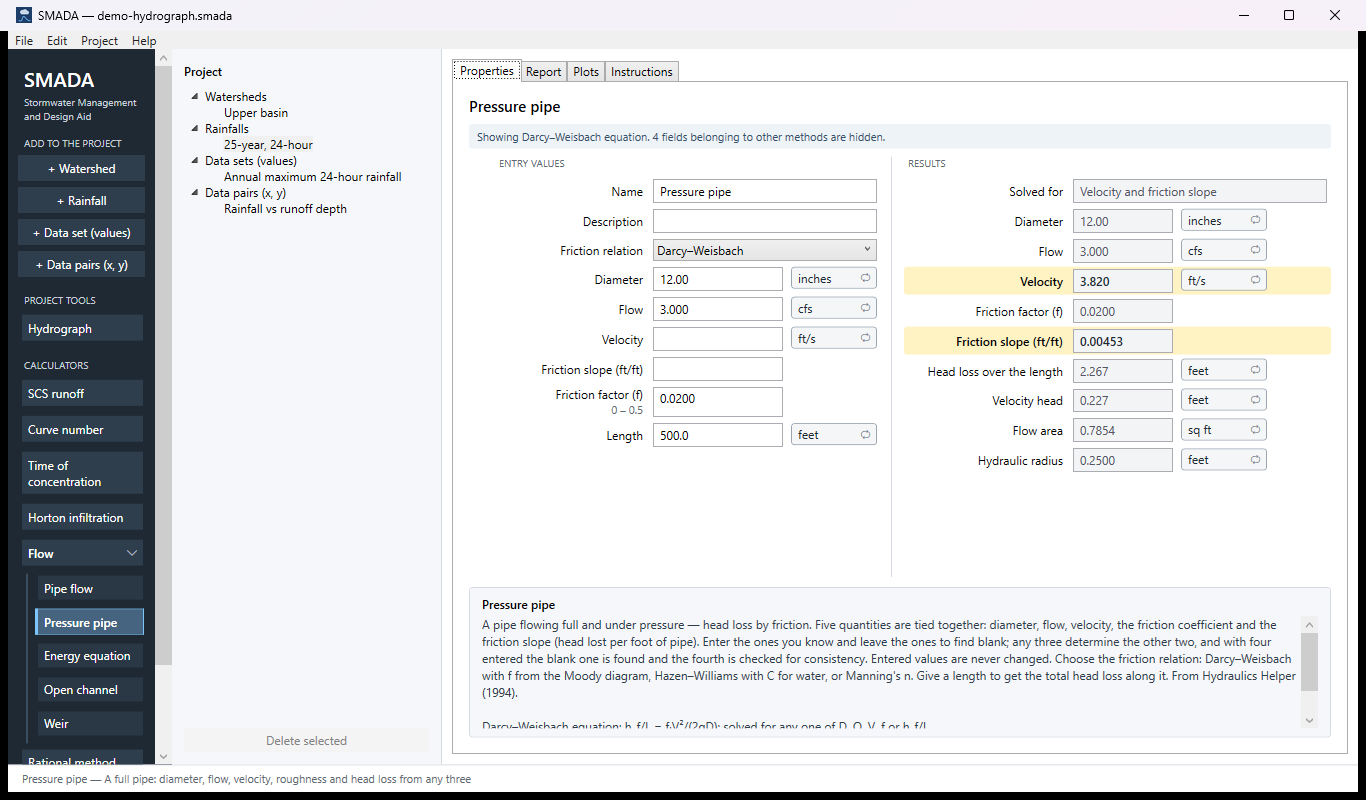
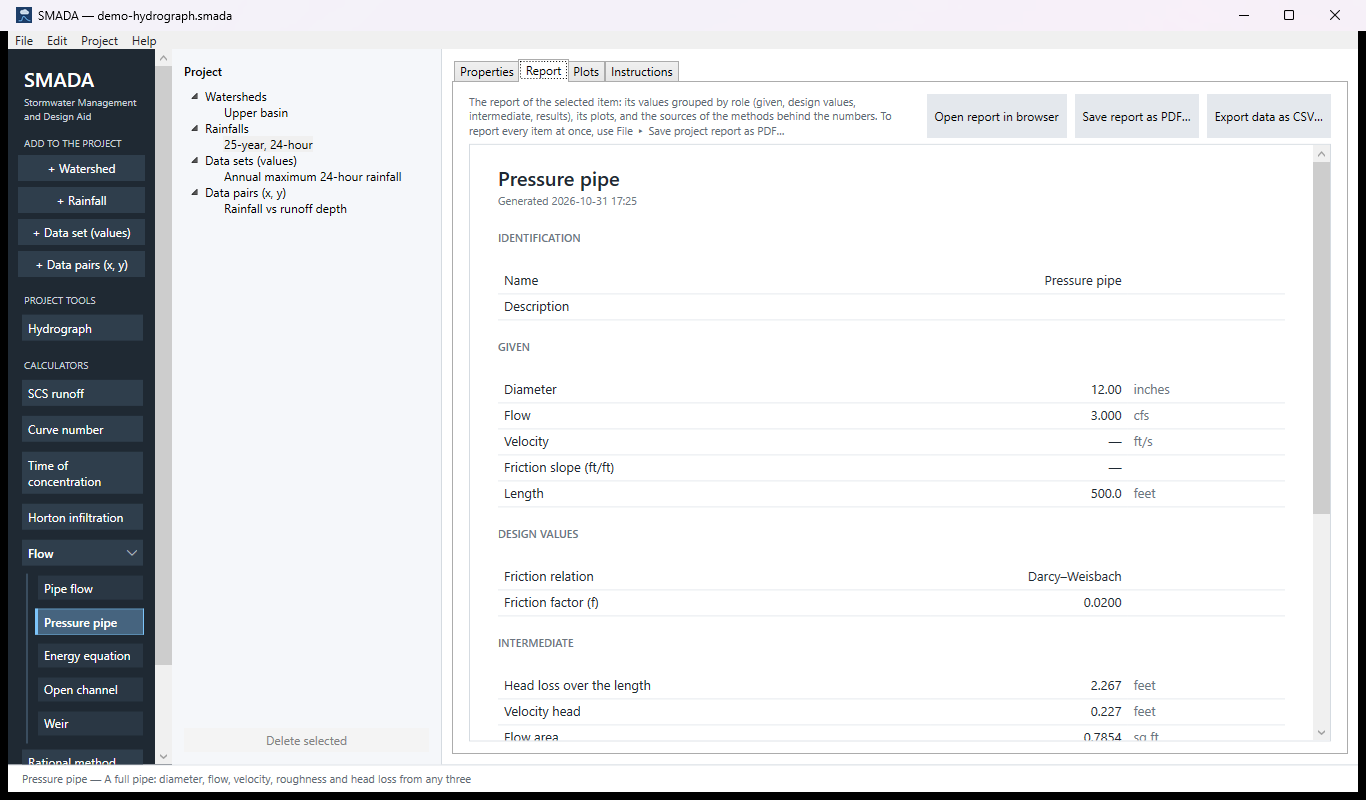
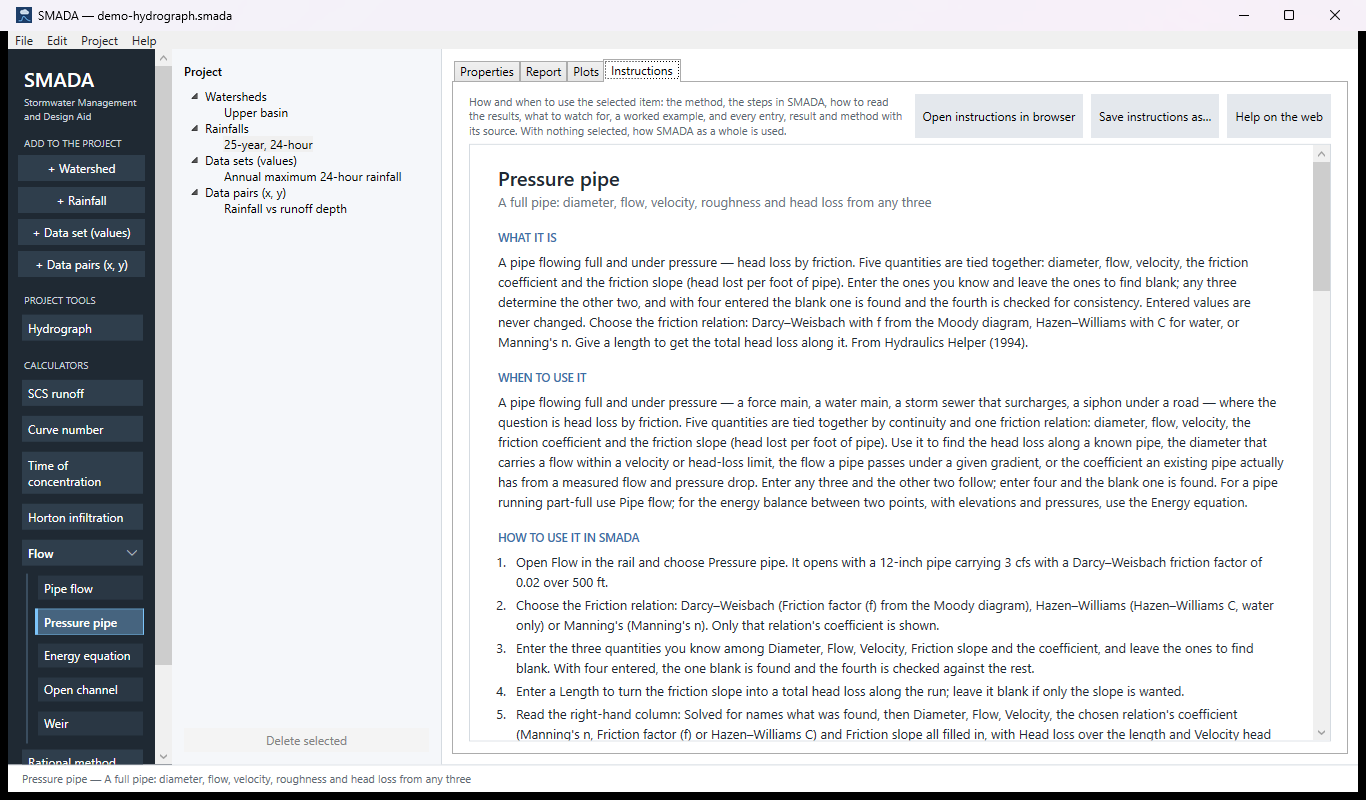
Every item in SMADA has the same four tabs. These are captured from the program with the example values it opens with; select a picture to see it full size.
Pressure pipe has nothing to draw, so its Plots tab is empty and is not shown.
Properties tab — where you enter values and read the results
Report tab — the same values as a report, ready for HTML, PDF or CSV
Instructions tab — the manual page in the program
How it calculates
The pipe is circular and flows full, so its geometry is fixed by the diameter alone. All calculations are in US customary units: the diameter is stored in inches and divided by 12, flow is in cfs, velocity in ft/s, flow area in sq ft, the friction slope in ft of head per ft of pipe, and g = 32.174 ft/s². The diameter has its own Pipe size unit button (inches or millimetres), velocity and flow area have theirs, and every message is written in the units on display. A blank entry is the unknown; a zero is a value, and every value you enter must be greater than zero.
The two relations
Two equations tie the five quantities together. The first is continuity with the full-pipe geometry:
A = π D2 / 4
R = D / 4
Q = V A
The second is the friction relation you choose. SMADA writes all three in terms of the hydraulic radius R = D/4:
Darcy–Weisbach: S = f V2 / (8 g R), the same as hf/L = f V2 / (2g D)
Hazen–Williams: V = 1.318 C R0.63 S0.54
Manning: V = (1.49 / n) R2/3 S1/2
- D
- inside diameter, ft
- A
- full flow area, sq ft
- R
- hydraulic radius, ft (D/4 for a full pipe)
- Q
- flow, cfs
- V
- mean velocity, ft/s
- S
- friction slope, the slope of the hydraulic grade line, ft/ft (hf/L)
- f
- Darcy–Weisbach friction factor, read from the Moody diagram
- C
- Hazen–Williams coefficient, water only
- n
- Manning roughness coefficient
- g
- 32.174 ft/s²
The friction factor f is used exactly as you enter it. SMADA does not compute f from the Reynolds number and relative roughness (no Colebrook or Swamee–Jain equation); if you find f, it is the value that makes the numbers agree, to compare with the Moody diagram.
The relations rearranged
To solve for whatever is blank, SMADA uses each friction relation in three forms. For the friction slope, given the coefficient, R and V:
Darcy–Weisbach: S = f V2 / (8 g R)
Hazen–Williams: S = (V / (1.318 C R0.63))1/0.54
Manning: S = (V n / (1.49 R2/3))2
For the coefficient, given R, S and V:
f = 8 g R S / V2
C = V / (1.318 R0.63 S0.54)
n = 1.49 R2/3 S1/2 / V
For the hydraulic radius (and so D = 4R), given the coefficient, S and V:
Darcy–Weisbach: R = f V2 / (8 g S)
Hazen–Williams: R = (V / (1.318 C S0.54))1/0.63
Manning: R = (V n / (1.49 S1/2))3/2
The order of solving
- Continuity first. If any two of D, Q and V are entered, the third follows: D = √(4Q / (πV)), V = Q / A, or Q = V A. If all three are entered they must agree: when V A differs from Q by more than 0.5 % of Q, SMADA stops and gives both flows, V A and the one entered.
- Then friction, when D and V are known.
- If the coefficient is entered and the slope blank, the slope is found.
- If the slope is entered and the coefficient blank, the coefficient is found.
- If both are entered and nothing at all was left blank, SMADA says everything is entered and asks you to blank the value to find. If one of D, Q, V was blank (and found in step 1), the slope implied by the coefficient must be within 1 % of the slope entered, or SMADA stops and quotes the implied slope beside the one entered.
- If neither is entered, it asks for one of them.
- Otherwise only one of D, Q, V is known, and both the coefficient and the slope must be entered:
- D known: V from the friction relation with R = D/4, then Q = V A.
- V known: R from the rearranged relation, D = 4R, then Q = V A.
- Q known: the diameter is found by bisection, because the flow a pipe carries at a fixed slope grows with its diameter. SMADA brackets D between 0.001 ft and 200 ft, halves the interval until it is narrower than 10−9 of the upper bound (at most 200 halvings), and then sets V = Q / A. If even a 200 ft pipe cannot carry the flow at that slope, it says so.
- None of the three known: SMADA asks for the diameter, the flow or the velocity.
The Solved for line names the quantities found, starting with a capital and calling the coefficient by its own name — for example "Velocity and friction slope", or "Friction factor (f)" — and the rows holding them are highlighted among the results, so you can tell your numbers from SMADA's. This lets you enter any three of the five; the old HYDHELP program needed four, and did not check a redundant entry.
The results repeat all five quantities, entered or found. The coefficient is shown to the precision that suits it: Manning's n and the friction factor f to 4 decimals, Hazen–Williams C to 1.
Head loss and velocity head
Once all five quantities are known:
hf = S L
hv = V2 / (2g)
- hf
- friction head loss over the length, ft (blank when no length is given)
- L
- length of the pipe run, ft
- hv
- velocity head, ft
The head loss is friction only. SMADA does not add minor losses; multiply each fitting's loss coefficient K by the velocity head shown, K V2/2g, and add them by hand or in the Energy equation calculator.
Checking the example by hand
D = 12 in = 1 ft, Q = 3 cfs, f = 0.02, L = 500 ft. A = π(1)2/4 = 0.7854 sq ft, so V = 3 / 0.7854 = 3.820 ft/s. With R = 0.25 ft, S = 0.02 × 3.8202 / (8 × 32.174 × 0.25) = 0.00453 ft/ft, and the head loss over 500 ft is 2.267 ft. The velocity head is 3.8202 / 64.348 = 0.227 ft. Solved for reads "Velocity and friction slope", and those two rows are highlighted; the friction factor shows as 0.0200, the flow area as 0.7854 sq ft and the hydraulic radius as 0.2500 ft.
Sources
- Moody, L. F., "Friction factors for pipe flow", Trans. ASME 66, 1944; Streeter, V. L. and Wylie, E. B., Fluid Mechanics, 8th ed., McGraw-Hill, 1985, Chapter 5.
- Williams, G. S. and Hazen, A., Hydraulic Tables, 3rd ed., Wiley, 1920.
- Manning, R., "On the flow of water in open channels and pipes", Trans. Inst. Civil Engineers of Ireland 20, 1891.
All SMADA calculators · Get SMADA free for Windows from the Microsoft Store