Open channel
Finds the one of flow, depth, slope or Manning's n you leave blank for steady uniform flow in a channel of any of seven shapes, a surveyed section divided at its bank stations, with velocity, Froude number, critical depth and slope, specific energy and shear stress.
What it is for
The Open channel calculator answers the everyday question of channel design: how deep does a flow run in a ditch, swale, flume or stream, and is the channel big enough and safe from erosion? It works by Manning's equation for steady uniform flow, which ties four things together: the flow, the depth, the bed slope and the roughness (Manning's n). You enter three and leave one blank, and SMADA finds it. So the same screen gives you the normal depth for a design flow, the flow a channel carries at a given depth (its bank-full capacity, say), the slope needed to carry a flow at a depth, or the n a real channel has from a measured flow and stage.
You first choose the shape: rectangular, trapezoidal, triangular (a V-ditch), circular (a pipe running part-full), parabolic (a grassed swale), compound (a main channel with a floodplain on each side, each with its own n), or irregular (a surveyed line of station, elevation pairs, with one n or an n per segment, divided at its bank stations into left overbank, main channel and right overbank as HEC-RAS does). Only the dimensions of the chosen shape are shown on the form.
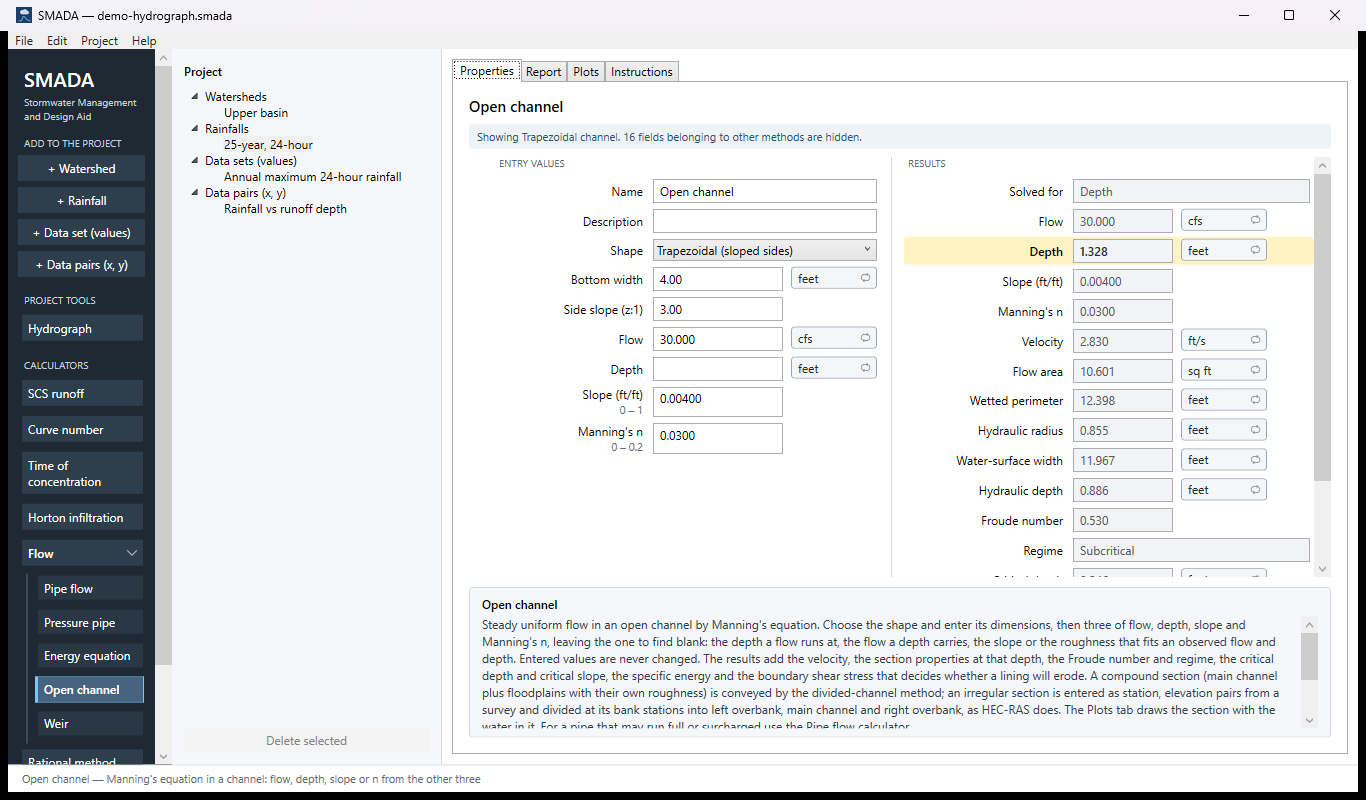
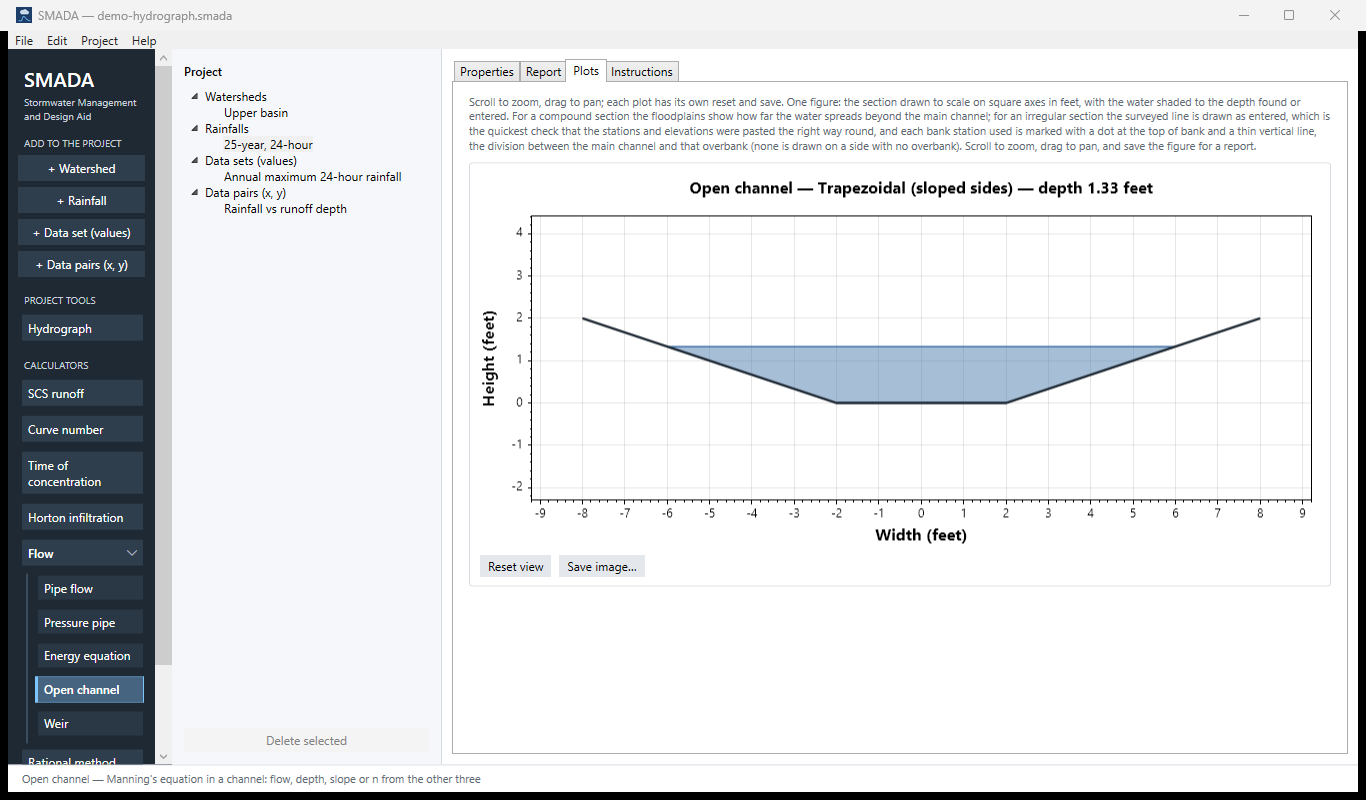
Besides the four main values you get the velocity, the flow area, wetted perimeter, hydraulic radius, water-surface width and hydraulic depth, the Froude number and flow regime, the critical depth and critical slope, the specific energy and the boundary shear stress, and for a compound or irregular section an equivalent n and (for a survey) the bank stations used. The value found is highlighted. The Plots tab draws the section to scale with the water in it, and marks the bank stations of a surveyed section.
The calculator sits in the Flow group in the list of tools down the left side of SMADA, with Pipe flow, Pressure pipe, Energy equation and Weir. Use it for the channel that carries the runoff the Hydrograph or Rational method tools give you. For a pipe at normal depth, use Pipe flow; for a pipe flowing full under pressure, use Pressure pipe. For the outlet over a pond's crest, use Weir.
The Open channel tabs
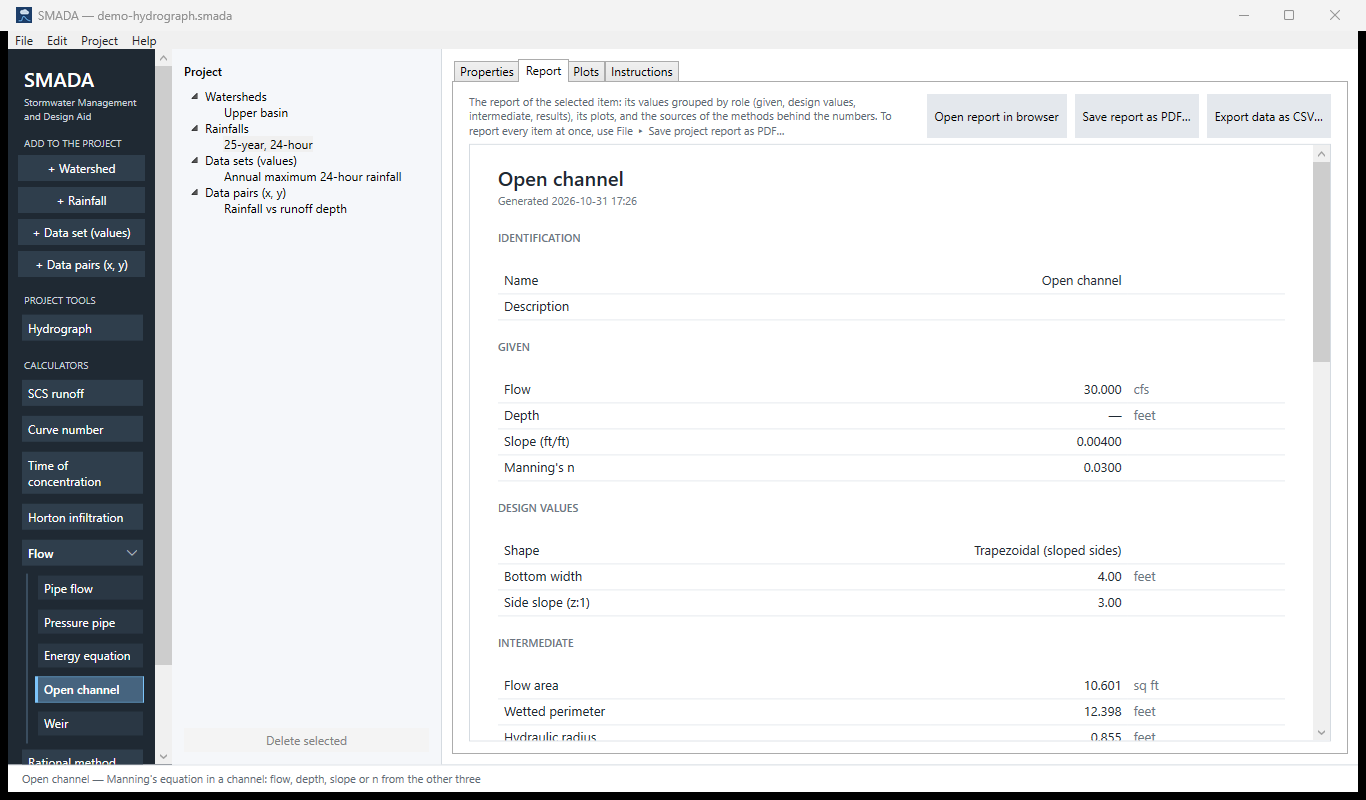
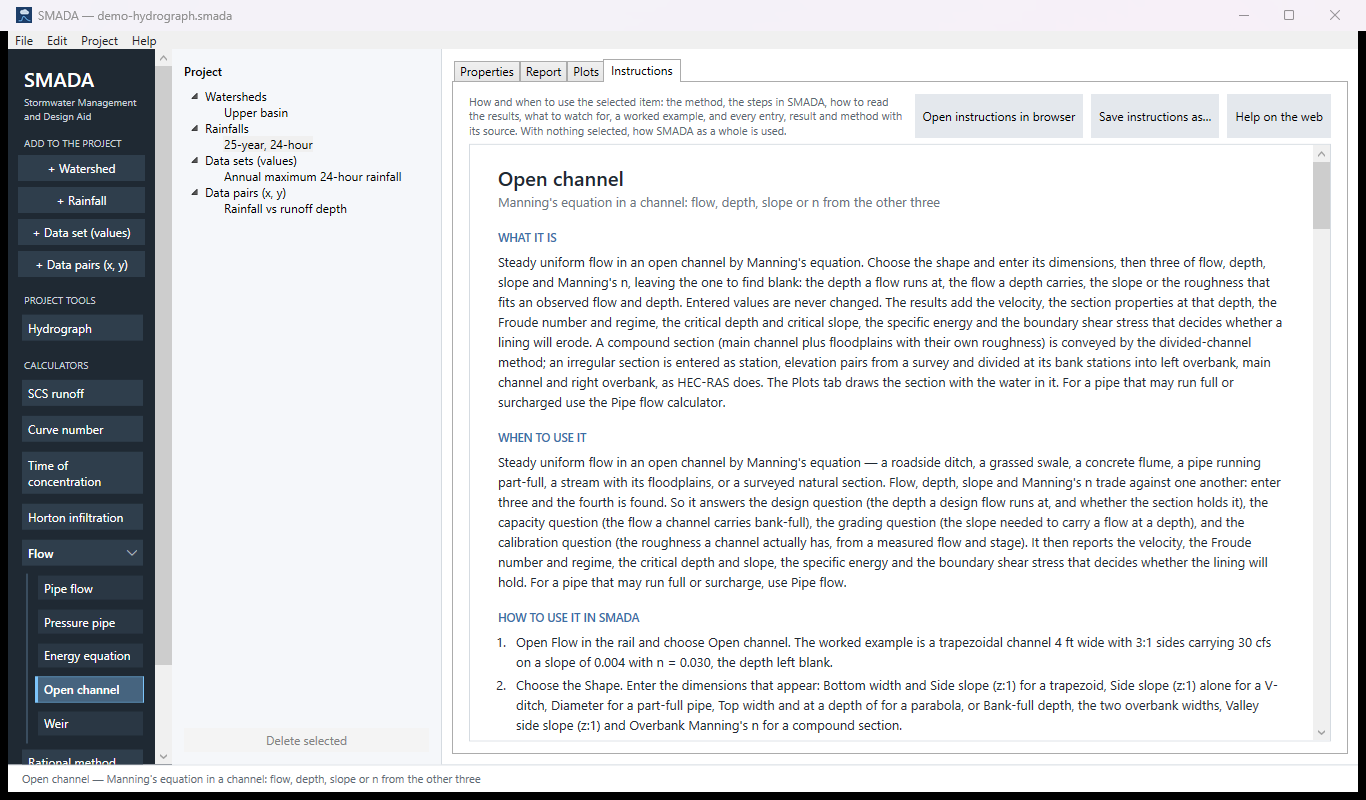
Every item in SMADA has the same four tabs. These are captured from the program with the example values it opens with; select a picture to see it full size.
Properties tab — where you enter values and read the results
Report tab — the same values as a report, ready for HTML, PDF or CSV
Plots tab — what it draws
Instructions tab — the manual page in the program
How it calculates
Manning's equation
Every shape uses the same relation for steady uniform flow, in US customary units with the constant 1.49:
V = (1.49 / n) R2/3 S1/2
Q = V A
R = A / P
- V
- mean velocity, ft/s
- Q
- discharge, cfs
- n
- Manning roughness coefficient
- R
- hydraulic radius, ft
- S
- bed slope (equal to the friction slope in uniform flow), ft/ft
- A
- flow area at the depth, sq ft
- P
- wetted perimeter at the depth, ft
The compound and irregular sections do not use one A and one R for the whole section. They compute their own conveyance K and then
Q = K S1/2
- K
- conveyance of the section at the depth, cfs (the flow it would carry at a slope of 1)
How K is built is described under those two shapes below.
Section geometry
Each shape supplies the flow area A, the wetted perimeter P and the water-surface (top) width T as functions of the depth y, measured from the lowest point of the section. All lengths are in feet; the circle's Diameter is entered in the project's pipe-size unit (inches by default) and converted to feet.
| Shape | You enter | Area A | Wetted perimeter P | Top width T |
|---|---|---|---|---|
| Rectangular | bottom width b | b y | b + 2y | b |
| Trapezoidal | bottom width b, side slope z | (b + z y) y | b + 2y √(1 + z2) | b + 2z y |
| Triangular | side slope z (must be > 0) | z y2 | 2y √(1 + z2) | 2z y |
| Circular, part-full | diameter D | D2 (θ − sin θ) / 8 | D θ / 2 | D sin(θ/2), 0 when full |
| Parabolic | top width T0 at depth y0 | (2/3) T y | exact arc length (below) | 2 √(y / k) |
For the circle, the central angle of the wetted arc is
θ = 2 acos(1 − 2y / D)
- θ
- angle subtended by the wetted arc, radians: 0 empty, 2π full
- D
- pipe diameter, ft
The triangular channel is the trapezoid with b = 0. The circle is the only shape with a fixed top: the depth may not exceed D.
The parabola is the curve y = k x2, fixed by the one measured pair you enter:
k = 4 y0 / T02
x = √(y / k), s = 2 k x
P = x √(1 + s2) + asinh(s) / (2k)
- k
- coefficient of the parabola, 1/ft
- T0, y0
- measured top width and the depth it was measured at, ft
- x
- half the top width at depth y, ft
- s
- slope of the bank at the water's edge, dy/dx
Compound section (main channel and overbanks)
SMADA builds a ground line: a trapezoidal main channel (Bottom width b, Side slope (z:1) z, Bank-full depth h), then a flat floodplain on each side of the width you enter, then a valley side rising at the Valley side slope (z:1) without limit. A, P and T for the whole section are summed segment by segment along that ground line, as for an irregular section (below).
The conveyance uses the divided-channel method. Up to the bank-full depth the whole section is one panel with the main channel's n. Above it, vertical lines at the tops of the two main banks split the water into three panels: the main channel with Manning's n, and each overbank with the Overbank Manning's n. The vertical division lines are not counted as wetted perimeter.
The panels are runs of the ground line's own corner points: the main channel from one bank top to the other, each overbank from its valley wall to its bank top. So every wall belongs to the panel whose water touches it, even a vertical one (side slope 0: a rectangular main channel, or a levee). Until 15 October 2026 the panels were cut by station, which lost a vertical wall and gave a conveyance up to 20 % low; sections with sloped sides are unchanged.
K = Σ (1.49 / ni) Ai Ri2/3
Ri = Ai / Pi
- K
- conveyance of the whole section, cfs
- ni
- Manning's n of panel i (main channel or overbank)
- Ai
- flow area of panel i, sq ft
- Pi
- wetted perimeter of panel i along the ground only, ft
- Ri
- hydraulic radius of panel i, ft
The velocity reported is Q divided by the total area, so it is the section's mean velocity, not the main channel's. The results add an Equivalent n, the single n that, applied to the whole section's A and R, gives the same conveyance (Chow, §6-5):
ne = 1.49 A R2/3 / K
- ne
- equivalent Manning's n of the whole section at this depth
- A, R
- area (sq ft) and hydraulic radius (ft) of the whole section
- K
- the divided section's conveyance, cfs
Up to bank-full it equals the main channel's n; once the floodplains are wet it shows how much dividing the section changes the result.
Irregular (surveyed) section
You enter station, elevation pairs from left bank to right. Stations must not decrease, there must be at least three points, and both ends must stand higher than the lowest point. Depth is measured above the lowest point, and the section is full when the water reaches the lower of the two end points.
At a water-surface elevation W each segment between consecutive points is treated on its own and the results summed:
- both ends below W: area dx (d1 + d2) / 2, the full segment length is wetted, and dx is added to the top width;
- one end below W: only the wet fraction f = dwet / (d1 − d2) counts, as a triangle of water with area f dx dwet / 2, wetted length f times the segment length, and top width f dx;
- both ends at or above W: the segment is dry.
- dx
- horizontal length of the segment, ft
- d1, d2
- depth of water W − z over each end of the segment, ft
- dwet
- the depth at the wet end, ft
Bank stations. The section is divided, as HEC-RAS divides it, into a left overbank, the main channel and a right overbank by vertical lines at the two bank stations. The lines are not counted as wetted perimeter, so a shallow, wide floodplain is conveyed on its own and does not drag down the main channel.
- Left bank station (ft) and Right bank station (ft) are in feet on the survey's own stationing. A station between two survey points gets a point added on the ground line there.
- Left blank, SMADA finds each one: from the lowest point (across a flat bed at the invert) it walks outward to the first point past which the ground stops rising, the top of bank. A side whose ground rises all the way to its end has no overbank.
- Both stations must lie inside the survey and the left must be to the left of the right, or SMADA says which is wrong.
- The stations used are reported as Left bank station used (ft) and Right bank station used (ft), and marked on the Plots tab with a dot at the top of bank and a thin vertical line.
Until 15 October 2026 a surveyed section with one n was conveyed as one panel. With flat floodplains its conveyance then fell just above bank-full, and a flow could have three normal depths. Dividing at the bank stations gives one rising rating. Results at or below bank-full with one n are unchanged, as are sections whose ground rises all the way to both ends.
Roughness. The Roughness choice says how n is given:
- One n for the whole section. Manning's n applies to every segment, and each of the three subsections is conveyed with it.
- Per segment, Composite. Each segment between consecutive stations has its own n in Segment n (left to right); a segment given 0, or left off the end of the list, uses Manning's n. Each subsection (left overbank, main channel, right overbank) takes one Horton–Einstein composite n, each segment's n weighted by its wetted length at that depth.
- Per segment, Divided. HEC-RAS's default: the main channel is still one element with a composite n, but each overbank is divided again wherever n changes, each run of segments with the same n a panel of its own.
nc = (Σ Pi ni1.5 / Σ Pi)2/3
K = Σ (1.49 / nj) Aj Rj2/3
- nc
- composite Manning's n of one subsection at this depth
- Pi, ni
- wetted length (ft) and Manning's n of segment i in that subsection
- K
- conveyance of the whole section, cfs
- nj
- n of panel j: the composite n of a subsection, or the n of one run of an overbank under Divided
- Aj, Rj
- area (sq ft) and hydraulic radius (ft) of panel j, its vertical edges not wetted
Every irregular section reports an Equivalent n, 1.49 A R2/3 / K with the whole section's A and R, as the compound section does.
Finding the one value left blank
Exactly one of flow, depth, slope and Manning's n must be blank, and the three you enter must all be greater than zero. Entered values are never changed. Solved for names the one found, and its row in the results is highlighted. An entered depth may not exceed the section's own: the diameter for the circle, the lower end of the survey for an irregular section; the message says which, in the project's units.
- Flow. Direct: Q = (1.49 / n) A R2/3 S1/2, or Q = K S1/2 for a compound or irregular section.
- Depth (normal depth). By bisection on depth: 100 halvings of the interval, so the depth is found to far better than a thousandth of a foot. For an open shape the upper bound starts at 1 ft and is doubled until the section carries the flow there. For a section that fills (the circle, or an irregular section, full when the water reaches its lower end) SMADA first finds the flow at the full depth; a flow at or above it is reported as a problem, in the project's units: for the circle, that the flow exceeds what the pipe carries as an open channel (use Pipe flow for a full or surcharged pipe); for a survey, that the flow overtops the section, with its bank-full flow and depth. An irregular section is otherwise searched over its whole depth. Only the circle, a closed section, is searched up to its depth of greatest discharge, found by checking 80 % to 100 % of the full depth in 1 % steps; that is near 0.94 D, where a part-full pipe carries more than a full one, and the depth returned is on the rising part of the curve.
- Slope. Closed form, Manning's equation inverted at the depth entered:
S = (V n / (1.49 R2/3))2 with V = Q / A
S = (Q / K)2 (compound or irregular)
- Manning's n. By bisection between n = 0.0001 and n = 2, since the flow falls as n rises, until the interval is under 10−13 (at most 200 halvings). For an irregular section with per-segment roughness this is the n of the segments given 0; if every segment has its own n there is nothing to find and SMADA says so.
Results at the depth
With all four values known, SMADA reports the section properties at the depth and these:
V = Q / A
Dh = A / T
Fr = V / √(g A / T)
E = y + V2 / 2g
τ = 62.4 R S
- Dh
- hydraulic depth, ft
- Fr
- Froude number
- g
- acceleration of gravity, 32.174 ft/s2
- T
- water-surface width, ft
- E
- specific energy, ft
- y
- depth of flow, ft
- τ
- mean boundary shear stress (Shear stress), lb/sq ft
- 62.4
- unit weight of water γ, lb/cu ft
τ = γRS is the mean over the boundary. The greatest shear, on the bed at the deepest point, is about γyS, more than the mean in a narrow or V-shaped channel, and that maximum is what HEC-15 compares with the permissible shear of a lining. Velocity and flow area are shown in the project's velocity and area units (ft/s and sq ft by default).
The Regime line says subcritical when Fr < 0.9, supercritical when Fr > 1.1, and near critical in between, where the surface is unstable.
Critical depth and critical slope
Critical depth is the depth at which the flow has the least specific energy, where
Q2 T / (g A3) = 1
SMADA finds it by bisection on depth (100 halvings), with the upper bound doubled from 1 ft for an open shape. In a circle the search stops at 0.999 D; if the flow is still supercritical there, no critical depth is reported. For the compound and irregular sections the test, and the Froude number above, use the whole section's A and T, not a separate test per panel. Such a section can have more than one critical depth (one in the main channel, another once the floodplains are wet); the bisection finds one, and only one is reported. The whole-section Froude number can understate the main channel's own when shallow floodplains are wet.
The critical slope is the slope that would make the normal depth equal the critical depth: the slope formula above evaluated at yc with the same n. A bed milder than this runs subcritical in uniform flow, a steeper one supercritical.
Checking the example by hand
The calculator opens with a trapezoidal channel, b = 4 ft and z = 3, carrying Q = 30 cfs on S = 0.004 with n = 0.030, the depth blank. Solved for reads Depth, and the highlighted Depth result is 1.328 ft. Check it with Manning's equation at that depth:
A = (4 + 3 × 1.328) × 1.328 = 10.60 sq ft
P = 4 + 2 × 1.328 × √(1 + 32) = 12.40 ft
R = 10.60 / 12.40 = 0.855 ft
Q = (1.49 / 0.030) × 10.60 × 0.8552/3 × 0.0041/2 = 30.0 cfs
The other results follow from the same depth:
- T = 4 + 2 × 3 × 1.328 = 11.97 ft, so Dh = 10.60 / 11.97 = 0.886 ft.
- V = 30 / 10.60 = 2.83 ft/s, and Fr = 2.83 / √(32.174 × 0.886) = 0.53, subcritical.
- E = 1.328 + 2.832 / (2 × 32.174) = 1.45 ft.
- τ = 62.4 × 0.855 × 0.004 = 0.213 lb/sq ft, the mean; the maximum on the bed, γyS = 62.4 × 1.328 × 0.004 = 0.33 lb/sq ft, is the one to compare with a lining.
- Critical depth yc ≈ 0.946 ft: there A = 6.47 sq ft and T = 9.68 ft, and 302 × 9.68 / (32.174 × 6.473) = 1.00.
- Critical slope: at yc, P = 9.98 ft, R = 0.648 ft and V = 4.64 ft/s, so Sc = (4.64 × 0.030 / (1.49 × 0.6482/3))2 ≈ 0.0156. The bed slope of 0.004 is milder, which agrees with the subcritical regime.
Sources
- Manning, R., "On the flow of water in open channels and pipes", 1891.
- Chow, V. T., Open-Channel Hydraulics, McGraw-Hill, 1959: Chapter 2 (geometry), Chapter 4 (critical flow), Chapter 6 (uniform flow), §6-5 (channels of compound section), §6-9 (composite roughness).
- Horton, R. E., "Separate roughness coefficients for channel bottom and sides", Engineering News-Record 111, 1933; Einstein, H. A., 1934 (composite roughness).
- U.S. Army Corps of Engineers, HEC-RAS Hydraulic Reference Manual, Ch. 2, "Cross Section Subdivision for Conveyance Calculations" (bank stations, overbanks divided where n changes, main channel one element).
- Eaglin, R., Hydraulics Helper 1.0, 1994.
All SMADA calculators · Get SMADA free for Windows from the Microsoft Store