Weir
Finds the one of flow, head, crest length or weir coefficient you leave blank for a sharp-crested, broad-crested, V-notch or Cipolletti weir, with Villemonte's reduction for a submerged weir and a free-flow rating curve.
What it is for
The Weir calculator works out the flow over a weir: the outlet weir of a detention pond or control structure, an emergency spillway, a road embankment that overtops, or a notch set in a channel to measure its flow. The weir equation ties together the flow, the head (the height of the upstream water surface above the crest), the crest length and the weir coefficient. You enter all but one and leave that one blank, and SMADA finds it: the flow a pool level passes, the head a design flow raises, the crest length that keeps the pool below a limit, or the coefficient a measured flow and head imply.
Four weirs are offered: sharp-crested rectangular (Francis's equation, with 0, 1 or 2 end contractions), broad-crested, V-notch with any notch angle, and Cipolletti. Each keeps its own coefficient, filled in with the usual value and used as it stands, with no correction for the weir's height or the approach velocity. You can also give a tailwater head, when the downstream water stands above the crest, and the flow is then reduced by Villemonte's submergence factor. A crest elevation, if you give one, turns the head into a water-surface elevation.
The results give the four values with the blank filled in and highlighted, the effective crest length after end contractions, and, for a submerged weir, the free-flow discharge and the submergence factor. The Plots tab draws the free-flow rating curve, head (or elevation) against flow, with your result marked, which is the stage-discharge relation a pond routing needs.
Weir sits in the Flow group in the list of tools down the left side of SMADA, beside Pipe flow, Pressure pipe, Energy equation and Open channel. Use Open channel for the channel downstream of the weir. This calculator handles the weir alone; a pond outlet that also has an orifice needs the two flows added.
The Weir tabs
Every item in SMADA has the same four tabs. These are captured from the program with the example values it opens with; select a picture to see it full size.
Properties tab — where you enter values and read the results
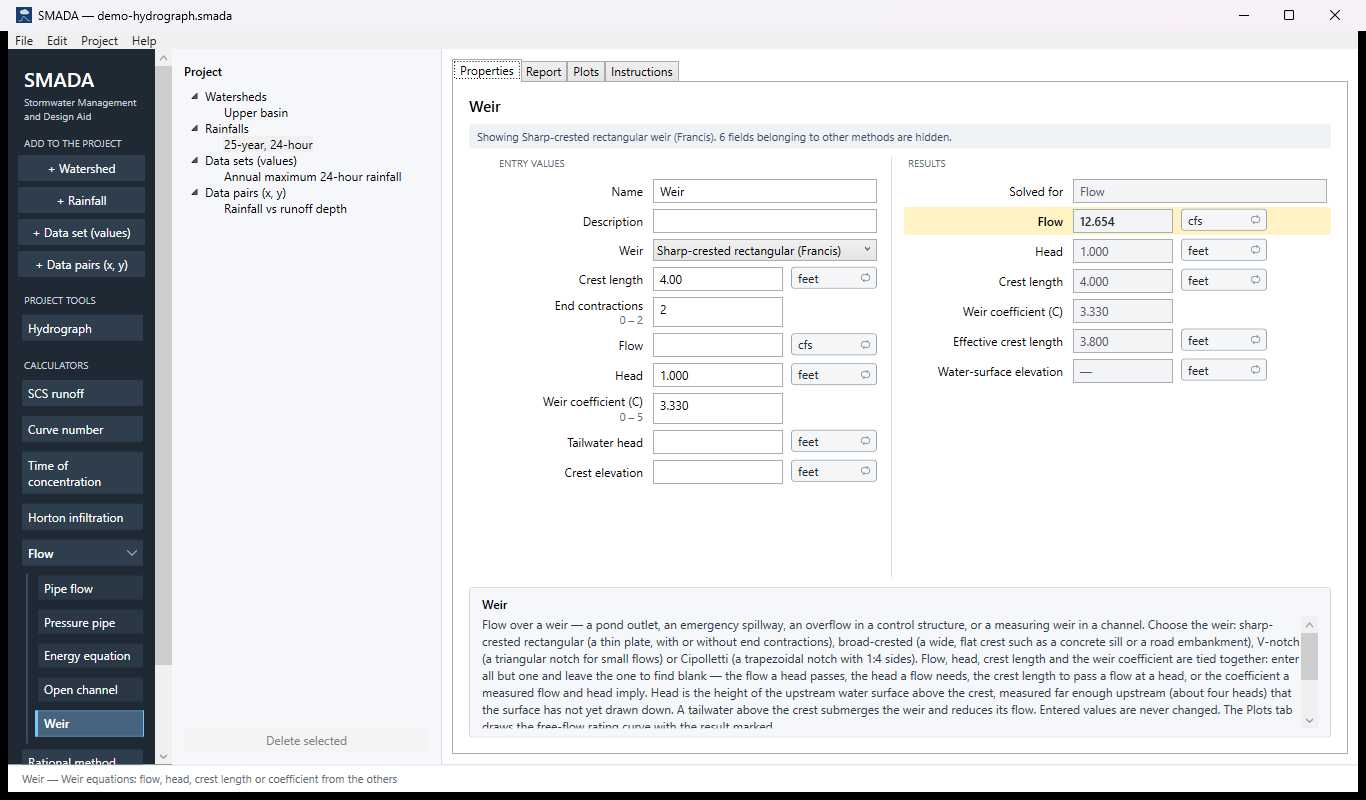
Report tab — the same values as a report, ready for HTML, PDF or CSV
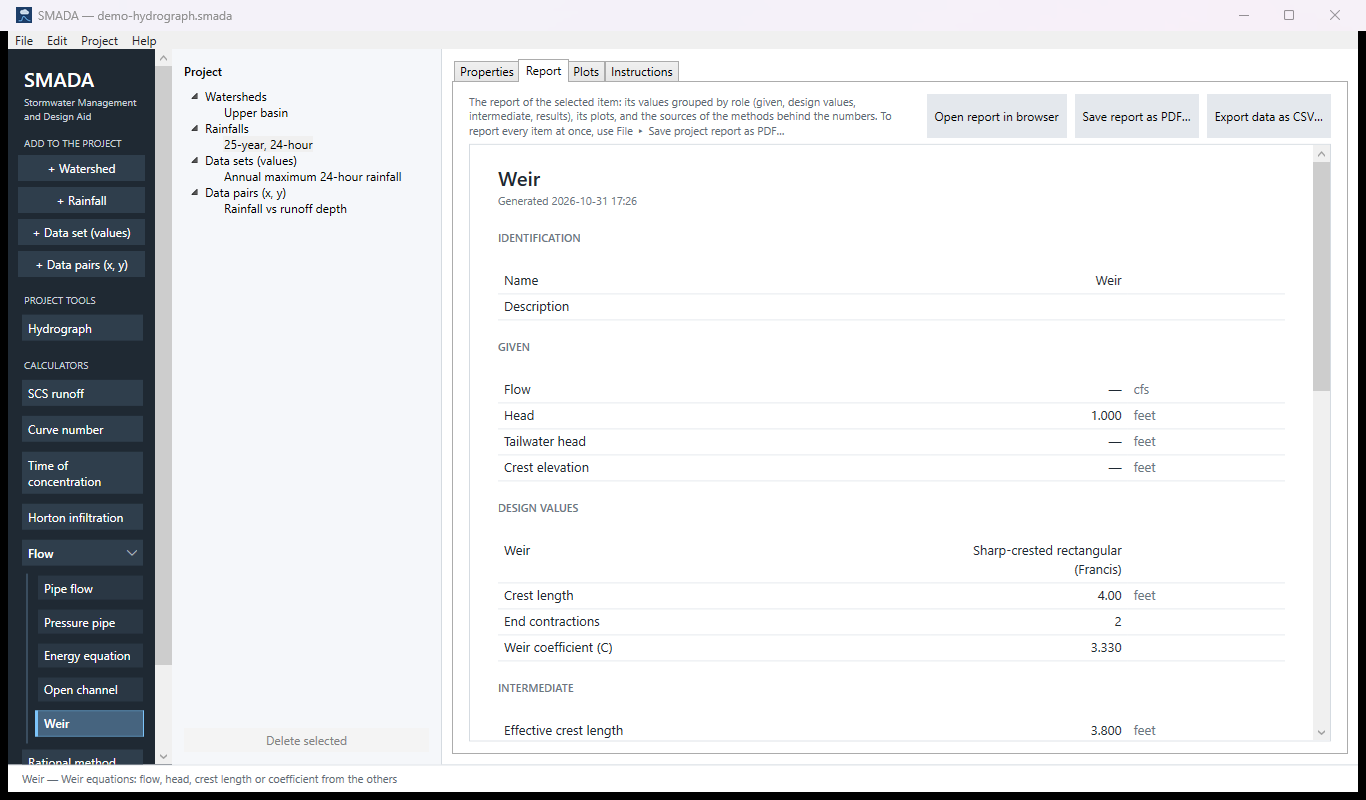
Plots tab — what it draws
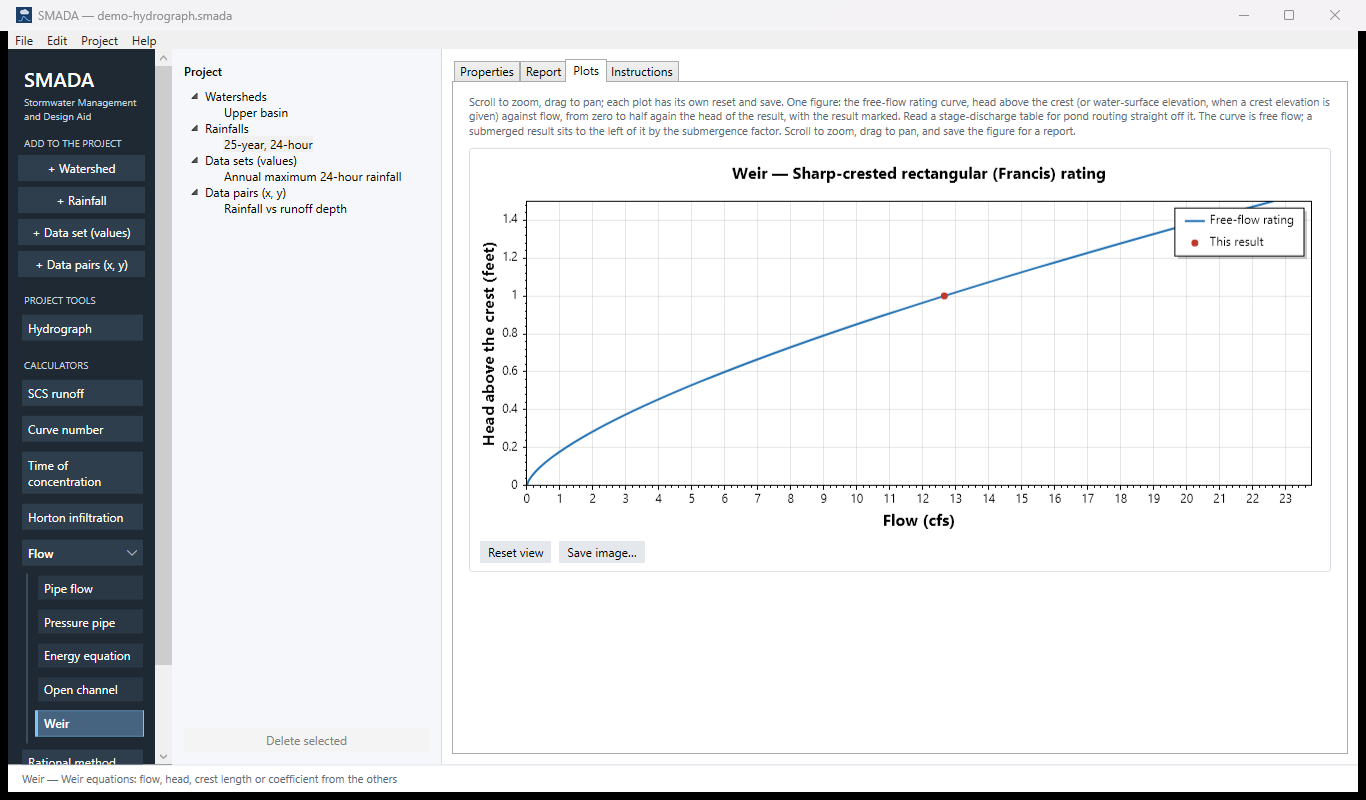
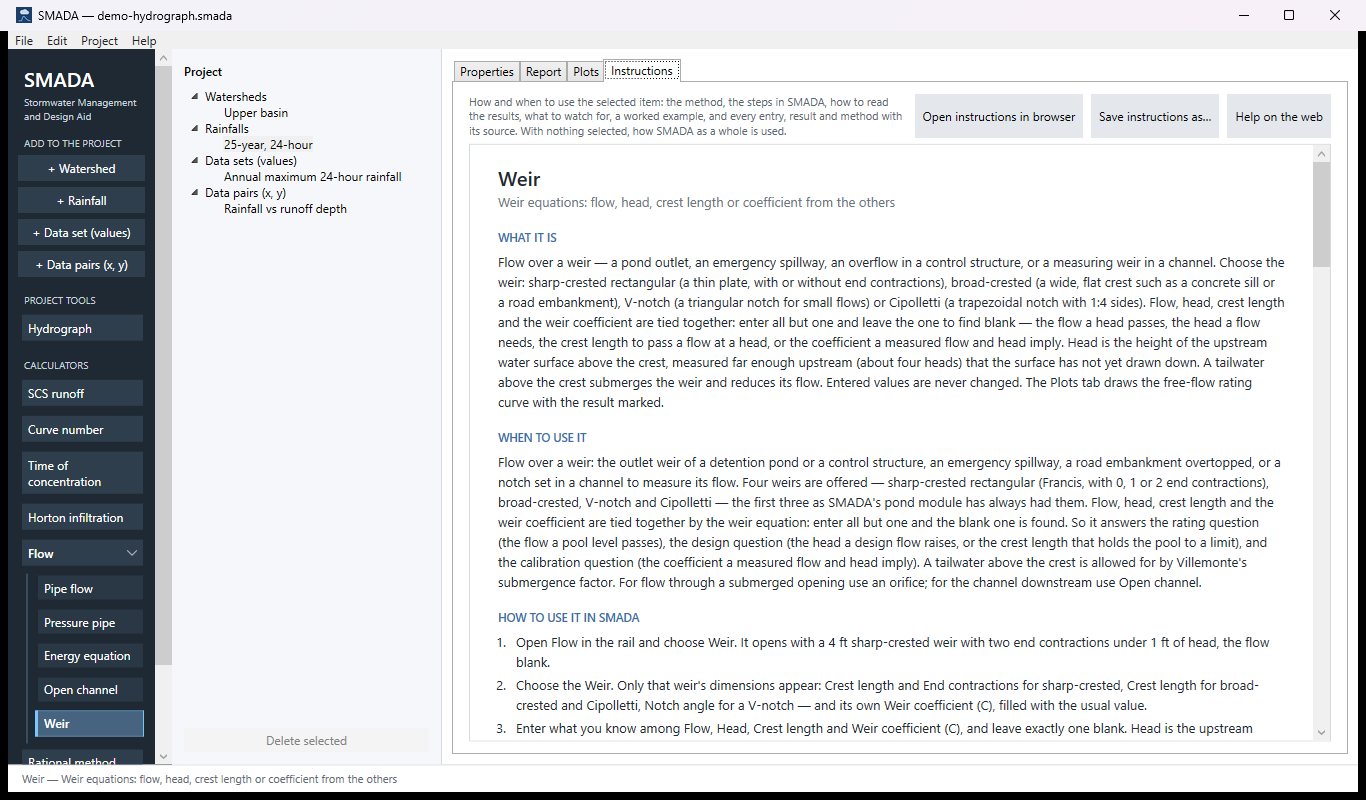
Instructions tab — the manual page in the program
How it calculates
The four weir equations
Lengths, heads and flows show in the project's units, but the weir coefficient C is always the US customary coefficient, for feet and cfs: 3.33 for a sharp-crested weir, not the SI 1.84. SMADA converts the other values to feet and cfs, computes, and converts the results back for display.
| Weir | Equation (free flow) | Default C | Head exponent |
|---|---|---|---|
| Sharp-crested rectangular (Francis) | Q = C (L − 0.1 N H) H1.5 | 3.33 | 1.5 |
| Broad-crested rectangular | Q = C L H1.5 | 3.087 | 1.5 |
| V-notch (triangular) | Q = C tan(θ/2) H2.5 | 2.5 | 2.5 |
| Cipolletti (1:4 sides) | Q = C L H1.5 | 3.367 | 1.5 |
In general form, with the effective length:
Q = C Le H1.5
Le = L − 0.1 N H
and for the V-notch:
Q = C tan(θ/2) H2.5
- Q
- free-flow discharge over the weir, cfs
- C
- weir coefficient of the chosen weir (US customary units)
- L
- crest length across the flow, ft; for a Cipolletti weir the bottom width of the notch
- Le
- effective crest length, ft (equal to L for every weir but the sharp-crested)
- N
- number of end contractions, a whole number 0, 1 or 2 (sharp-crested only)
- H
- head: upstream water surface above the crest (or above the notch invert), ft
- θ
- included angle of the V-notch, degrees, between 0 and 180
The broad-crested default 3.087 is the theoretical value for critical depth on the crest; Brater and King tabulate 2.6 to 3.1 depending on head and crest breadth. The V-notch default 2.5 is the 90° notch coefficient SMADA has always used. The Cipolletti's sloping sides make up for its end contractions, so it takes no contraction term. SMADA uses the C you enter as it stands: it makes no correction for the height of the weir above the channel bed (no Rehbock-type adjustment for the head-to-weir-height ratio) and adds no approach-velocity head, and the help on the coefficient says so. Enter a different C, or add the velocity head to H, if you need those.
End contractions must be a whole number, 0, 1 or 2 (a crest spanning the channel, against one wall, or a notch cut in a wider plate); a fraction is refused. Francis's term is applied as he wrote it, 0.1 N H off the length with H1.5 on the head. The VB3 pond module that SMADA's weirs come from had raised the effective length, not the head, to the 1.5 power, and elsewhere ignored the crest length or always took two contractions; those are corrected (ENGINE-DEPARTURES §19).
If the end contractions take up the whole crest (Le ≤ 0), the flow is zero and SMADA reports the problem.
Submerged weir (Villemonte)
When you enter a tailwater head greater than zero, the flow is the free flow times Villemonte's factor:
Qs = Q × (1 − (H2 / H)m)0.385
- Qs
- submerged discharge, cfs
- Q
- free-flow discharge at the same head, cfs
- H2
- tailwater head: downstream water surface above the crest, ft
- H
- upstream head, ft
- m
- the weir's head exponent: 2.5 for a V-notch, 1.5 for the others
A blank or zero tailwater means free flow (factor 1). The tailwater must be below the upstream head; a tailwater at or above it is refused, since nothing would flow. When the factor is below 0.7 the weir is drowned: the downstream water controls, and the Solved for line adds "weir drowned, factor …: the tailwater controls, so treat this as a rough estimate". With a tailwater given, the flow you enter or the flow SMADA finds is the submerged flow, and the free-flow discharge and the factor are shown beside it.
Finding the one value left blank
Exactly one of flow, head, crest length and coefficient must be blank (for a V-notch, which has no crest length, one of flow, head and coefficient). Every value entered must be greater than zero, and the notch angle between 0 and 180°. Entered values are never changed. If none or more than one is blank, SMADA says which to clear.
- Flow. Direct: the free-flow equation times the submergence factor.
- Coefficient. Direct, since Q is proportional to C: C = Q / Q1, where Q1 is the flow computed with C = 1 at the same head, length and tailwater.
- Crest length. Direct, since Q is proportional to the effective length. SMADA computes the flow per foot of effective length at the head (with the submergence factor), divides the flow by it to get Le, and for a sharp-crested weir adds back the contractions: L = Le + 0.1 N H. The length is exact; round it up to a buildable size and run again to see the head it gives.
- Head. By bisection, because the head appears both in the power and, for a contracted weir, in the effective length. The search runs from zero (or from the tailwater head, when one is given) up to an upper limit, and stops when the interval is under 10−10 of its upper end, or after 200 halvings. For a sharp-crested weir with end contractions the upper limit is 6L/N, the head at which C (L − 0.1 N H) H1.5 is greatest; beyond it more head gives less flow. For the others the limit is 1000 ft above the lower bound. If the flow at the upper limit is still less than the flow asked for, SMADA reports that no head passes the flow (and, for a contracted weir, to lengthen the crest).
Results reported
- Flow, Head, Crest length (not for a V-notch) and Weir coefficient (C), with the blank filled in. Solved for names the one found (Flow, Head, Crest length or Coefficient), and its row in the results is highlighted.
- Effective crest length L − 0.1 N H at the head (equal to L for broad-crested and Cipolletti weirs).
- With a tailwater head: the Free-flow discharge and the Submergence factor.
- With a crest elevation: the Water-surface elevation, crest elevation plus head.
The rating curve
The Plots tab evaluates the free-flow equation with the coefficient, length and contractions of the result at 61 heads, evenly spaced from zero to 1.5 times the result's head, and draws head (or water-surface elevation, when a crest elevation is given) against flow. The result is marked on it. The curve is always free flow, so a submerged result sits to the left of the curve by its submergence factor.
Checking the example by hand
The calculator opens with a sharp-crested weir: Crest length 4 ft, End contractions 2, Weir coefficient (C) 3.330 and Head 1.000 ft, the Flow blank and no tailwater or crest elevation. Solved for reads Flow, and the highlighted Flow is 12.654 cfs with an Effective crest length of 3.800 ft. By hand:
Le = 4 − 0.1 × 2 × 1 = 3.8 ft
Q = 3.33 × 3.8 × 11.5 = 12.654 cfs
The rating curve on the Plots tab runs to 1.5 ft of head, where Le = 3.7 ft and Q = 3.33 × 3.7 × 1.51.5 = 22.6 cfs. Asking instead for the head that passes 20 cfs (Flow 20, Head blank) gives H = 1.375 ft, found by bisection between 0 and 6 × 4 / 2 = 12 ft: there Le = 3.725 ft and 3.33 × 3.725 × 1.3751.5 = 20.0 cfs.
Sources
- Francis, J. B., Lowell Hydraulic Experiments, 1855.
- Brater, E. F. and King, H. W., Handbook of Hydraulics, 6th ed., McGraw-Hill, 1976, Section 5 and Table 5-3.
- Chow, V. T., Open-Channel Hydraulics, McGraw-Hill, 1959, §3-7.
- U.S. Bureau of Reclamation, Water Measurement Manual, 3rd ed., 2001, Chapter 7.
- Cipolletti, C., 1886.
- Villemonte, J. R., "Submerged weir discharge studies", Engineering News-Record 139, 1947, pp. 866–869.
- Wanielista, M. P., Kersten, R. and Eaglin, R., Hydrology: Water Quantity and Quality Control, 2nd ed., Wiley, 1997.
All SMADA calculators · Get SMADA free for Windows from the Microsoft Store