Rational method
Finds the peak discharge from a small catchment, Q = 1.008 C i A, from its runoff coefficient, the design rainfall intensity and its area.
What it is for
The rational method answers one question: what is the peak rate of runoff from a small catchment for a design storm? It is the usual tool for sizing an inlet, a gutter or a storm pipe for a parking lot, a street or a subdivision of a few tens of acres, where only the peak matters. It assumes the rainfall intensity is uniform over the whole catchment for a duration equal to the time of concentration, which is reasonable up to about 200 acres.
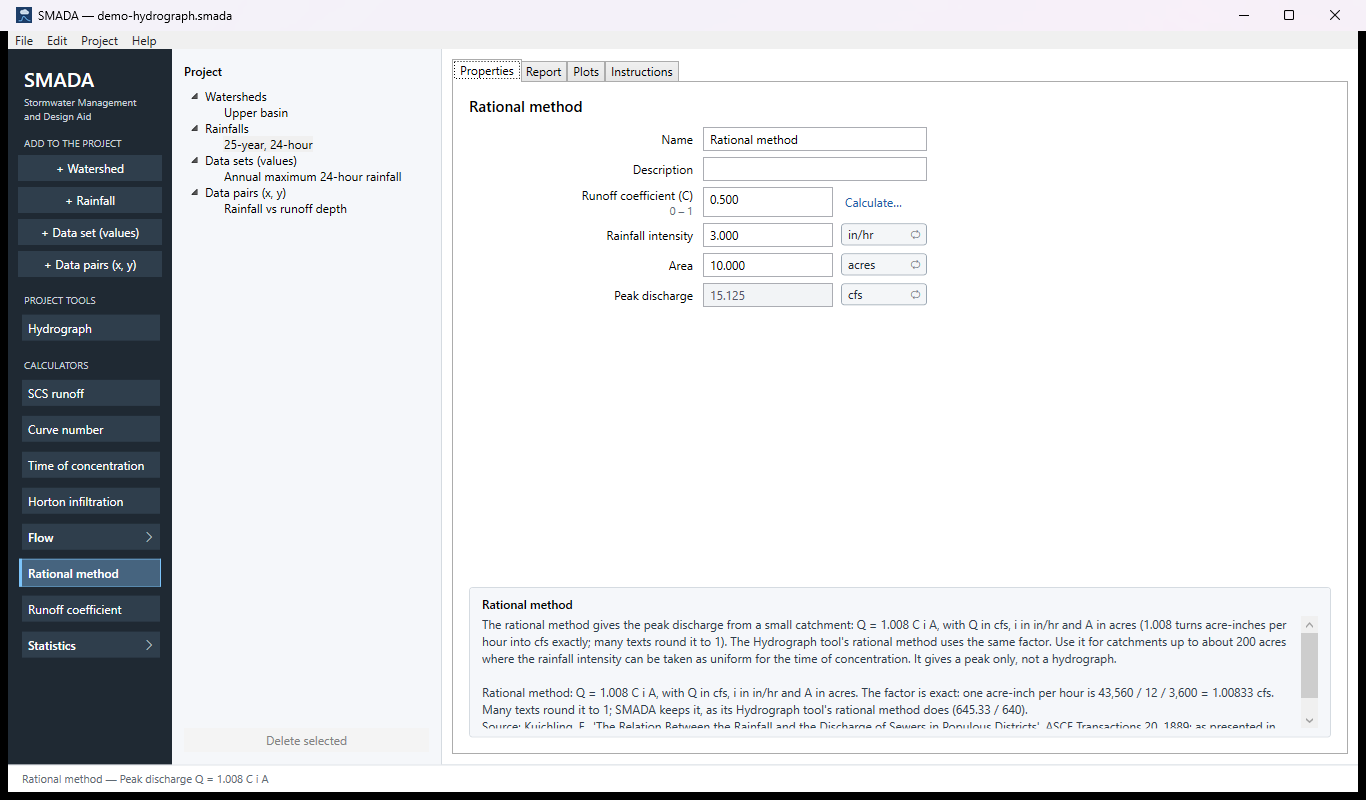
You enter three values: the Runoff coefficient (C) (the fraction of rainfall that appears as peak runoff, 0 to 1), the Rainfall intensity in the rate unit shown beside it (in/hr, cm/hr or mm/hr), and the drainage Area. You get back the Peak discharge in cfs (click the unit label for cms or gpm).
The other SMADA tools feed it. The Time of concentration calculator gives the duration at which you read the intensity from the IDF curve, and the Runoff coefficient calculator, opened from the Calculate link beside Runoff coefficient (C), builds an area-weighted C for mixed cover. When you need a volume or the shape of the flood rather than just its peak, use the Hydrograph tool, whose rational method applies the same C to a storm step by step.
The Rational method tabs
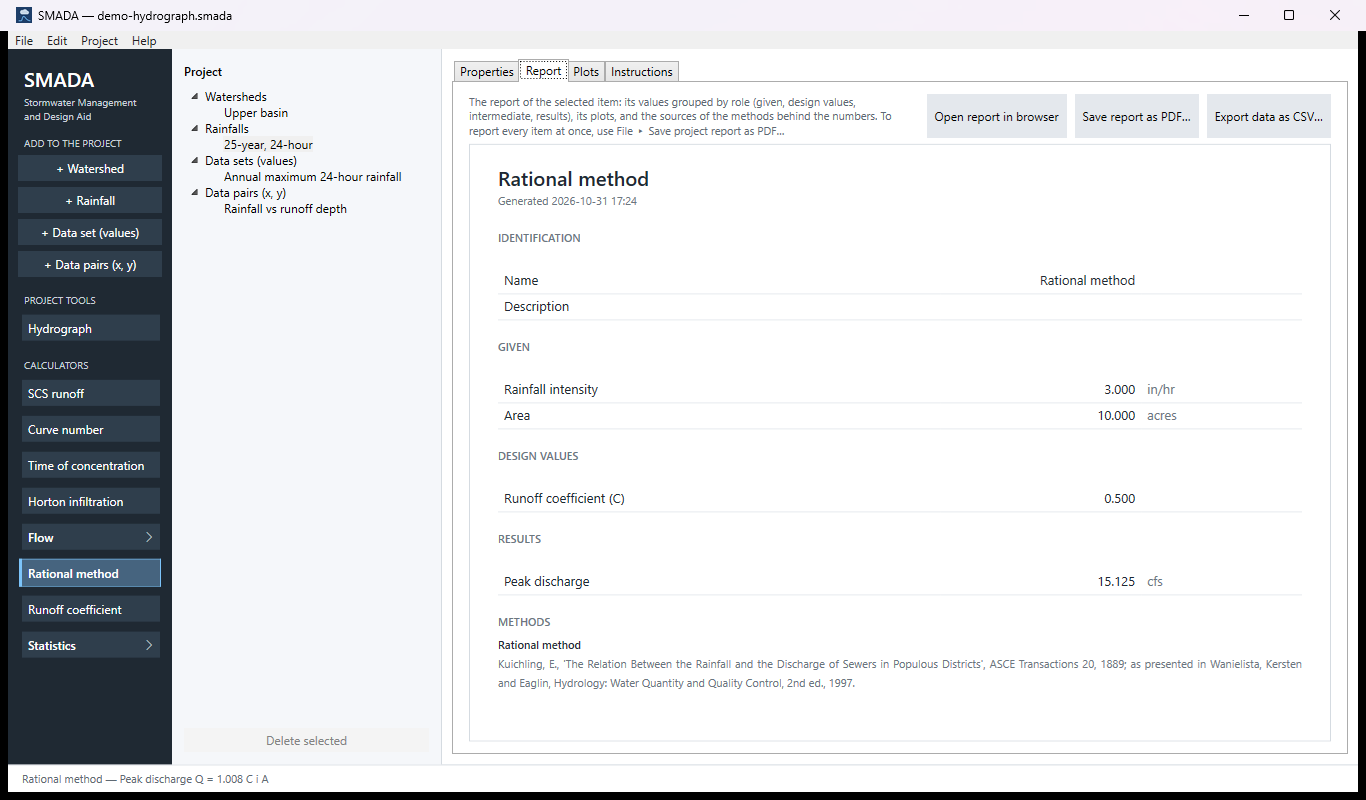
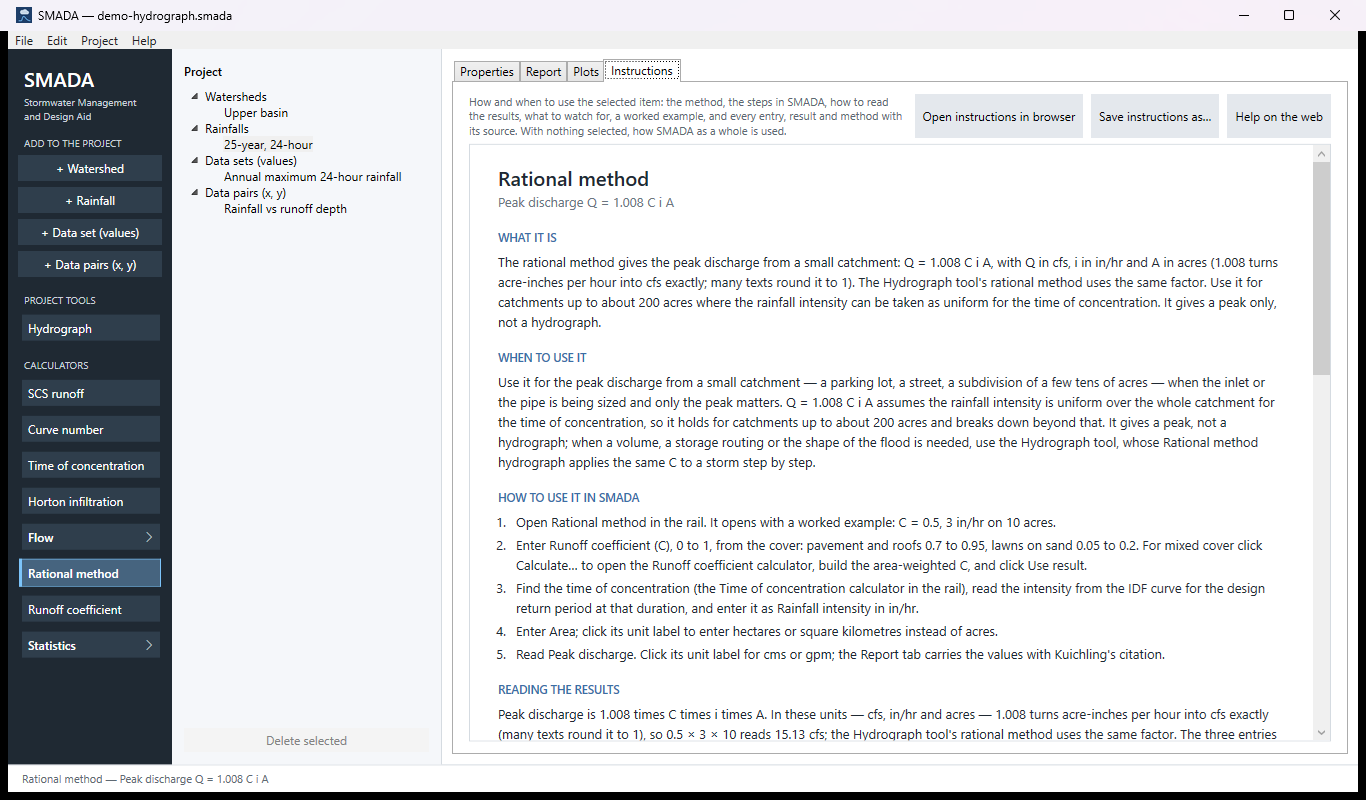
Every item in SMADA has the same four tabs. These are captured from the program with the example values it opens with; select a picture to see it full size.
Rational method has nothing to draw, so its Plots tab is empty and is not shown.
Properties tab — where you enter values and read the results
Report tab — the same values as a report, ready for HTML, PDF or CSV
Instructions tab — the manual page in the program
How it calculates
Peak discharge
The calculator evaluates one equation, directly, whenever an entry changes:
Q = 1.008 C i A
- Q
- peak discharge, cfs
- 1.008
- unit factor, cfs per acre·in/hr (43,560 / 12 / 3,600 = 1.00833, used unrounded)
- C
- runoff coefficient, dimensionless, 0 to 1
- i
- rainfall intensity for a duration equal to the time of concentration, in/hr
- A
- drainage area, acres
The factor is exact: one acre of rain falling at one inch per hour is 43,560 ft² × (1/12) ft / 3,600 s = 1.00833 cfs. Many texts round it to 1 and write Q = C i A; SMADA keeps it, so its peak is 0.8 % above the rounded form. The Hydrograph tool's rational method uses the same factor (its triangular unit hydrograph delivers 645.33 / 640 = 1.008 C i A for a steady intensity lasting the time of concentration), so the two tools give the same peak from the same C, i and A.
Units
- The calculation is done in cfs, in/hr and acres. Each entry is stored in those base units and shown in the unit beside it.
- The area can be entered in hectares or square kilometres (click the unit label); SMADA converts it to acres before multiplying.
- The intensity can be entered in in/hr, cm/hr or mm/hr (click the unit label); SMADA converts it to in/hr before multiplying.
- The peak is computed in cfs and can be shown in cms or gpm by clicking its unit label. Because the factor is exact, the m³/s shown equals the SI form Q = C i A / 3.6×10⁶ (i in mm/hr, A in m²).
- The report labels carry no unit; the units column beside each value gives it.
What it does not do
- It does not find the intensity. Compute the time of concentration first (the Time of concentration calculator), then read i from the IDF curve for your return period at that duration, and type it in.
- It applies no frequency factor. For return periods beyond about 10 years, practice multiplies C by a frequency factor of 1.1 to 1.25; do that yourself if your design standard calls for it.
- It does not check the area. Above about 200 acres the uniform-intensity assumption fails and the method overstates the peak; move to a hydrograph.
- It gives a peak only, with nothing about runoff volume or when the peak arrives.
Because Q is linear in each entry, doubling any one of C, i or A doubles the peak.
Checking the example by hand
The opening example, C = 0.5, i = 3 in/hr, A = 10 acres: C i A = 15, and Q = 1.00833 × 15 = 15.125 cfs (about 15.13). With the C of 0.4125 that the Runoff coefficient calculator gives for 6 acres of residential lawn and shrubs (good, group B) and 2 acres of pavement and roofs, on those 8 acres, Q = 1.00833 × 0.4125 × 3 × 8 = 9.98 cfs.
Sources
- Kuichling, E., "The Relation Between the Rainfall and the Discharge of Sewers in Populous Districts", ASCE Transactions 20, 1889; as presented in Wanielista, Kersten and Eaglin, Hydrology: Water Quantity and Quality Control, 2nd ed., 1997.
All SMADA calculators · Get SMADA free for Windows from the Microsoft Store