Time of concentration
Computes the time of concentration by seven published formulas (FAA, Izzard, Kerby, kinematic wave, Kirpich, Bransby-Williams and NRCS lag) from one flow path, so you can compare them and pick the one to use.
What it is for
The time of concentration (Tc) is the time runoff takes to travel from the hydraulically most distant point of a watershed to its outlet. It sets the timing and the peak of a hydrograph, and it is the storm duration at which the rational method reads its rainfall intensity. There are many published formulas for it, and they disagree, often by a factor of two or more. This calculator works out seven of them from one set of entries and shows them side by side, so you can see the spread before you choose.
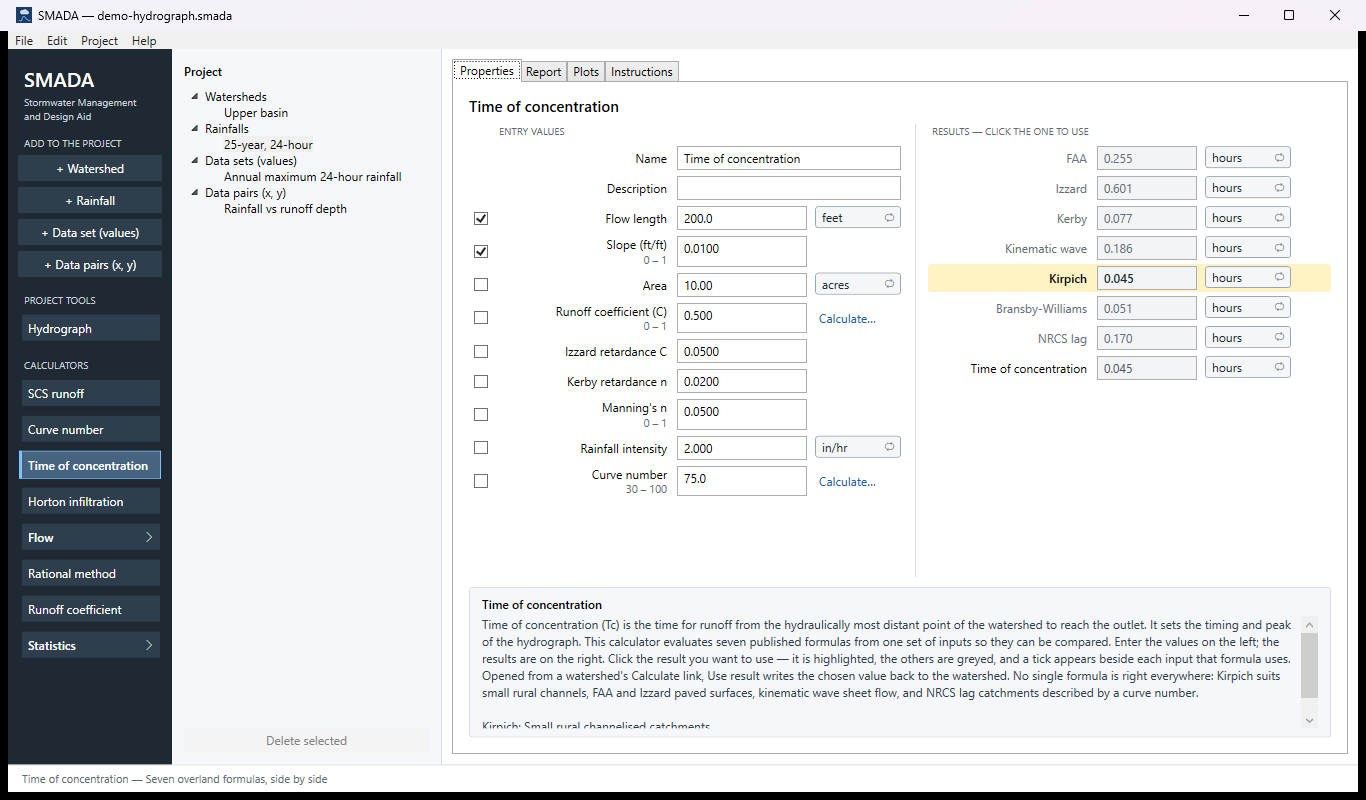
You enter the Flow length and the average Slope (ft/ft) along the path, which every formula uses, and then the values the individual formulas need: the Area (Bransby-Williams), the Runoff coefficient (C) (FAA), the Izzard retardance C, the Kerby retardance n, Manning's n and the Rainfall intensity (kinematic wave; Izzard also uses the intensity), and the Curve number (NRCS lag). The intensity is entered in the rate unit shown beside it (in/hr, cm/hr or mm/hr). The help panel under the form gives typical values for each surface.
You get seven times of concentration, in hours to three decimals (click the unit label to read minutes). Click the one you want to use: it is highlighted, the others grey out, and a tick appears beside each entry that formula depends on. The clicked result becomes the calculator's Time of concentration.
Opened from a watershed's Calculate link, the calculator starts from that watershed's total area and curve number, and Use result writes the chosen time back to the watershed, where the hydrograph methods use it. The Calculate links beside Runoff coefficient (C) and Curve number open the Runoff coefficient and Curve number calculators, so those entries can be built from the covers.
The Time of concentration tabs
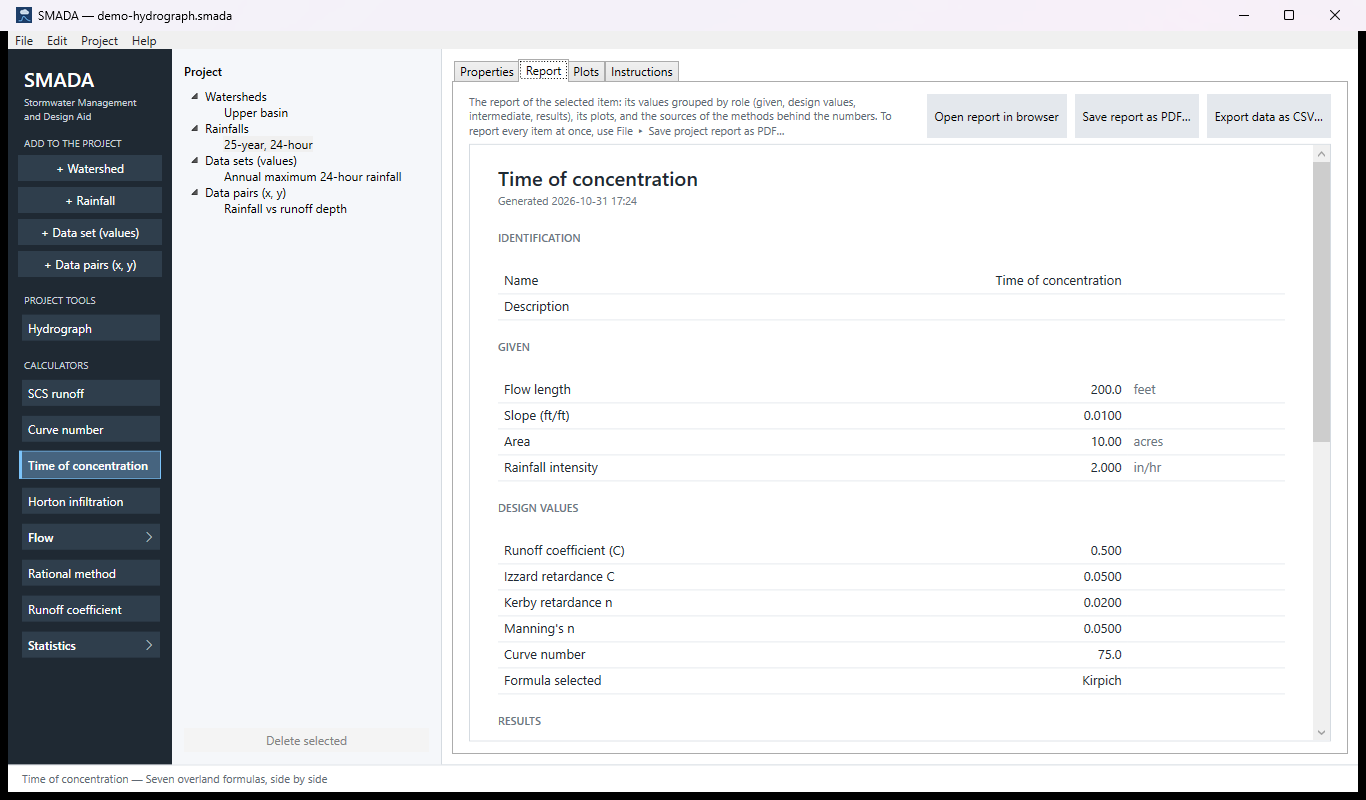
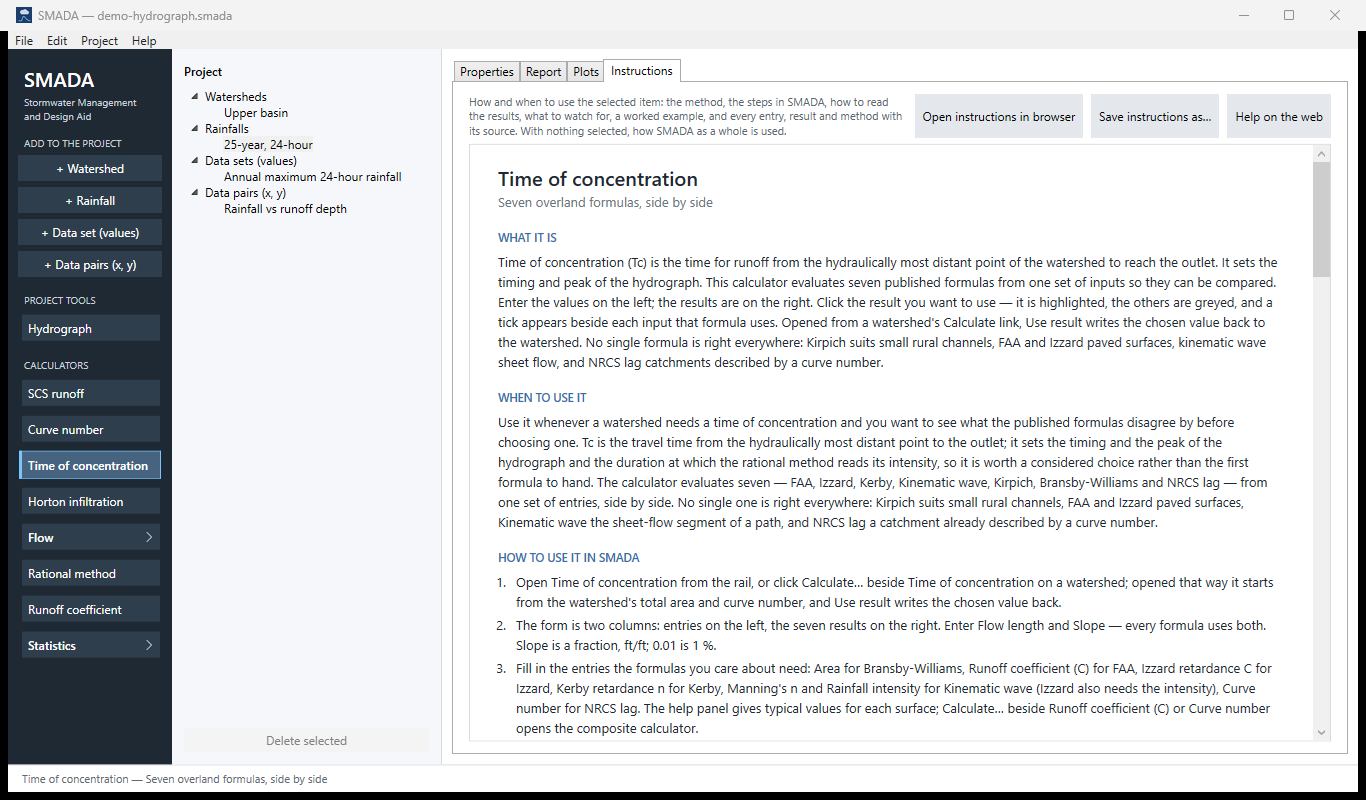
Every item in SMADA has the same four tabs. These are captured from the program with the example values it opens with; select a picture to see it full size.
Time of concentration has nothing to draw, so its Plots tab is empty and is not shown.
Properties tab — where you enter values and read the results
Report tab — the same values as a report, ready for HTML, PDF or CSV
Instructions tab — the manual page in the program
How it calculates
How the seven are evaluated
Every time an entry changes, SMADA runs all seven formulas, one after the other, from the same entries. Each formula is a separate method that reads only the entries it declares and writes only its own result, so one formula can never overwrite another's. Then the Time of concentration is set to the result of the formula you clicked (Kirpich when the calculator first opens).
The published formulas give minutes. SMADA works each one out in minutes, exactly as published, and divides by 60 at the end, because hours are SMADA's base unit of time. The NRCS lag relation is the exception: it is published in hours and stays in hours. Slope is always entered as a fraction (ft/ft); the formulas published with slope in percent multiply it by 100 inside. Length is worked in feet, area in acres (Bransby-Williams converts it to square miles) and intensity in in/hr: if you enter the intensity in cm/hr or mm/hr, or the length and area in metric units, SMADA converts them before the formulas run.
Two checks apply to every formula:
- If an entry the formula uses is blank, its result is blank.
- If the flow length or the slope is zero or negative, or a formula's own coefficient (C, retardance, n, intensity, area or curve number) is zero or negative, the result is 0 rather than an error.
No formula is solved iteratively inside SMADA: each is a closed-form expression evaluated once. See the note on rainfall intensity below.
FAA (Federal Aviation Administration)
Developed for airfield drainage and used for paved and urban overland flow.
Tc = 1.8 (1.1 − C) L1/2 / (100 S)1/3
- Tc
- time of concentration, minutes (divided by 60 for hours)
- C
- rational runoff coefficient, dimensionless, 0 to 1
- L
- flow length, ft
- S
- slope, ft/ft (so 100 S is the slope in percent)
A negative result (C above 1.1) is set to 0.
Izzard
From Izzard's laboratory work on shallow overland flow over paved and turfed surfaces.
K = (0.0007 i + c) / S1/3
Tc = 41 K L1/3 / i2/3
- K
- intermediate coefficient
- i
- rainfall intensity, in/hr
- c
- Izzard retardance coefficient, dimensionless (about 0.007 smooth asphalt, 0.012 concrete, 0.017 tar and gravel, 0.046 closely clipped sod, 0.060 dense bluegrass turf)
- S
- slope, ft/ft
- L
- flow length, ft
- Tc
- minutes
Izzard's formula is published only for i · L below 500 (i in in/hr, L in ft). SMADA still shows the Izzard result outside that range, since the other six are unaffected, but whenever i · L is 500 or more a red note above the form says so, gives the product, and suggests a shorter path or another formula.
Kerby
The Kerby-Hathaway formula for overland flow, for paths up to about 1,200 ft.
Tc = 0.83 (L n / S1/2)0.467
- L
- flow length, ft
- n
- Kerby retardance roughness, dimensionless (0.02 smooth pavement, 0.10 bare packed soil, 0.20 poor grass, 0.40 pasture or average grass, 0.60 deciduous timber, 0.80 conifer timber or dense grass)
- S
- slope, ft/ft
- Tc
- minutes
Kinematic wave
Sheet-flow travel time in which the rainfall intensity sets the flow depth. Best for the sheet-flow part of a path, up to a few hundred feet.
Tc = 0.93 L0.6 n0.6 / (i0.4 S0.3)
- L
- flow length, ft
- n
- Manning's roughness for sheet flow (0.011 smooth concrete, 0.05 short grass, 0.15 dense grass, 0.24 bluegrass sod, 0.40 light woods)
- i
- rainfall intensity, in/hr
- S
- slope, ft/ft
- Tc
- minutes
The constant 0.93 is the one in the cited textbook (Wanielista, Kersten and Eaglin). FHWA HEC-22 prints 0.933 and Ragan and Duru (1972) round it to 0.94; the differences are under 1 %.
Kirpich
From small rural Tennessee catchments with defined channels. It needs only length and slope, so it is the common first estimate. It tends to run short on flat or grassed paths.
Tc = 0.0078 L0.77 / S0.385
- L
- flow length, ft
- S
- slope, ft/ft
- Tc
- minutes
Bransby-Williams
A catchment-scale formula that brings in the drainage area as well as length and slope. SMADA converts the length to miles and the area to square miles before applying it.
Lmi = L / 5280
Ami = A / 640
Tc = 21.3 Lmi / (Ami0.1 S0.2)
- L
- flow length, ft
- Lmi
- flow length, miles
- A
- drainage area, acres
- Ami
- drainage area, square miles
- S
- slope, ft/ft
- Tc
- minutes
The constant 21.3 is the metric form 14.6 L / (A0.1 S0.2) (L in km, A in km²) carried into miles and square miles: 14.6 × 1.609 / 2.5900.1 = 21.3. The result is not sensitive to the area, which enters only to the tenth power.
NRCS lag
The NRCS (SCS) watershed lag relation, for catchments described by a curve number, up to about 2,000 acres. The lag is converted to a time of concentration with the NRCS ratio lag = 0.6 Tc.
S′ = (1000 / CN) − 10
lag = L0.8 (S′ + 1)0.7 / (1900 Y1/2)
Tc = lag / 0.6
- CN
- SCS curve number, 30 to 100
- S′
- potential maximum retention, in
- L
- flow length, ft
- Y
- slope in percent (100 S)
- lag
- watershed lag, hours
- Tc
- hours
NEH 630 prints the conversion as Tc = 1.67 lag; dividing by 0.6, as SMADA does, gives 0.2 % less.
Choosing the result
- Click one of the seven results. SMADA records which formula you chose (reported as "Formula selected"), highlights it, greys the other six and ticks the entries that formula uses.
- Time of concentration is set equal to that formula's result and recalculated whenever an entry changes.
- Opened from a watershed, Use result writes that value to the watershed's time of concentration (Edit ▸ Undo puts the old value back). The other six are not passed on. Use result is unavailable while the chosen formula's result is blank or zero (an entry it needs is missing or zero); its tooltip then says to fill in the ticked entries or click another formula's result.
Rainfall intensity and iteration
Izzard and kinematic wave need the rainfall intensity, and the intensity should be read from the IDF curve at a duration equal to the time of concentration, which is what you are computing. SMADA does not iterate this for you, because it holds no IDF curve: it uses the intensity you type. To do it properly, guess an intensity, read the Tc, read a new intensity from the IDF curve at that duration, enter it, and repeat until the two agree.
Departures from SMADA 10
- SMADA 10 showed the FAA result in the Kerby column. Each formula is now its own method and cannot write another's result.
- SMADA 10's Izzard routine lost its exponents to integer division (1/3 evaluated to 0), so length, slope and intensity dropped out. The published exponents now apply.
- SMADA 10 returned minutes into a value the rest of the program read as hours. Every formula now returns hours.
- SMADA 10 fed Bransby-Williams the area in acres, which made every result 6400.1 = 1.91 times too short. The area is now converted to square miles.
Checking the example by hand
With the opening entries (L = 200 ft, S = 0.01, A = 10 acres, C = 0.5, Izzard c = 0.05, Kerby n = 0.02, Manning's n = 0.05, i = 2 in/hr, CN = 75):
- FAA: 1.8 × 0.6 × 2000.5 / 11/3 = 1.08 × 14.142 = 15.27 minutes.
- Izzard: K = (0.0014 + 0.05) / 0.011/3 = 0.0514 / 0.2154 = 0.2386; Tc = 41 × 0.2386 × 2001/3 / 22/3 = 41 × 0.2386 × 5.848 / 1.587 = 36.04 minutes. Here i · L = 400, inside the published range, so no note appears.
- Kerby: L n / S1/2 = 200 × 0.02 / 0.1 = 40; Tc = 0.83 × 400.467 = 4.65 minutes.
- Kinematic wave: 0.93 × 2000.6 × 0.050.6 / (20.4 × 0.010.3) = 0.93 × 24.02 × 0.1657 / (1.320 × 0.2512) = 11.17 minutes.
- Kirpich: 0.0078 × 2000.77 / 0.010.385 = 0.0078 × 59.13 / 0.1698 = 2.72 minutes.
- Bransby-Williams: Lmi = 0.03788, Ami = 0.015625; Tc = 21.3 × 0.03788 / (0.6598 × 0.3981) = 3.07 minutes.
- NRCS lag: S′ = 1000/75 − 10 = 3.333 in; lag = 2000.8 × 4.3330.7 / (1900 × 1) = 0.1018 hours; Tc = 0.1018 / 0.6 = 0.170 hours (10.2 minutes).
| Formula | Minutes | Hours (as shown) |
|---|---|---|
| FAA | 15.27 | 0.255 |
| Izzard | 36.04 | 0.601 |
| Kerby | 4.65 | 0.077 |
| Kinematic wave | 11.17 | 0.186 |
| Kirpich | 2.72 | 0.045 |
| Bransby-Williams | 3.07 | 0.051 |
| NRCS lag | 10.18 | 0.170 |
Kirpich is selected when the calculator opens, so the Time of concentration is 0.045 hours.
Sources
- Wanielista, Kersten and Eaglin, Hydrology: Water Quantity and Quality Control, 2nd ed., Wiley, 1997, Chapter 5 (Time of concentration). FAA, Izzard, Kerby, kinematic wave, Kirpich and Bransby-Williams.
- USDA NRCS, National Engineering Handbook, Part 630 Hydrology, Chapter 15 (Time of Concentration), 2010. NRCS lag.
All SMADA calculators · Get SMADA free for Windows from the Microsoft Store