
All programs › BMPFast › Sample problems
Retention efficiency from the tables: Zone 2, 1.2 in
CN 75, DCIA 25 %, 1.2 in in Zone 2, against the worksheet.
Help: Retention Efficiency Lookup Tables (help page 4325) · Download the .bmpt · Link to Solution in BMPFast Version 2
1The problem
A 10-acre subdivision in Zone 2 (CN 75, DCIA 25 %). Read the capture of a 1.2-inch treatment depth from the tables, then check it on the Retention worksheet.
| Input | Value | Source |
|---|---|---|
| Project (General Site Information) | ||
| Meteorological zone | Florida Zone 2 | Zone map (help page 815) |
| Mean annual rainfall | 50 in | Mean annual rainfall map (help page 815) |
| Performance standard (analysis type) | BMP Analysis | Site (illustrative) |
| Catchment 1: Subdivision (Watershed Characteristics) | ||
| Land use, pre / post | Agricultural - Pasture / Single-Family | Site (illustrative) |
| Area, pre / post | 10 / 10 ac | Site (illustrative) |
| Non-DCIA curve number, pre / post | 61 / 75 | Site (illustrative) |
| DCIA, pre / post | 0 / 25 % | Site (illustrative) |
| EMC TN, pre / post | 3.030 / 1.770 mg/L | BMPFast land use table (AH Vol I Table 9.2) |
| EMC TP, pre / post | 0.593 / 0.327 mg/L | BMPFast land use table (AH Vol I Table 9.2) |
Find: the capture efficiency from the tables, and the same value from the Retention worksheet.
2Steps in BMPFast
Open Tools › Retention Efficiency Lookup Tables. Choose the zone, type the non-DCIA CN, the DCIA and the treatment depth, and press Find (the table button). The box shows the efficiency read from the tables, interpolated between the depths that bound the one typed.
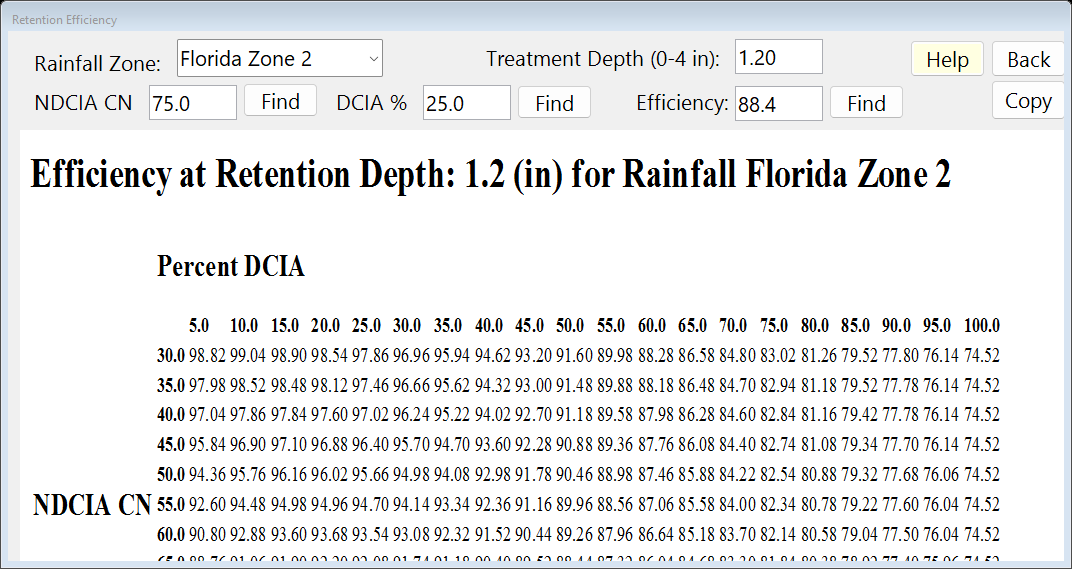
Retention Efficiency Lookup Tables (Tools). On the Retention worksheet of a catchment with the same CN and DCIA, type the volume that gives that depth (1.0 ac-ft) and press Calculate. Press Save Project to keep your copy; compare it with the .bmpt under Files.
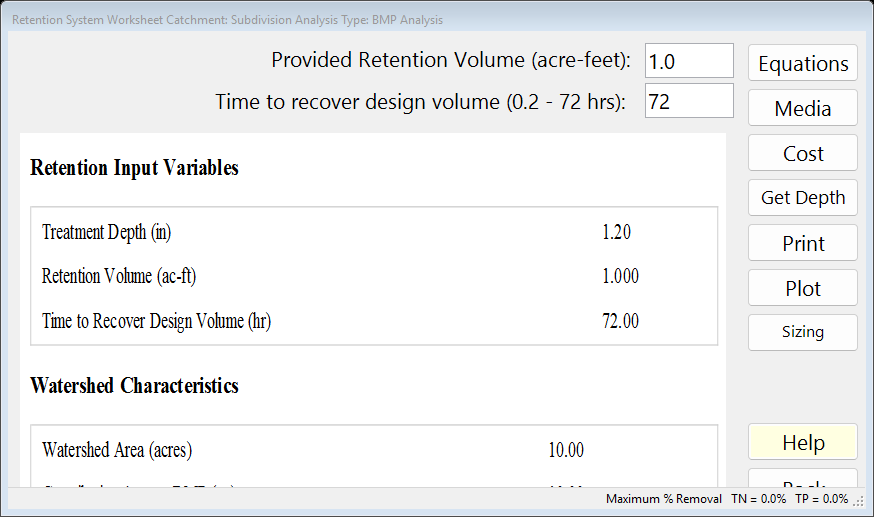
The BMP worksheet after Calculate: the report on the left.
3Results
| Result | Value |
|---|---|
| Efficiency from the lookup tables | 88.4 % |
| Retention worksheet: treatment depth | 1.200 in |
| Retention worksheet: capture | 88.40 % |
The table the window shows
4Check
Same tables, same answer. The lookup window gives 88.4 % and the worksheet, at 1.200 in, gives 88.40 %. Between two tabulated depths the program interpolates linearly; between CN and DCIA rows and columns it interpolates too (AH Vol I Appendix O; help page 4325).
5Files
- lookup-table-zone2.bmpt: the project, saved by BMPFast. Save it (your browser puts it in Downloads). In BMPFast press Open Project, then Open Project again in the Open BMPFast Project dialog (below its Recent Projects list), and choose the file.
- Lookup table (as BMPFast shows it)
- Summary Report (as BMPFast shows it)
- BMP report (worksheet) (as BMPFast shows it)
6Help and methodology
Calculated with BMPFast 1.1.9 (build 6.0.0, 2026-10-16). Older versions may not have the Equations button or may give slightly different results; download the latest at bmpfast.com. Screen captures are for demonstration only.