
A retention basin followed by a wet detention pond can be calculated several ways. BMPFast has its own method for this pair in BMPs in Series; the routing, and Equation 9-5 of the Applicant’s Handbook, give others. This page solves one problem by each and compares them over a range of basin sizes.
Every number on this page was calculated by the BMPFast program (the Release build of October 16, 2026). A method that BMPFast does not run is put together from the program’s own results, as each section says.
The problem
Example Problem 5 (a BMPFast test project): a 6 ac highway catchment in Florida Zone 5, Non-DCIA Curve Number 80, DCIA 60 %, 61 in of rain a year; 13.90 ac-ft/yr of runoff carrying 21.43 kg/yr of nitrogen and 2.966 kg/yr of phosphorus. BMP 1 is a retention basin of 0.313 ac-ft (0.7512 in over 5 ac). BMP 2 is a wet pond with a permanent pool of 3.809 ac-ft and a littoral zone, no MAPs credit.
The basin on its own removes e = 62.14 % (the retention curves at its Treatment Depth). It lets 5.26 ac-ft/yr of runoff go on to the pond: 13.90 x (100 – 62.14) / 100.
The method BMPFast uses (BMPs in Series)
The pond’s residence time comes from the water the basin lets through. The pond’s removal D at that residence time is then reduced by an adjustment factor before it is added to the basin’s removal.
Effective residence time (days) = pool / runoff passed on x 365      (no 200-day limit is applied here)
Pond contribution N (%) = (100 - e) x (D_N / 100 - 10 / 100 x e / 100)
Pond contribution P (%) = (100 - e) x (D_P / 100 - 20 / 100 x e / 100)      (neither below 0)
Removal of the two (%) = e + pond contribution
Example: residence time = 3.809 / 5.26 x 365 = 264.1 days;  D_N = 43.04 %, D_P = 82.29 %
N: (100 - 62.14) x (0.4304 - 0.10 x 0.6214) = 13.94;  62.14 + 13.94 = 76.08 %
P: (100 - 62.14) x (0.8229 - 0.20 x 0.6214) = 26.45;  62.14 + 26.45 = 88.59 %
Applicant’s Handbook reference
Appendix O, Wet Detention: residence time is the permanent pool volume divided by the annual runoff inputs, times 365, with the TN and TP percent removal equations, up to 200 days; BMPFast takes the inputs as the water the basin lets through.
Section 9.5.1 Treatment Train Nutrient Reduction: Equation 9-5, 1 − [(1 − Eff1) × (1 − Eff2)], combines BMPs that act independently; where a BMP acts in combination with the one upstream, “the designer should consider the use of another methodology”.
Source reference
BMPFast’s method, from the BMPTrains model: the adjustment factors 10 (N) and 20 (P) come from the BMPTrains model and are marked “Temporary N/P Adjustment Factor” in the code (MultipleBMP.RouteRetentionToWetDetention); no published source for them has been found. The pond equations are Harper and Baker’s (Harper, H.H. and Baker, D.M. (2007), Evaluation of Current Stormwater Design Criteria within the State of Florida, final report, FDEP Contract S0108, Environmental Research & Design).
B. Routing: the pond in a catchment of its own
The basin’s catchment is routed (Routing) to a catchment with no area of its own and only the wet pond. The program then calculates the pond with the water the basin lets through (with the 200-day limit), and chains the two removals by Equation 9-5. These figures are the program’s own routing results.
Residence time (days) = pool / runoff passed on x 365   (200 days at most)
Removal of the two (%) = e + D x (1 - e / 100)
Example: residence time = 264.1 -> 200.0 days;  D_N = 42.81 %, D_P = 79.87 %
N: 62.14 + 42.81 x (1 - 0.6214) = 78.35 %;   P: 62.14 + 79.87 x (1 - 0.6214) = 92.38 %
C. Equation 9-5 with the pond on its own
Each BMP keeps the removal its own worksheet shows. The pond’s residence time is then from all the catchment’s runoff, as if the basin were not there. BMPFast does not run this; it is put together from the program’s basin removal and the pond’s stand-alone removal.
Residence time (days) = 3.809 / 13.90 x 365 = 100.0 days;  D_N = 41.91 %, D_P = 73.99 %
N: 62.14 + 41.91 x (1 - 0.6214) = 78.01 %;   P: 62.14 + 73.99 x (1 - 0.6214) = 90.15 %
The methods compared
| Method | Pond residence time (days) | N removal (%) | P removal (%) | N out (kg/yr) | P out (kg/yr) |
|---|---|---|---|---|---|
| BMPFast (BMPs in Series) | 264.1 | 76.1 | 88.6 | 5.13 | 0.338 |
| B. Routing, Equation 9-5 | 200.0 | 78.3 | 92.4 | 4.64 | 0.226 |
| C. Equation 9-5, pond on its own | 100.0 | 78.0 | 90.2 | 4.71 | 0.292 |
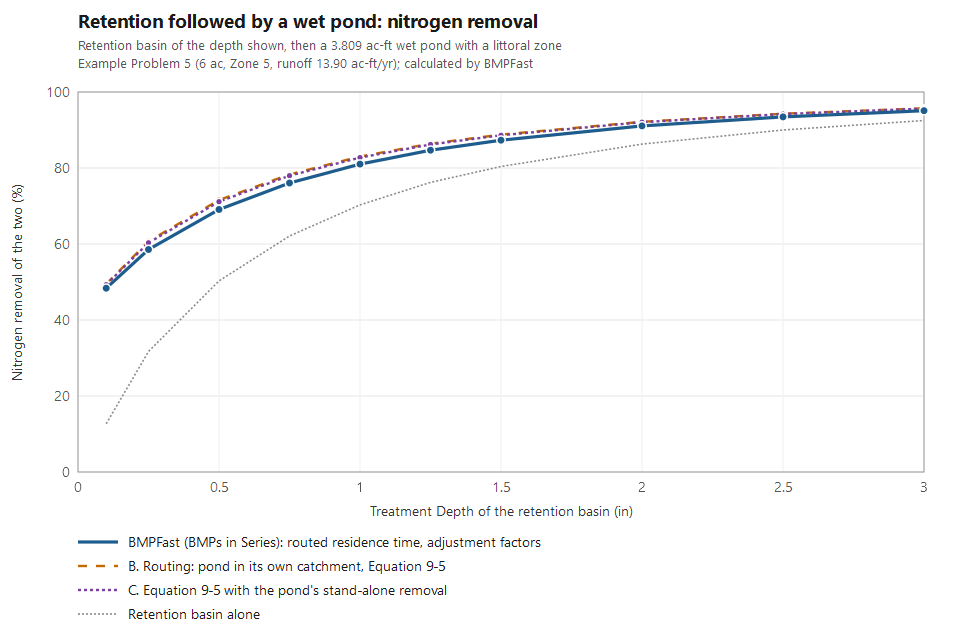
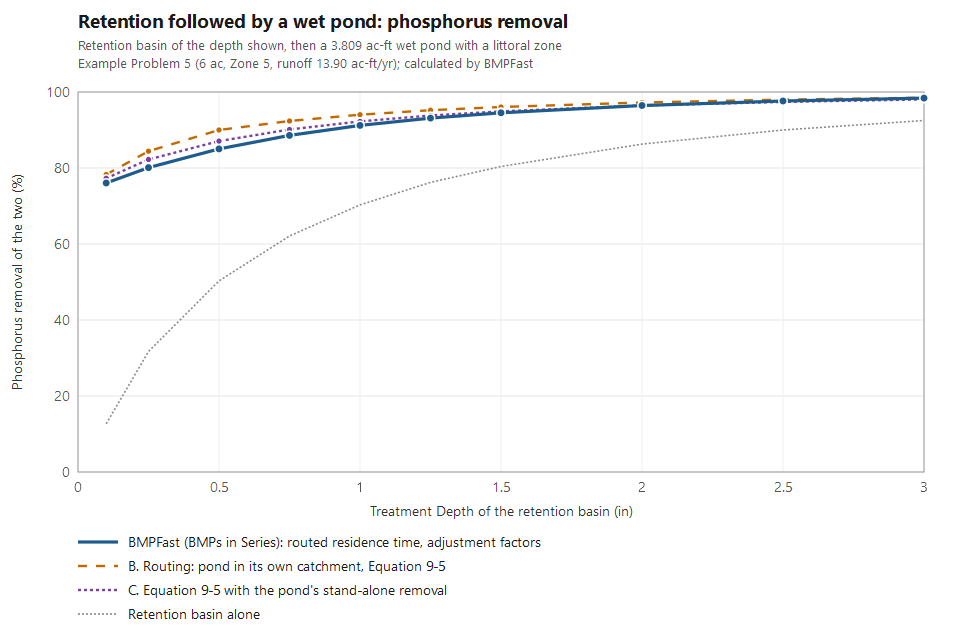
Over a range: the pond stays the same and the basin goes from 0.1 to 3 in.
| Basin Treatment Depth (in) | Basin e (%) | Pond residence time, BMPFast (days) | BMPFast N / P (%) | B. Routing N / P (%) | C. Pond on its own N / P (%) |
|---|---|---|---|---|---|
| 0.1 | 12.7 | 115 | 48.4 / 76.1 | 49.5 / 78.3 | 49.3 / 77.3 |
| 0.25 | 31.7 | 146 | 58.5 / 80.1 | 60.7 / 84.4 | 60.3 / 82.2 |
| 0.5 | 50.3 | 201 | 69.1 / 85.0 | 71.6 / 90.0 | 71.1 / 87.1 |
| 0.75 | 62.1 | 264 | 76.1 / 88.6 | 78.3 / 92.4 | 78.0 / 90.1 |
| 1 | 70.3 | 337 | 81.0 / 91.2 | 83.0 / 94.0 | 82.7 / 92.3 |
| 1.25 | 76.2 | 420 | 84.7 / 93.1 | 86.4 / 95.2 | 86.2 / 93.8 |
| 1.5 | 80.4 | 510 | 87.3 / 94.5 | 88.8 / 96.1 | 88.6 / 94.9 |
| 2 | 86.3 | 730 | 91.1 / 96.5 | 92.2 / 97.2 | 92.0 / 96.4 |
| 2.5 | 90.0 | 1000 | 93.5 / 97.6 | 94.3 / 98.0 | 94.2 / 97.4 |
| 3 | 92.5 | 1333 | 95.1 / 98.4 | 95.7 / 98.5 | 95.6 / 98.0 |
What the comparison shows
- BMPFast’s method gives less removal than the routing (B) at every basin size: 0.6 to 2.5 percentage points less nitrogen and 0.1 to 5.0 less phosphorus. The adjustment factors take 10 % (N) and 20 % (P) of the basin’s removal off the pond’s removal, so the pond adds less the more the basin removes.
- Against C, BMPFast’s method gives less nitrogen at every size and less phosphorus up to about 1.5 in; for larger basins its long, unlimited residence time gives it slightly more phosphorus than C (a few tenths of a point).
- B and C differ only in the pond’s residence time. With the basin upstream the pond receives less water, so its residence time is longer and its removal a little higher (B); C ignores the basin when it works out the pond.
- In BMPFast’s method the pond’s residence time is not limited to 200 days: at the worked example it is 264.1 days, so the pond’s P removal is 82.3 % against 79.9 % at the 200-day limit. The routing (B) applies the limit.
- All three agree that the basin does most of the work: the pond adds 13 to 16 points of nitrogen at the worked example.
Which BMPFast uses, and why. In BMPs in Series, the method above, from the BMPTrains model: the basin and pond act together (the pond receives water already treated by the basin), the case section 9.5.1 sets aside for “another methodology”. The adjustment factors make the credit conservative. The routing (B) is what BMPFast does when the pond is in another catchment. Since October 1, 2026 the same route is used when retention BMPs lead a longer series (Ron).
Related pages
- BMPs in Series: several BMPs in one catchment (Multiple BMP).
- Wet Detention: the worksheet.
- Wet Detention Methodology: residence time, the pond equations, the 200-day limit and the littoral zone.
- Routing: catchments routed one into another.
- Comparison of Methods for Calculating Retention BMPs in Series.
- Comparison of Methods for Calculating Retention Followed by a Surface Discharge Filter.
- Comparison of Methods for Calculating Wet Detention Ponds in Series.
- Comparison of Methods for Calculating the Littoral Zone Credit.