
The Applicant’s Handbook gives a wet pond with a littoral zone a “maximum 10% removal” more. It does not say whether the pond equations describe a pond with a littoral zone or one without, so the credit can be read two ways. This page shows both on one pond (Wet Detention) and over the range of residence times.
BMPFast 2 adds the credit (Ron, October 20, 2026: “This will be a 10% credit for having a littoral zone, it is no longer a penalty”): a pond with a littoral zone adds the credit the designer enters, up to 10 percentage points. BMPFast (version 1) reduces: a pond without a littoral zone gets 90 % of the equations’ removal. BMPFast 2 keeps v1’s reduction as a choice on the pond’s Entry tab, “How the littoral zone counts”.
The equations’ values and version 1’s figures were calculated by BMPFast version 1 (the Release build of October 16, 2026). The credit’s figures are the equations’ values plus 10, which is what BMPFast 2 gives with the full credit.
The problem
Example Problem 5’s wet pond: a permanent pool of 3.809 ac-ft receiving 13.90 ac-ft/yr of runoff, no MAPs credit.
Residence time = 3.809 / 13.90 x 365 = 100.0 days
N removal (equation) = 43.75 x 100.0 / (4.38 + 100.0) = 41.91 %
P removal (equation) = 40.13 + 6.372 ln(100.0) + 0.213 [ln(100.0)]^2 = 73.99 %
The method BMPFast 2 uses: a credit for a littoral zone
The equations are taken as a pond without a littoral zone. A pond without one gets the equations’ removal; a pond with one gets the credit the designer enters added to it, from 0 to 10 percentage points (10 unless a smaller littoral zone calls for less), to both nitrogen and phosphorus, and never above 100 %. The credit is added before the MAPs credit.
With a littoral zone:    removal = equation + credit   (credit 0 to 10 percentage points)
Without a littoral zone: removal = equation
Example, credit 10, with: N 51.91 %, P 83.99 %;  without: N 41.91 %, P 73.99 %
Applicant’s Handbook reference
Appendix O, Table 1 (BMP Efficiencies), Littoral Zone: gives “Maximum 10% removal with a minimum littoral zone area as described in AH Volume II”; it does not say which pond the equations describe.
Appendix O, Wet Detention: gives the TN and TP percent removal equations against the residence time.
Source reference
BMPFast 2’s reading (Ron, October 20, 2026): the equations, from Harper, H.H. and Baker, D.M. (2007), Evaluation of Current Stormwater Design Criteria within the State of Florida, final report, FDEP Contract S0108, Environmental Research & Design, are taken as a pond without a littoral zone, and a pond with one adds a credit of up to 10 percentage points, entered by the designer. The credit is taken only once in ponds in series (Ron, October 16, 2026).
BMPFast (version 1)’s method: a reduction without a littoral zone
The equations are taken as a pond with a littoral zone. A pond with one gets the equations’ removal, and a pond without one gets 90 % of it (Ron, October 5, 2026; before then it was / 1.10, which is 0.909, almost the same). BMPFast version 1 calculates this way; in BMPFast 2 it is the choice “Reduce without a littoral zone (v1)”. A v1 project opened in BMPFast 2 uses the credit, and BMPFast 2 says so when it opens it.
With a littoral zone:    removal = equation
Without a littoral zone: removal = equation x 0.90
Example, with: N 41.91 %, P 73.99 %;  without: N 37.72 %, P 66.59 %
The two methods compared
| Pond | BMPFast 2 (credit 10 with a littoral zone): N / P (%) | BMPFast v1 (x 0.90 without a littoral zone): N / P (%) | BMPFast 2 minus v1: N / P (points) |
|---|---|---|---|
| With a littoral zone | 51.9 / 84.0 | 41.9 / 74.0 | 10.0 / 10.0 |
| Without a littoral zone | 41.9 / 74.0 | 37.7 / 66.6 | 4.2 / 7.4 |
| Residence time (days) | Equations, N / P (%) (BMPFast 2 without a littoral zone = v1 with one) | BMPFast 2 with a littoral zone, equations + 10: N / P (%) | BMPFast v1 without a littoral zone, equations x 0.90: N / P (%) |
|---|---|---|---|
| 1 | 8.1 / 40.1 | 18.1 / 50.1 | 7.3 / 36.1 |
| 2 | 13.7 / 44.6 | 23.7 / 54.6 | 12.3 / 40.2 |
| 5 | 23.3 / 50.9 | 33.3 / 60.9 | 21.0 / 45.8 |
| 10 | 30.4 / 55.9 | 40.4 / 65.9 | 27.4 / 50.3 |
| 14 | 33.3 / 58.4 | 43.3 / 68.4 | 30.0 / 52.6 |
| 20 | 35.9 / 61.1 | 45.9 / 71.1 | 32.3 / 55.0 |
| 30 | 38.2 / 64.3 | 48.2 / 74.3 | 34.4 / 57.8 |
| 50 | 40.2 / 68.3 | 50.2 / 78.3 | 36.2 / 61.5 |
| 75 | 41.3 / 71.6 | 51.3 / 81.6 | 37.2 / 64.5 |
| 100 | 41.9 / 74.0 | 51.9 / 84.0 | 37.7 / 66.6 |
| 150 | 42.5 / 77.4 | 52.5 / 87.4 | 38.3 / 69.7 |
| 200 | 42.8 / 79.9 | 52.8 / 89.9 | 38.5 / 71.9 |
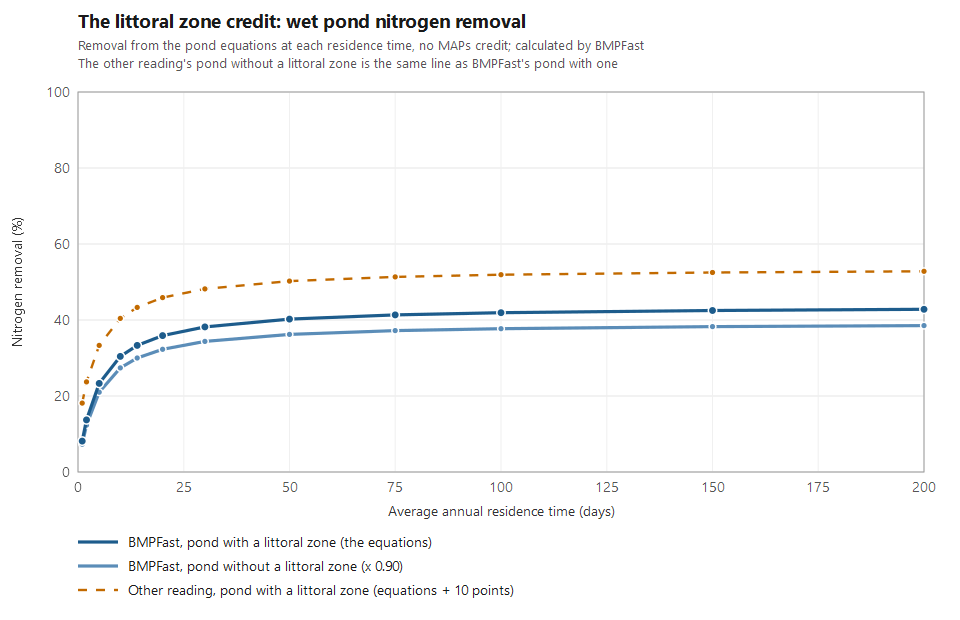
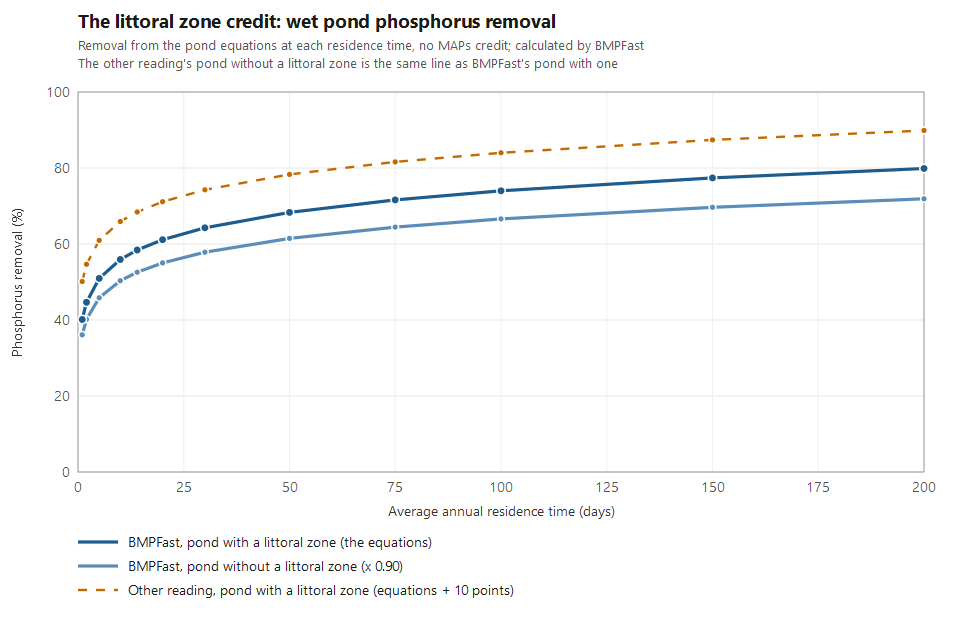
The plots below were drawn before BMPFast 2 took the credit, so their legend names the lines the old way:
- “BMPFast, pond with a littoral zone (the equations)”: version 1 with a littoral zone, and also BMPFast 2 without one.
- “BMPFast, pond without a littoral zone (x 0.90)”: version 1 without a littoral zone.
- “Other reading, pond with a littoral zone (equations + 10 points)”: BMPFast 2 with a littoral zone and the full credit.
What the comparison shows
- BMPFast 2’s credit gives every pond more removal than v1’s reduction: 10 points more with a littoral zone (at the full credit), and the equations’ value instead of 90 % of it without one (4.2 points of N and 7.4 of P on the worked example).
- With the credit a littoral zone is always worth the points entered, 10 at most. In v1’s reduction it is worth 10 % of the pond’s removal, so from under 1 point of nitrogen at 1 day to 8 points of phosphorus at 200 days.
- A pond without a littoral zone is no longer penalised: it gets the handbook’s equations, which at the 200-day limit give 42.8 % N and 79.9 % P. With the full credit the same pond reaches 52.8 % N and 89.9 % P.
Which method each version uses, and why. BMPFast 2 uses the credit (Ron, October 20, 2026): the handbook names the littoral zone as removal it adds, “Maximum 10% removal”, so the designer enters up to 10 points and gives the basis to the permit reviewer. BMPFast version 1 uses the reduction (Ron, October 5, 2026), and BMPFast 2 keeps it as a choice so a v1 result can be repeated.
Related pages
- Wet Detention: the worksheet.
- Wet Detention Methodology: residence time, the pond equations, the 200-day limit and the littoral zone.
- Comparison of Methods for Calculating Wet Detention Ponds in Series.
- Comparison of Methods for Calculating Retention Followed by Wet Detention.
- Strand Based Routing for Wet Detention in Series: ponds in series between catchments.