
A strand is a run of catchments routed one into the next, in which no catchment receives water from more than one catchment. When every catchment in the strand has a Wet Detention pond, BMPFast calculates the strand as one Detention in Series system instead of catchment by catchment. The Routing screen and the Complete Report name the method for each strand. See Routing.
This page shows the calculation BMPFast uses, the other methods that have been used or proposed, and how far apart they are on a worked example.
The method BMPFast uses
Each pond is calculated with all the runoff reaching it: its own catchment’s runoff plus the runoff of every catchment above it, which passes through the ponds above and reaches it. Its residence time is therefore the routed one, and its removal applies to all the load reaching it.
Runoff reaching pond i (ac-ft/yr) = runoff of catchment i + runoff of every catchment above it
Residence Time (days)             = Permanent Pool (ac-ft) / Runoff reaching the pond × 365   (at most 200)
N removal (%) = 43.75 × rt / (4.38 + rt)
P removal (%) = 40.13 + 6.372 ln(rt) + 0.213 [ln(rt)]²
No littoral zone: N and P removal × 0.90;  wetland credit added on the remaining load
Load leaving pond i = (load leaving the pond above + load of catchment i) × (1 − removal / 100)
The equations are Harper and Baker (2007), the same as the Wet Detention worksheet and every routing node (Wet Detention Methodology). The load leaving the last pond is the strand’s load at the outlet. The strand report (“Detention In Series – Residence Time & Effectiveness” in the Complete Report) lists, for each pond, the runoff from its catchment and the runoff reaching it, the residence time, the N and P reaching it, and the removal; its System Summary gives the load discharged, which is the outlet load. A Discovery Plot of a pond in the strand repeats this calculation at every point, so at the design value it shows what the report shows.
Applicant’s Handbook reference
Appendix O, Wet Detention: residence time is the permanent pool volume divided by the “annual runoff inputs”, times 365, with the TP and TN percent removal equations; BMPFast takes the inputs as all the runoff reaching the pond, including that of the catchments above it.
Appendix O, Wet Detention, Limits to Average Annual Residence Time throughout the State: the maximum is 200 days; BMPFast applies it to each pond.
Section 9.5.1 Treatment Train Nutrient Reduction (Equation 9-5): the loads are chained from pond to pond, which is Equation 9-5 in mass form, with each catchment’s own load added where it joins.
Worked example
The three-pond project from the BMP Trains manual (pages 190-196): catchments 1 → 2 → 3 → outlet, each with a wet pond (permanent pools 1.0, 1.25 and 2.5 ac-ft; pond 3 has no littoral zone). The catchments produce 197.2 kg/yr of nitrogen and 48.6 kg/yr of phosphorus.
| Pond | Runoff from catchment (ac-ft/yr) | Runoff reaching the pond (ac-ft/yr) | Residence time (days) | N removal (%) | P removal (%) | N leaving the pond (kg/yr) |
|---|---|---|---|---|---|---|
| 1 | 20.08 | 20.08 | 18.18 | 35.3 | 60.4 | 29.10 |
| 2 | 23.64 | 43.72 | 10.44 | 30.8 | 56.2 | 54.73 |
| 3 | 45.67 | 89.39 | 10.21 | 27.6 | 50.5 | 113.73 |
At the outlet: 113.73 kg/yr of nitrogen (42.3 % removed) and 16.17 kg/yr of phosphorus (66.7 % removed).
Other methods
A. Each pond from its own catchment’s runoff
Each pond’s residence time comes from its own catchment’s runoff only, and its removal is applied to all the load reaching it. This is what the outlet used before October 15, 2026, while the strand report showed method B, so the two disagreed. It credits a downstream pond with a residence time it does not have: pond 2 holds 1.25 ac-ft, but 43.7 ac-ft/yr flows through it, not 23.6.
Residence Time (days) = Permanent Pool / Runoff of its own catchment × 365
Removal: Harper and Baker, as above;  loads chained, as above
B. Residence time shared out by catchment (the earlier strand report)
Each catchment’s runoff is followed through every pond below it. In each pond it is given a share of that pond’s residence time in proportion to its part of the flow, and the shares are added. A different pair of equations then gives the removal, applied to the catchment’s own load only. No published source for these equations has been found. This was the strand report’s table until October 15, 2026; the outlet did not use it.
Applicant’s Handbook reference
Appendix O, Wet Detention: Method B’s equations (TN = 9.335 ln(ART) + 6.762, TP = 7.449 ln(ART) + 38.928) are not in the handbook, which gives only the TP and TN percent removal equations used above.
Pond j residence time    = Permanent Pool j / Runoff reaching pond j × 365
Catchment i's total ART  = sum over ponds j at or below i of  ART_j × Runoff_i / Runoff reaching pond j
TN removal (%) = 9.335 ln(total ART) + 6.762
TP removal (%) = 7.449 ln(total ART) + 38.928
Load removed = catchment i's own load × removal
The two pairs of equations agree near 25 days. At long residence times they part: at 200 days the strand equation gives 56.2 % nitrogen, while Harper and Baker never exceed 43.75 %.
The differences
| Method | Residence times, ponds 1 / 2 / 3 (days) | N removal (%) | P removal (%) | N at the outlet (kg/yr) | P at the outlet (kg/yr) |
|---|---|---|---|---|---|
| Used: all the runoff reaching each pond | 18.18 / 10.44 / 10.21 | 42.3 | 66.7 | 113.73 | 16.17 |
| A. Own catchment’s runoff | 18.18 / 19.30 / 19.98 | 47.4 | 70.5 | 103.69 | 14.35 |
| B. Shared-out residence time, strand equations | 25.27 / 8.34 / 5.22 (per catchment) | 26.6 | 54.8 | 144.65 | 21.96 |
Method A gives the most removal because every downstream pond is credited with a long residence time. Method B gives the least nitrogen removal: the load of an upstream catchment is treated once, at the residence time it is allotted, and the strand equations fall off quickly at short residence times. The method BMPFast uses sits between them, and it is the only one in which the strand report, the outlet and a Discovery Plot give the same numbers.
Why this method. A pond in a chain receives the water of the ponds above it, so its permanent pool is replaced faster than its own catchment alone would replace it. Calculating it with that flow is what BMPFast already does for a pond at a junction, where several catchments meet, so a strand and a junction now treat a pond the same way.
The methods over a range of pond sizes
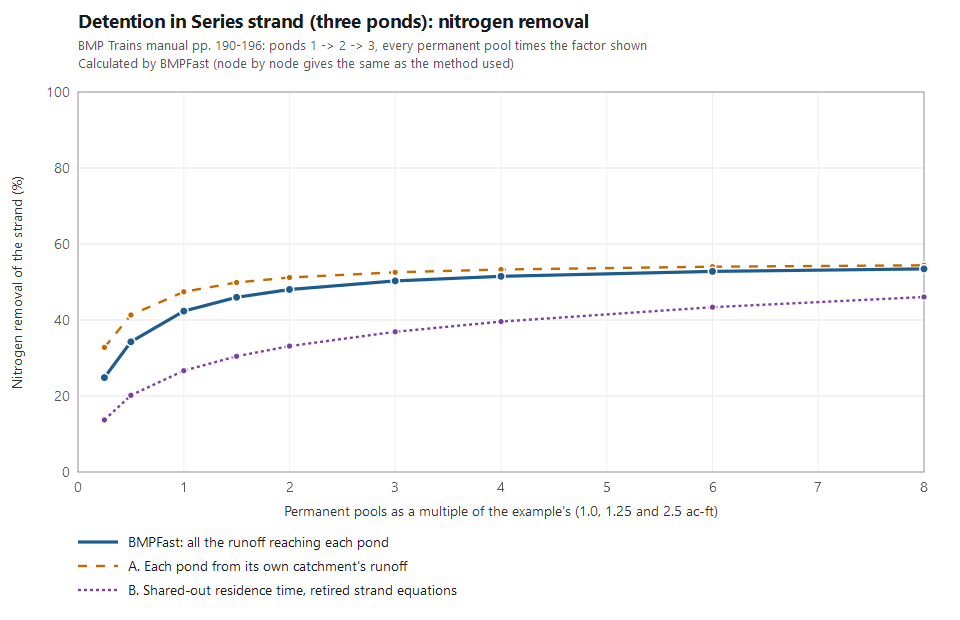
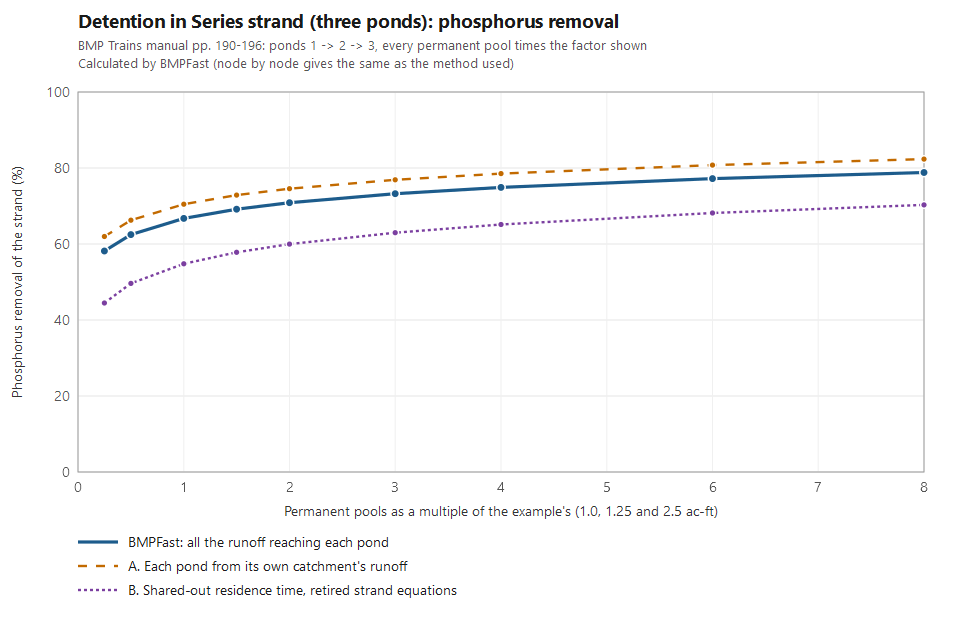
The worked example above has one size of each pond. Here every permanent pool is multiplied by the same factor, from 0.25 to 8. The method used and node by node (ComplexRouting.Calculate, the program’s other routing algorithm) were calculated by the program, and give the same numbers for ponds. A is put together from each pond’s own removal in the program (WetDetention.RemovalAtResidenceTime at its own residence time). B’s equations are no longer in the program; B is calculated from the program’s runoff and pools with the equations given above.
| Pool factor | Pools (ac-ft) | Residence times, BMPFast (days) | BMPFast N / P (%) | A. Own runoff N / P (%) | B. Retired equations N / P (%) |
|---|---|---|---|---|---|
| 0.25 | 0.25 / 0.3125 / 0.625 | 4.55 / 2.61 / 2.55 | 24.9 / 58.2 | 32.8 / 62.0 | 13.7 / 44.5 |
| 0.5 | 0.5 / 0.625 / 1.25 | 9.09 / 5.22 / 5.10 | 34.3 / 62.5 | 41.3 / 66.3 | 20.2 / 49.6 |
| 1 | 1 / 1.25 / 2.5 | 18.18 / 10.44 / 10.21 | 42.3 / 66.7 | 47.4 / 70.5 | 26.6 / 54.8 |
| 1.5 | 1.5 / 1.875 / 3.75 | 27.27 / 15.65 / 15.31 | 46.0 / 69.2 | 49.9 / 72.9 | 30.4 / 57.8 |
| 2 | 2 / 2.5 / 5 | 36.36 / 20.87 / 20.42 | 48.0 / 70.9 | 51.2 / 74.6 | 33.1 / 60.0 |
| 3 | 3 / 3.75 / 7.5 | 54.54 / 31.31 / 30.62 | 50.3 / 73.2 | 52.6 / 76.9 | 36.9 / 63.0 |
| 4 | 4 / 5 / 10 | 72.72 / 41.74 / 40.83 | 51.5 / 74.9 | 53.3 / 78.5 | 39.6 / 65.1 |
| 6 | 6 / 7.5 / 15 | 109.08 / 62.61 / 61.25 | 52.8 / 77.2 | 54.0 / 80.8 | 43.4 / 68.1 |
| 8 | 8 / 10 / 20 | 145.44 / 83.48 / 81.67 | 53.4 / 78.8 | 54.4 / 82.3 | 46.1 / 70.3 |
What the comparison shows
- Method A gives 0.9 to 7.9 points more nitrogen removal than the method used, most when the ponds are small. As the ponds grow, both approach the 200-day limit and the gap closes.
- The retired strand equations (B) give the least nitrogen removal over this whole range; for phosphorus they are lowest too. They are not Harper and Baker’s equations, and no published source for them has been found.
- Node by node gives the same numbers as the method used, because a pond at a junction is also calculated with all the runoff reaching it.
Source reference
Harper and Baker (2007): the pond equations are from Harper, H.H. and Baker, D.M. (2007), Evaluation of Current Stormwater Design Criteria within the State of Florida, final report, FDEP Contract S0108, Environmental Research & Design, the source cited in Appendix O. Calculating each pond in a strand with all the runoff reaching it is BMPFast’s method (Ron, October 15, 2026, plan 6.81).
Sample problems
Worked problems solved in BMPFast, each with every input, the steps with screen captures, the program’s results, a hand check and the project file to download. Captures are for demonstration only. All of them: BMPFast sample problems.
- Routing: untreated catchment into a retention basin
- Routing: wet ponds in series (2020 manual)
- Routing: two subdivisions joining at a wet pond
- Reports: AH Vol I Section 9 compliance report
Related pages
- Routing: how runoff moves between catchments, and what a strand is.
- Wet Detention Methodology: residence time and the pond equations.
- Retention Methodology and Retention BMPs: the retention curves and each BMP’s Treatment Depth.
- BMPs in Series: several BMPs in one catchment (Multiple BMP).
- Discovery Plots Methodology: plots that repeat the whole routing.
- Comparison of Methods for Calculating Wet Detention Ponds in Series.
- Comparison of Methods for Calculating the Littoral Zone Credit.