
A retention basin followed by a Surface Discharge Filter (Surface Discharge Filter) in BMPs in Series can be calculated two ways. BMPFast combines the two by Equation 9-5. The other way treats the basin and the filter as one storage, as BMPFast does for retention BMPs in series. This page solves one problem both ways and compares them over a range of filter sizes.
Every number on this page was calculated by the BMPFast program (the Release build of October 16, 2026). A method that BMPFast does not run is put together from the program’s own results, as each section says.
The problem
Example Problem 5 (a BMPFast test project): a 6 ac highway catchment in Florida Zone 5, Non-DCIA Curve Number 80, DCIA 60 %, 61 in of rain a year. BMP 1 is a retention basin of 0.313 ac-ft, a Treatment Depth of 0.7512 in. BMP 2 is a Surface Discharge Filter with a Treatment Depth of 0.5 in and B&G CTS12 media, which removes 60 % of the nitrogen and 90 % of the phosphorus in the water it filters (Media and Filtration Methodology).
Basin capture e = retention curves at 0.7512 in = 62.14 %
Filter capture  = retention curves at 0.5 in = 50.30 %
Filter on its own: N 50.30 x 60 / 100 = 30.18 %;  P 50.30 x 90 / 100 = 45.27 %
The method BMPFast uses: Equation 9-5
The filter keeps its own removal, and removes that share of what the basin lets through.
Removal (%) = e + filter removal x (1 - e / 100)
N: 62.14 + 30.18 x (1 - 0.6214) = 73.57 %
P: 62.14 + 45.27 x (1 - 0.6214) = 79.28 %
Applicant’s Handbook reference
Section 9.5.1 Treatment Train Nutrient Reduction: Equation 9-5, 1 − [(1 − Eff1) × (1 − Eff2)], combines BMPs that act independently; where a BMP acts in combination with the one upstream, “the designer should consider the use of another methodology”.
Appendix O, Detention with Engineered Media and Filtration: the efficiency is the detention efficiency for the water detained plus the volume filtered and not detained times the media efficiency; BMPFast takes the filtered share from the retention curves at the filter’s Treatment Depth.
Source reference
BMPFast’s method: the filter’s removal is taken as independent of the volume reaching it, provided the filter is built at least to the area Filter Sizing gives for the water the basin discharges (MultipleBMP.RouteRetentionToFiltration, FilterSizing).
B. Treatment Depths added
The basin and the filter are one storage holding the first (basin depth + filter depth) inches of each storm. The basin holds the first part; the filter captures the next part, between the basin’s depth and the sum, and removes the media’s share of it. BMPFast does not run this; it is put together from the program’s retention curve and media reductions.
Removal (%) = C(basin depth) + [C(basin depth + filter depth) - C(basin depth)] x media reduction / 100
C(0.7512 + 0.5 = 1.2512 in) = 76.22 %
N: 62.14 + (76.22 - 62.14) x 0.6 = 70.59 %
P: 62.14 + (76.22 - 62.14) x 0.9 = 74.81 %
Source reference
A method proposed for comparison: B extends BMPFast’s rule for retention BMPs in series (Treatment Depths added) to a filter after a basin. It is not in the handbook or the BMPTrains model; it is the same question as filters in series (plan 7.1, for Ron to decide).
The two methods compared
| Method | N removal (%) | P removal (%) |
|---|---|---|
| BMPFast: Equation 9-5 | 73.6 | 79.3 |
| B. Treatment Depths added | 70.6 | 74.8 |
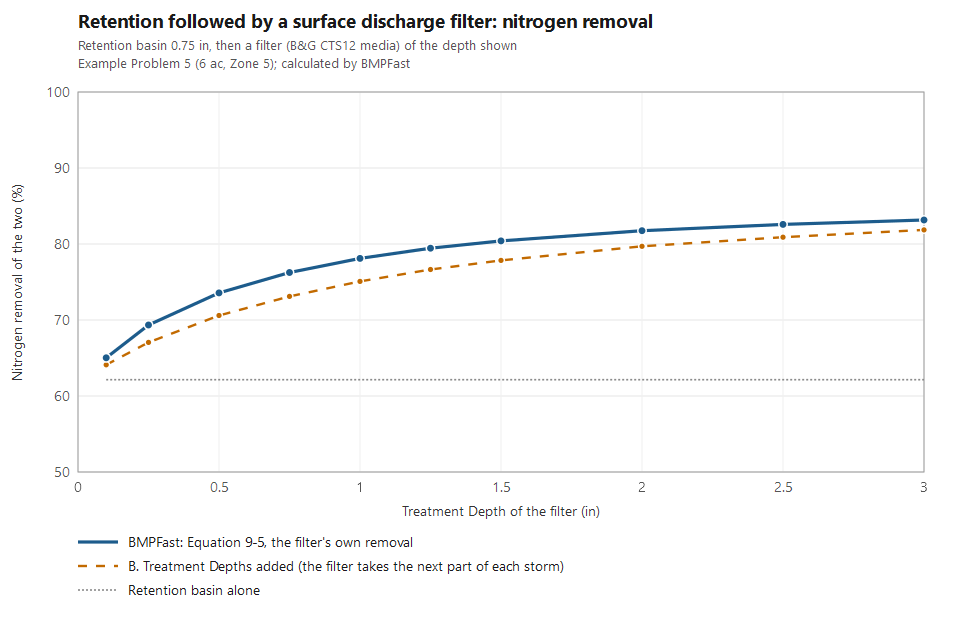
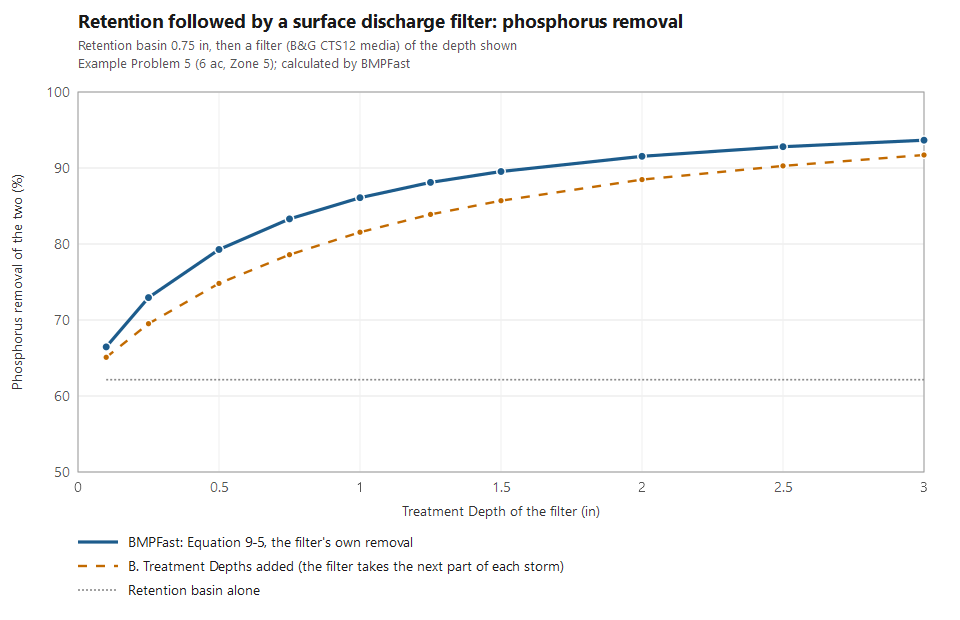
Over a range: the basin stays at 0.75 in and the filter goes from 0.1 to 3 in.
| Filter Treatment Depth (in) | Filter alone N / P (%) | BMPFast N / P (%) | B. Depths added N / P (%) | Difference N / P (points) |
|---|---|---|---|---|
| 0.1 | 7.6 / 11.4 | 65.0 / 66.5 | 64.1 / 65.1 | 0.9 / 1.4 |
| 0.25 | 19.0 / 28.5 | 69.3 / 72.9 | 67.1 / 69.5 | 2.3 / 3.4 |
| 0.5 | 30.2 / 45.3 | 73.6 / 79.3 | 70.6 / 74.8 | 3.0 / 4.5 |
| 0.75 | 37.3 / 55.9 | 76.2 / 83.3 | 73.1 / 78.6 | 3.1 / 4.7 |
| 1 | 42.2 / 63.3 | 78.1 / 86.1 | 75.1 / 81.6 | 3.0 / 4.5 |
| 1.25 | 45.7 / 68.6 | 79.4 / 88.1 | 76.6 / 83.9 | 2.8 / 4.2 |
| 1.5 | 48.2 / 72.4 | 80.4 / 89.5 | 77.8 / 85.7 | 2.6 / 3.8 |
| 2 | 51.8 / 77.7 | 81.7 / 91.5 | 79.7 / 88.5 | 2.0 / 3.1 |
| 2.5 | 54.0 / 81.0 | 82.6 / 92.8 | 80.9 / 90.3 | 1.7 / 2.5 |
| 3 | 55.5 / 83.2 | 83.2 / 93.7 | 81.9 / 91.7 | 1.3 / 1.9 |
What the comparison shows
- BMPFast’s method gives more removal at every filter size: 0.9 to 3.1 percentage points of nitrogen and 1.4 to 4.7 of phosphorus.
- The reason is the same as for retention BMPs in series: Equation 9-5 credits the filter with its full capture on the water the basin lets through, which comes from the larger storms. Adding the depths gives the filter only the part of each storm beyond what the basin holds.
- The gap is widest when the filter is about the size of the basin (0.75 in) and narrows for larger filters. It is larger for phosphorus, which the media remove more of.
Which BMPFast uses, and why. Equation 9-5, because a filter’s removal does not depend on the volume reaching it once it is sized for that volume. BMPFast does treat a basin followed by a basin as one storage, so the two choices differ; the same question for filters in series is open (plan 7.1).
Related pages
- BMPs in Series: several BMPs in one catchment (Multiple BMP).
- Surface Discharge Filter: the filter worksheet.
- Media and Filtration Methodology: the media and the filter’s removal.
- Retention Methodology: the retention curves.
- Comparison of Methods for Calculating Retention BMPs in Series.
- Comparison of Methods for Calculating Retention Followed by Wet Detention.
- Comparison of Methods for Calculating Filters in Series.