
All programs › BMPFast › BMPFast 2 sample problems
Cost analysis: stormwater harvesting with a water credit
Example Problem 4: pump station, force main and pond, with the resale credit.
Help: Cost Analysis (help page 350) · Download the .bmpf · Link to Solution in BMPFast Version 1
1The problem
The BMPFast sample project Example Problem 4: the stormwater harvesting system (pond, intermittent pump station, force main), mowing four times a year, 6,000 kWh a year of pumping, and a credit for the water sold (Stormwater Resale). Discount rate 3.3 %, 30 years, inflation 2.5 %.
| Input | Value | Source |
|---|---|---|
| Project (General Site Information) | ||
| Meteorological zone | Florida Zone 5 | Zone map (help page 815) |
| Mean annual rainfall | 61 in | Mean annual rainfall map (help page 815) |
| Performance standard (analysis type) | Net Improvement | BMPFast sample project |
| Cost analysis | ||
| Discount rate | 3.3 % | Cost analysis parameters |
| Duration | 30 years | Cost analysis parameters |
| BMP inflation rate | 2.5 % | Cost analysis parameters |
Find: the present worth, the annual cost and the cost per pound of TN and TP removed.
2Steps in BMPFast 2
Start BMPFast 2 and choose File ▸ New project. The tree on the left opens on the project (General Site Information). On its Entry tab enter: Project name Example #4 with harvesting pond; Meteorological zone Florida Zone 5; Mean annual rainfall 61.00 in; Type of analysis Net Improvement. (To follow along with the finished project instead, choose File ▸ Open and open
cost-pond-harvesting.bmpffrom Files below.)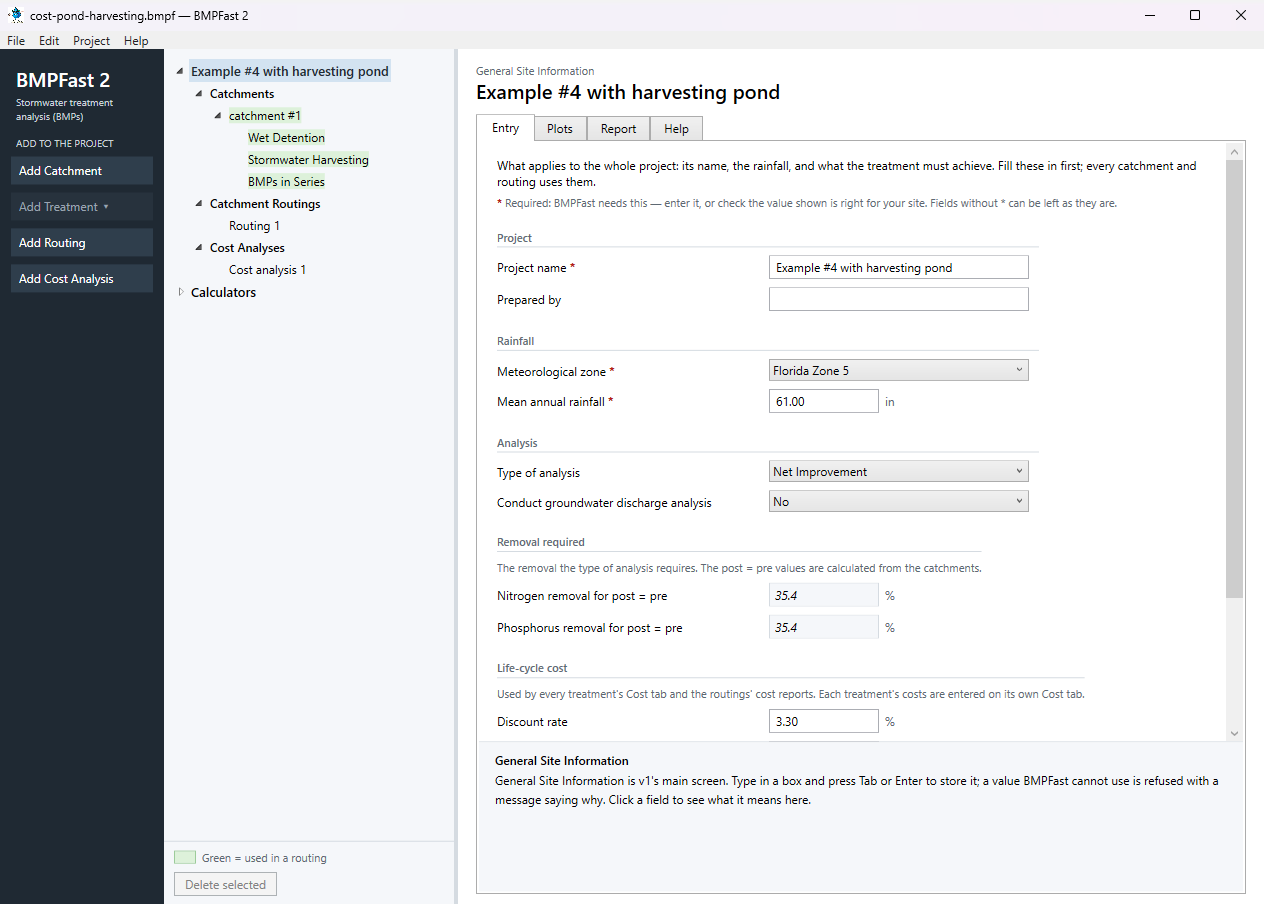
General Site Information: the project’s Entry tab. Press Add Catchment (left). Select the new catchment in the tree; on its Entry tab type the name catchment #1 and enter: Land use (pre) Highway; Land use (post) Highway; Area (pre) 5.50 ac; Area (post) 5.50 ac; Non-DCIA curve number (pre) 80.00; Non-DCIA curve number (post) 80.00; DCIA (pre) 40.00 %; DCIA (post) 85.00 %; Wet pond area (no loading from this area) 0.50 ac. Leave the other boxes as they are (0 or blank). BMPFast 2 calculates as you type; scroll down to Calculated for the results after development: Annual runoff coefficient (ROC) (post) 0.710; Runoff volume (post) 18.046 ac-ft/yr; Nitrogen load (post) 27.813 kg/yr; Phosphorus load (post) 3.849 kg/yr.
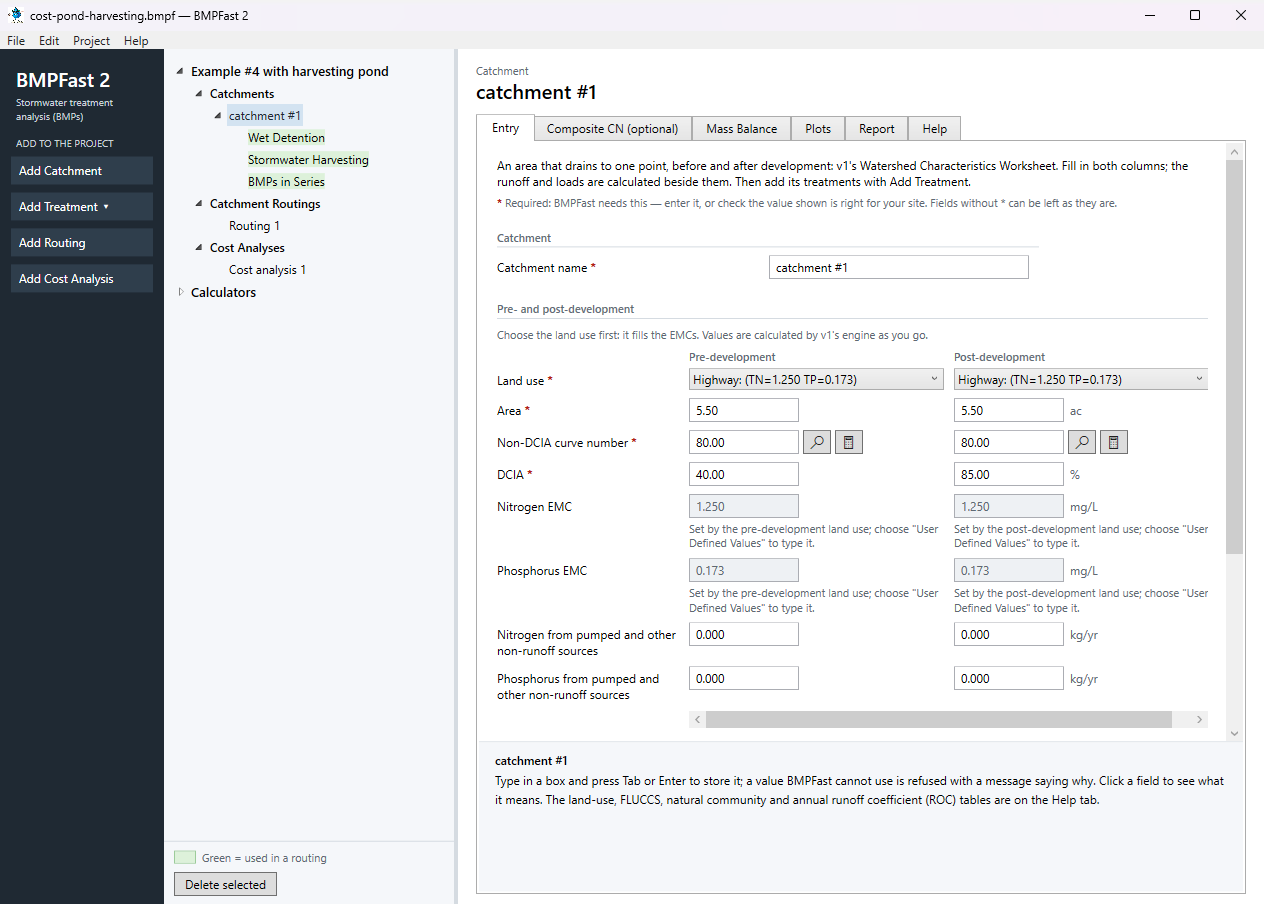
The catchment catchment #1: its Entry tab. With catchment #1 selected, press Add Treatment and choose Wet Detention. On its Entry tab type the Treatment name Wet Detention (BMPFast 2 starts it as “Wet Detention 1”) and enter: Permanent pool volume 2.472 ac-ft; How the littoral zone counts Littoral zone credit (BMPFast 2); There is a littoral zone Yes; Littoral zone credit 10.0 %; Floating wetland or other MAPs credit 10.00 %. The results are calculated as you type: Average residence time 50.00 days; Permanent pool volume for 31 days residence 1.53 ac-ft; Nitrogen removal provided 55.20 %; Phosphorus removal provided 80.49 %.
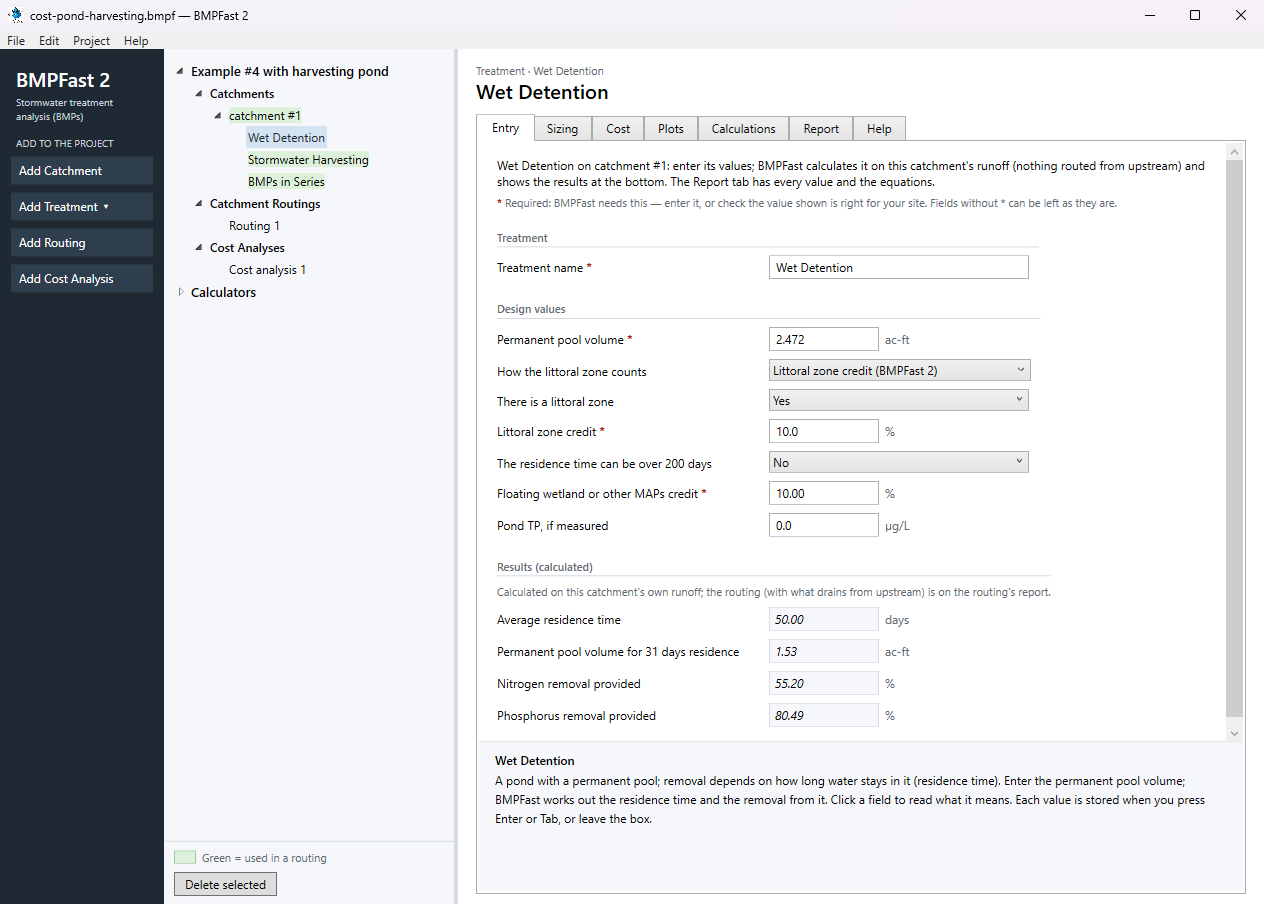
The treatment Wet Detention: its Entry tab. With catchment #1 selected, press Add Treatment and choose Stormwater Harvesting. On its Entry tab type the Treatment name Stormwater Harvesting (BMPFast 2 starts it as “Stormwater Harvesting 1”) and enter: Total contributing area 5.00 ac; Area available for irrigation 3.00 ac; Maximum available harvest volume 1.00 ac-ft; Harvest rate 0.80 in/week. The results are calculated as you type: Effective impervious area 3.55 ac; Harvest volume over the effective impervious area 0.67 in; Nitrogen removal provided 52.69 %; Phosphorus removal provided 52.69 %.
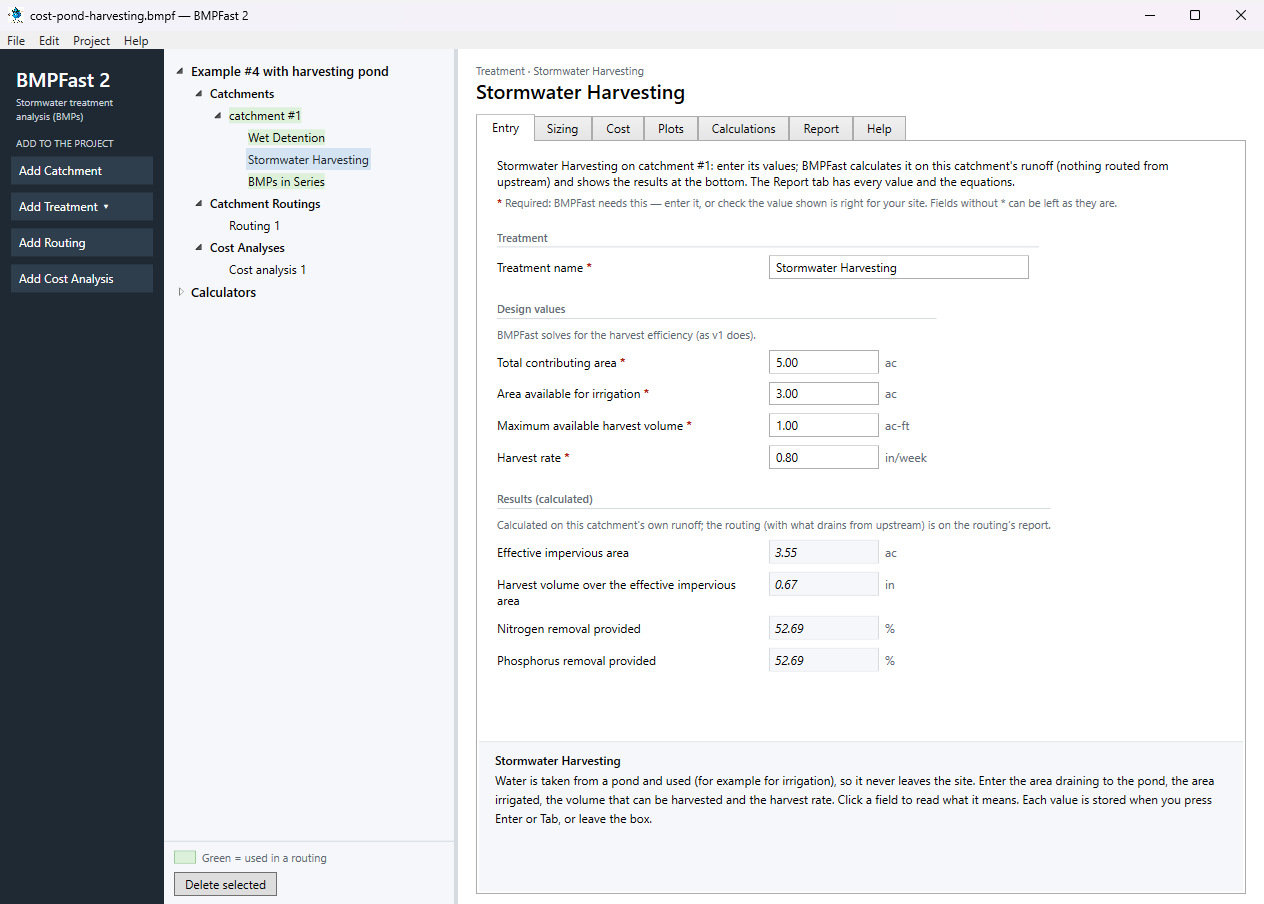
The treatment Stormwater Harvesting: its Entry tab. With catchment #1 selected, press Add Treatment and choose BMPs in Series. On its Entry tab type the Treatment name BMPs in Series and choose, upstream first: BMP 1 (upstream) Wet Detention; BMP 2 Stormwater Harvesting; BMP 3 (none); A series that starts with retention is calculated as One retention system (v1's method). Each member is a treatment of this catchment (the steps above). The results are at the bottom of the tab: Nitrogen removal provided 78.81 %; Phosphorus removal provided 90.77 %.
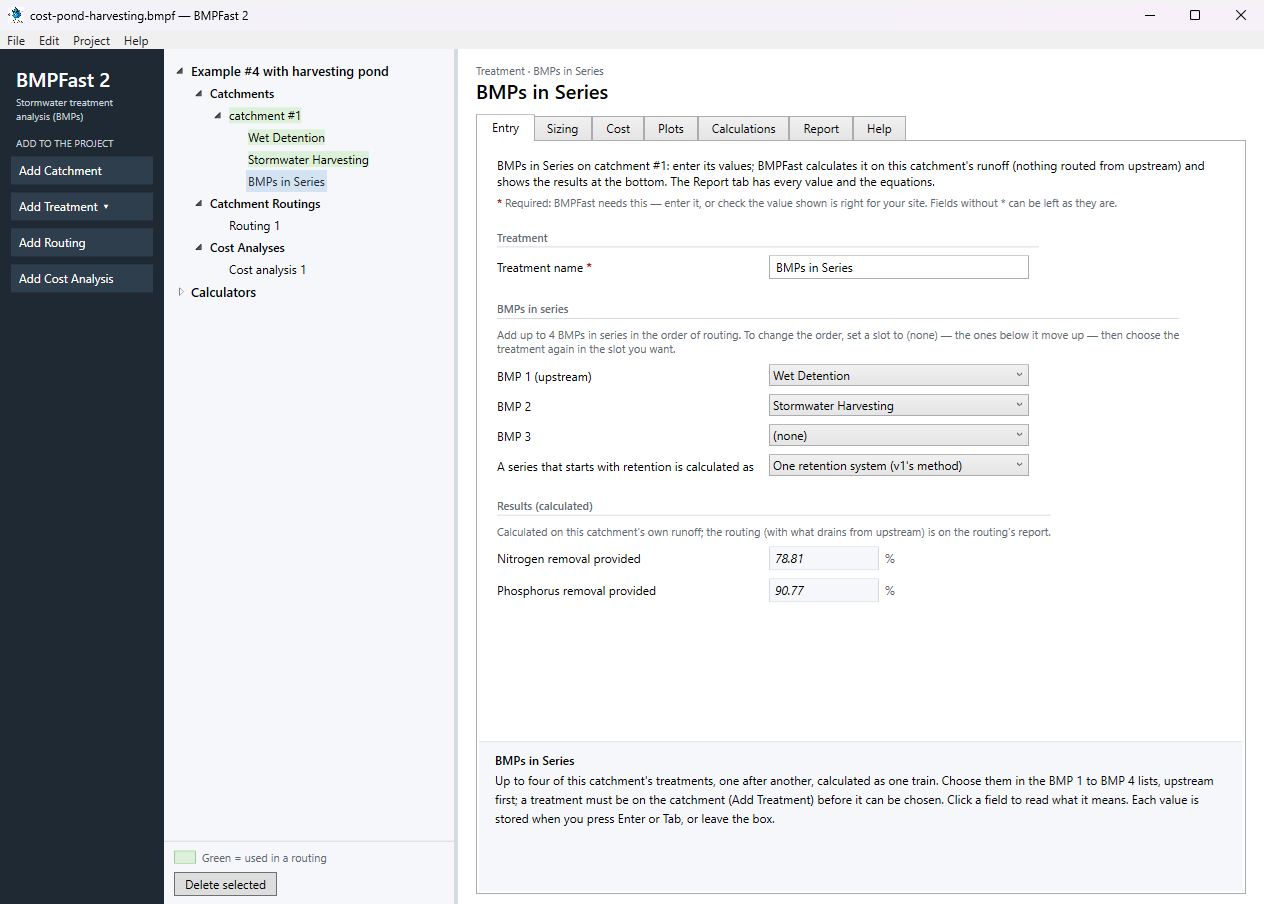
The treatment BMPs in Series: its Entry tab. Open the treatment’s Report tab: its inputs and removal, as a report to print or save.
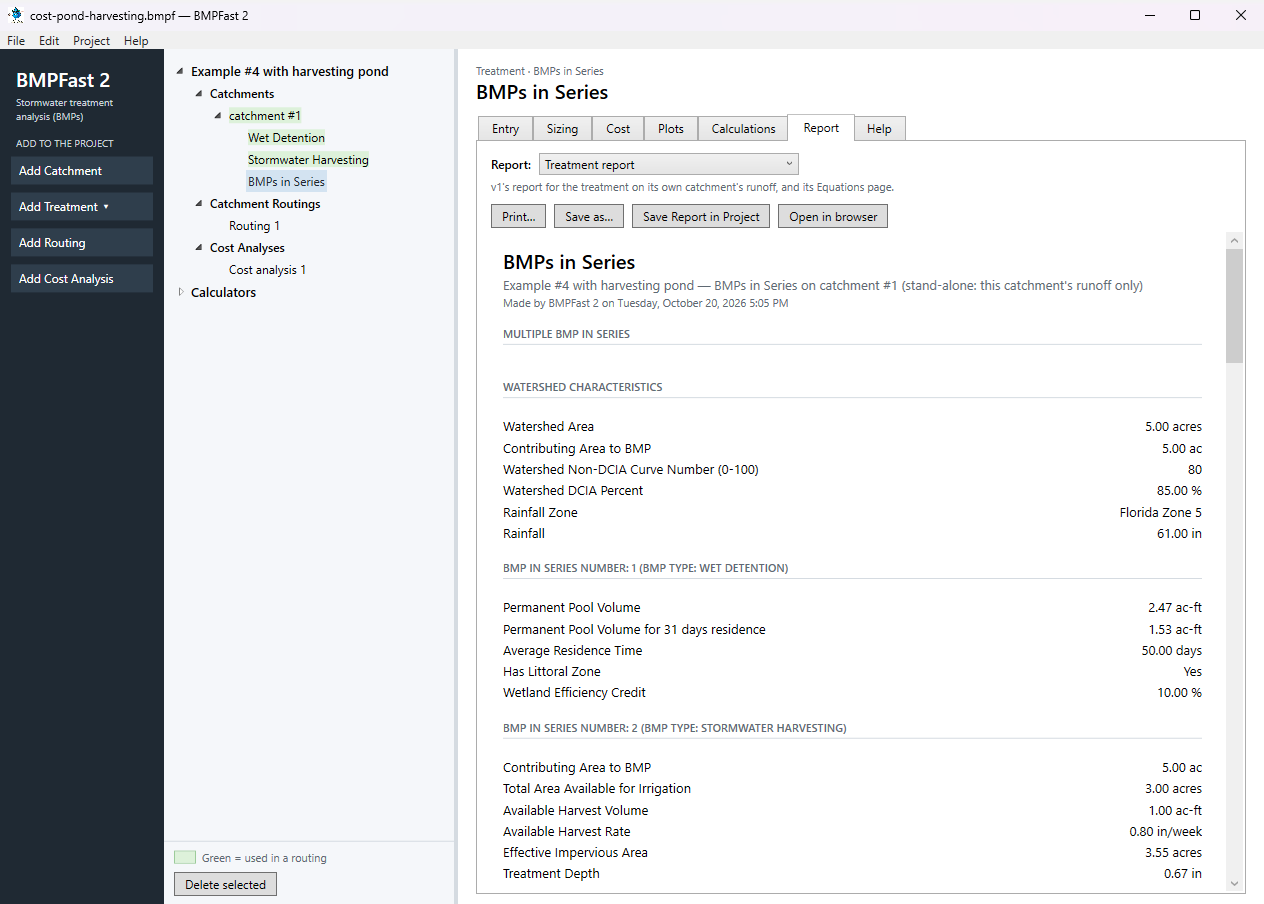
The treatment BMPs in Series: its Report tab. Press Add Routing (left). BMPFast 2 adds Routing 1 under Catchment Routings, with every catchment draining to the outlet and no treatment; a project can have several routings, compared side by side. On its Entry tab (How the routing is calculated Strand routing (v1's routing; use this for permits)) set each catchment as in this table:
Catchment Drains to Treatment used catchment #1 Outlet BMPs in Series A catchment is treated only by the treatment its routing uses.
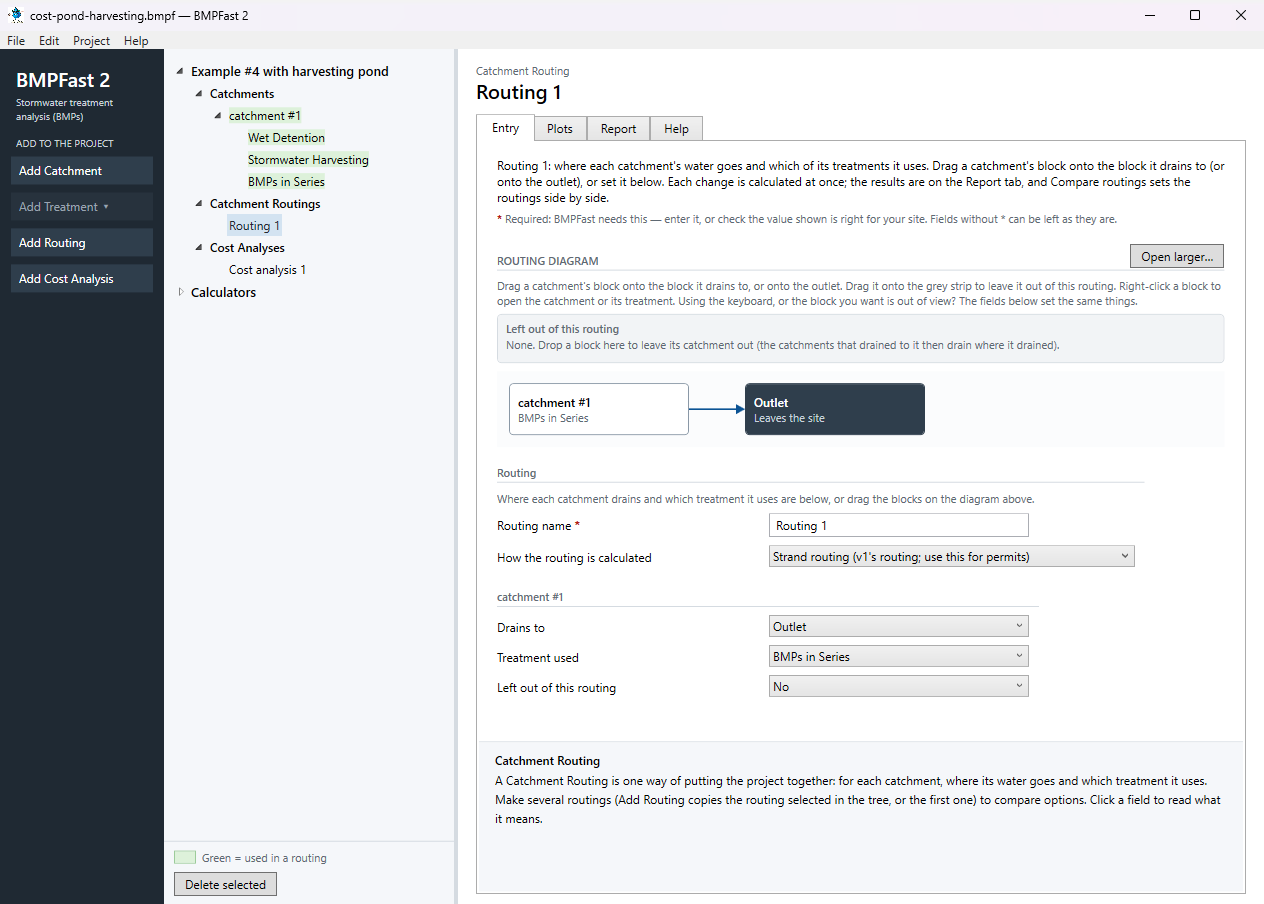
The routing’s Entry tab: where each catchment drains and the treatment it uses. Open the routing’s Report tab. Results shows the loads leaving the site, the removal provided and required, and whether the performance standard is met; the list at the top of the tab has v1’s reports for the same routing (Summary, Complete, Flow Balance, AH Vol I Sec 9 compliance). Save the project with File ▸ Save; compare it with the .bmpf under Files.
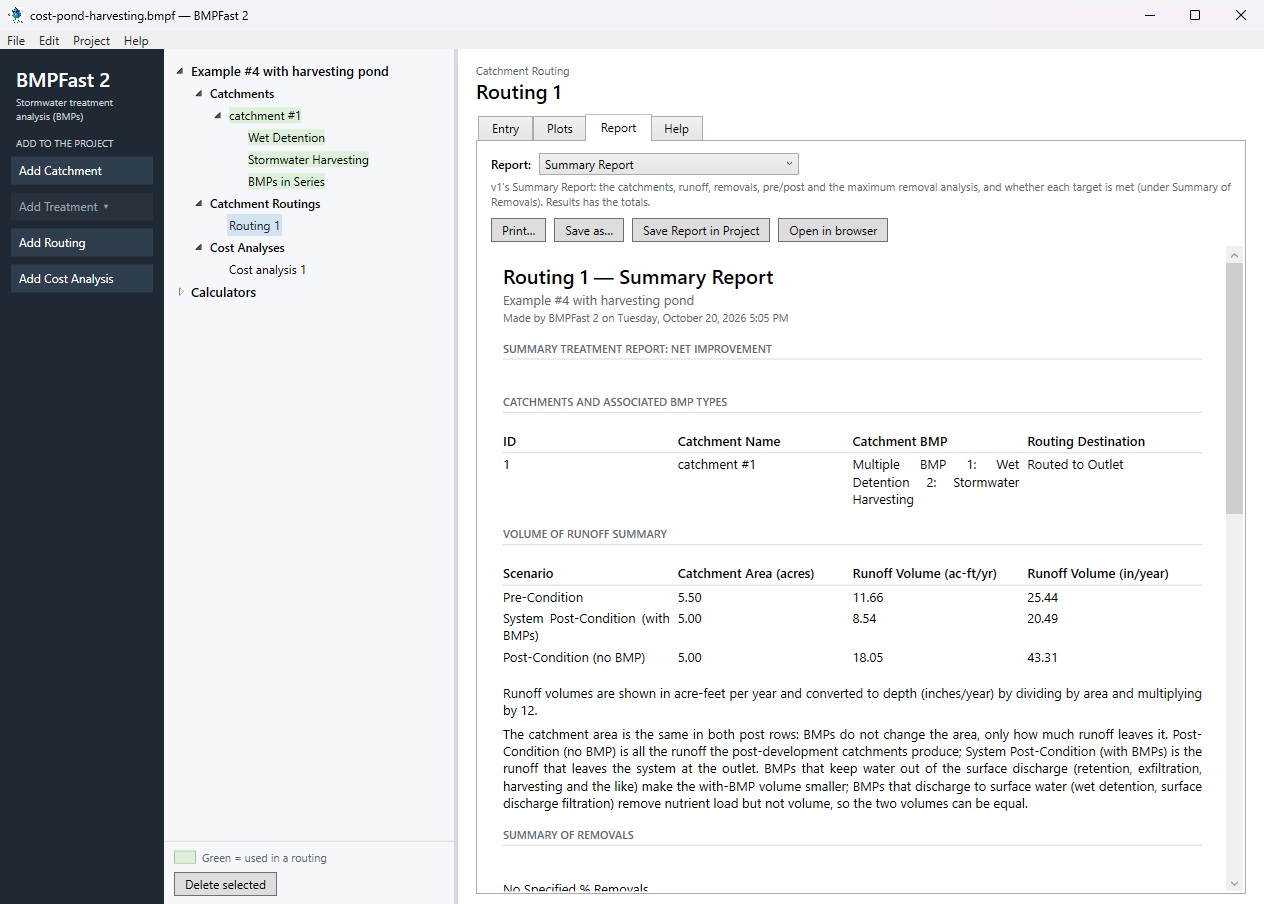
The routing’s Report tab: Results. Select the treatment Stormwater Harvesting and open its Cost tab. Under Settings the Discount rate (3.3 %) and the Analysis period (30 years) are the project’s (also on General Site Information, Life-cycle cost); type this treatment’s Inflation rate for replacements, 2.5 %. Under Cost components choose each from Component from the cost database and press Add this component, then type its costs in the table: Detention construction $120,000 – $180,000, service life 1,000 years, O&M 0.005 – 0.25 % a year; Pump Station, Intermittent construction $40,000 – $60,000, service life 20 years, O&M 0.5 – 3 % a year; Piping, Force Main construction $15,000 – $25,000, service life 30 years, O&M 0.5 – 1.5 % a year. Under Routine maintenance add, from the cost database, Mowing / Vegetation Control / Litter Removal, 4 each at $1,850 a unit; Stormwater Resale, 3.1 MGY at −$1,000 a unit (a credit: the water sold). Under Electrical energy type Electricity used 6,000 kWh/yr ($690 a year; $13,015 over 30 years, today).
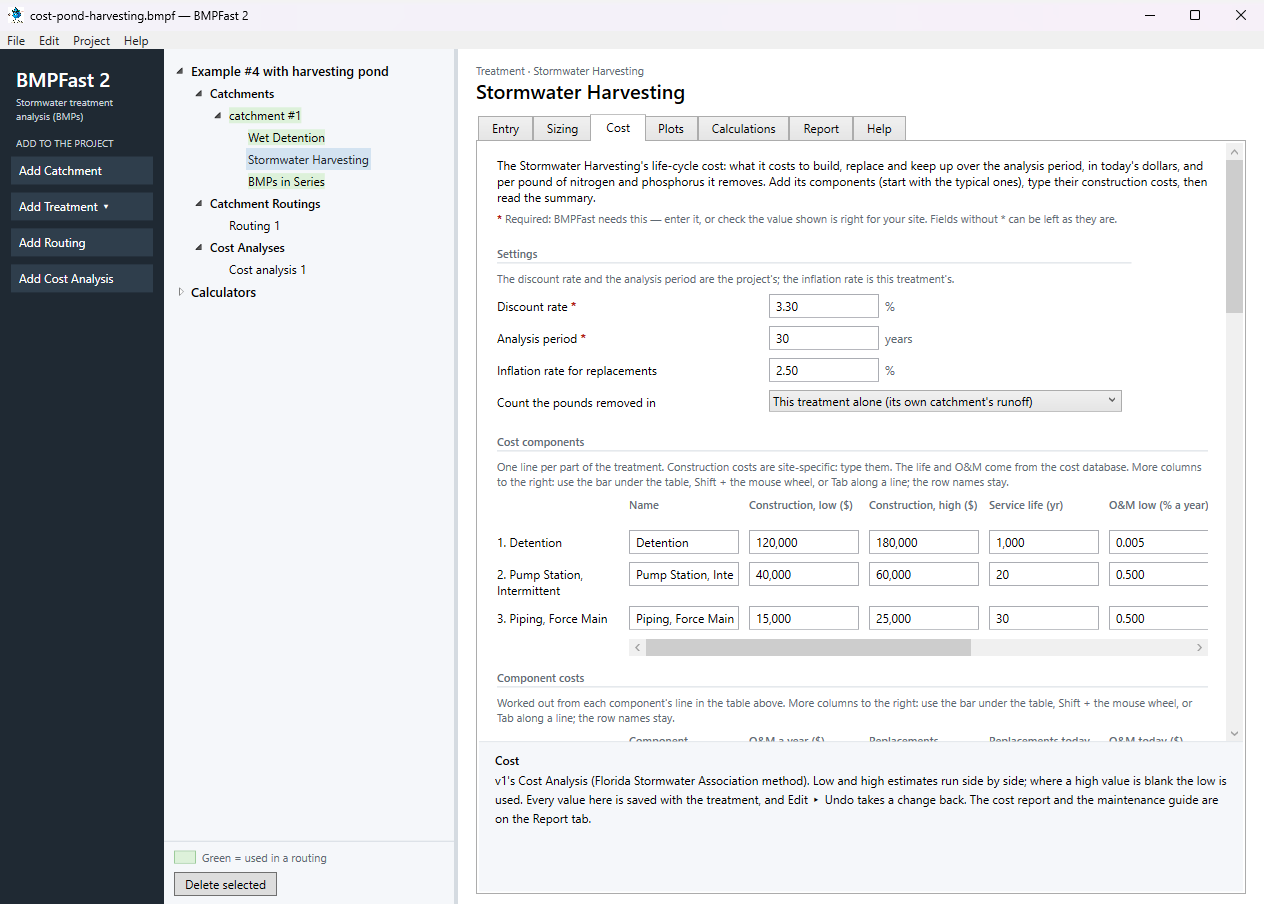
The treatment’s Cost tab: settings, components and routine maintenance. Scroll to the bottom of the Cost tab. Pounds removed says what is counted: 32.31 lb of nitrogen and 4.47 lb of phosphorus a year, on the treatment alone (choose a routing in Count the pounds removed in to count them there). The Summary gives the present worth, $308,660 – $459,992, the annualized cost and the cost per pound (the results below).
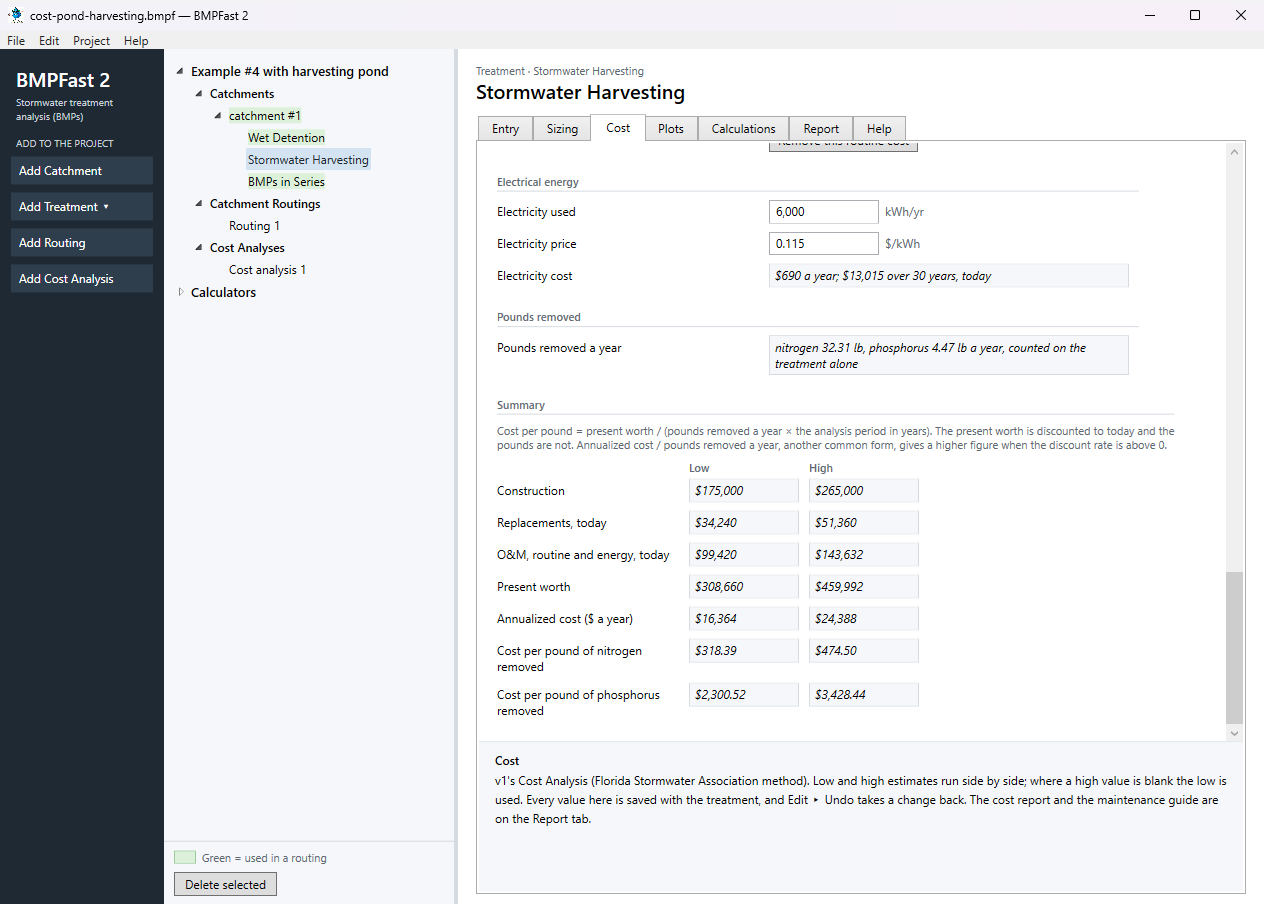
The bottom of the Cost tab: pounds removed and the summary. Press Add Cost Analysis (left): Cost analysis 1 appears under Cost Analyses. On its Entry tab choose Routing 1 as the routing costed; the discount rate and period start at the project’s. Its table, v1’s Cost Hub, has a line for each treatment the routing uses (each member of the BMPs in Series has its own line), with its present worth, annualized cost and cost per pound, and the project totals; Enter costs on a line opens that treatment’s Cost tab. The line BMPs in Series, 1: Wet Detention has no costs (an amber Enter costs and a note at the top of the tab): this problem, like v1’s, costs only the harvesting system, so the totals leave it out.
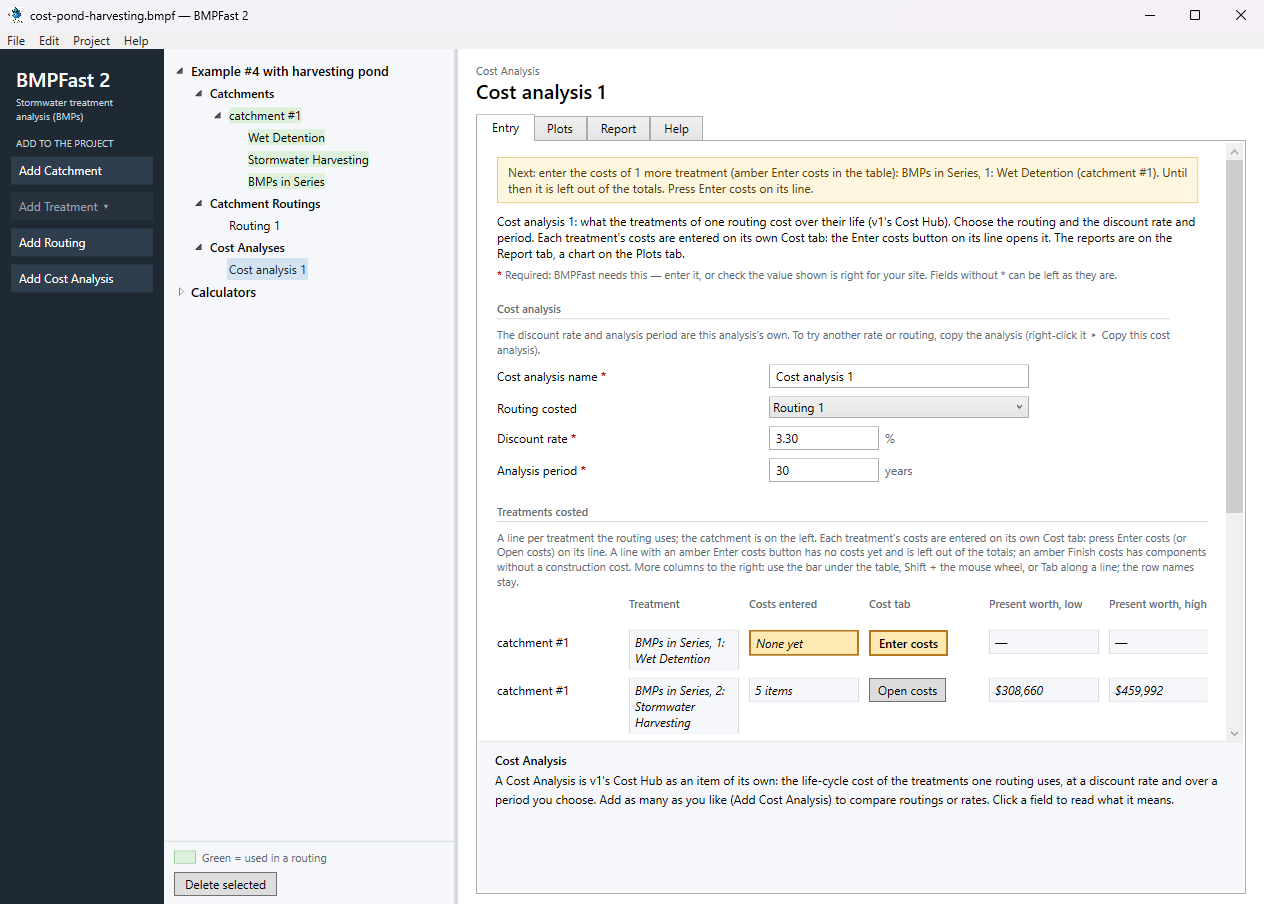
The Cost Analysis: its Entry tab (v1’s Cost Hub). Open the Cost Analysis’s Report tab: the list at its top has the table, v1’s Cost summary (Unit Cost Summary) and v1’s Full cost report, worked out at this analysis’s rate and period.
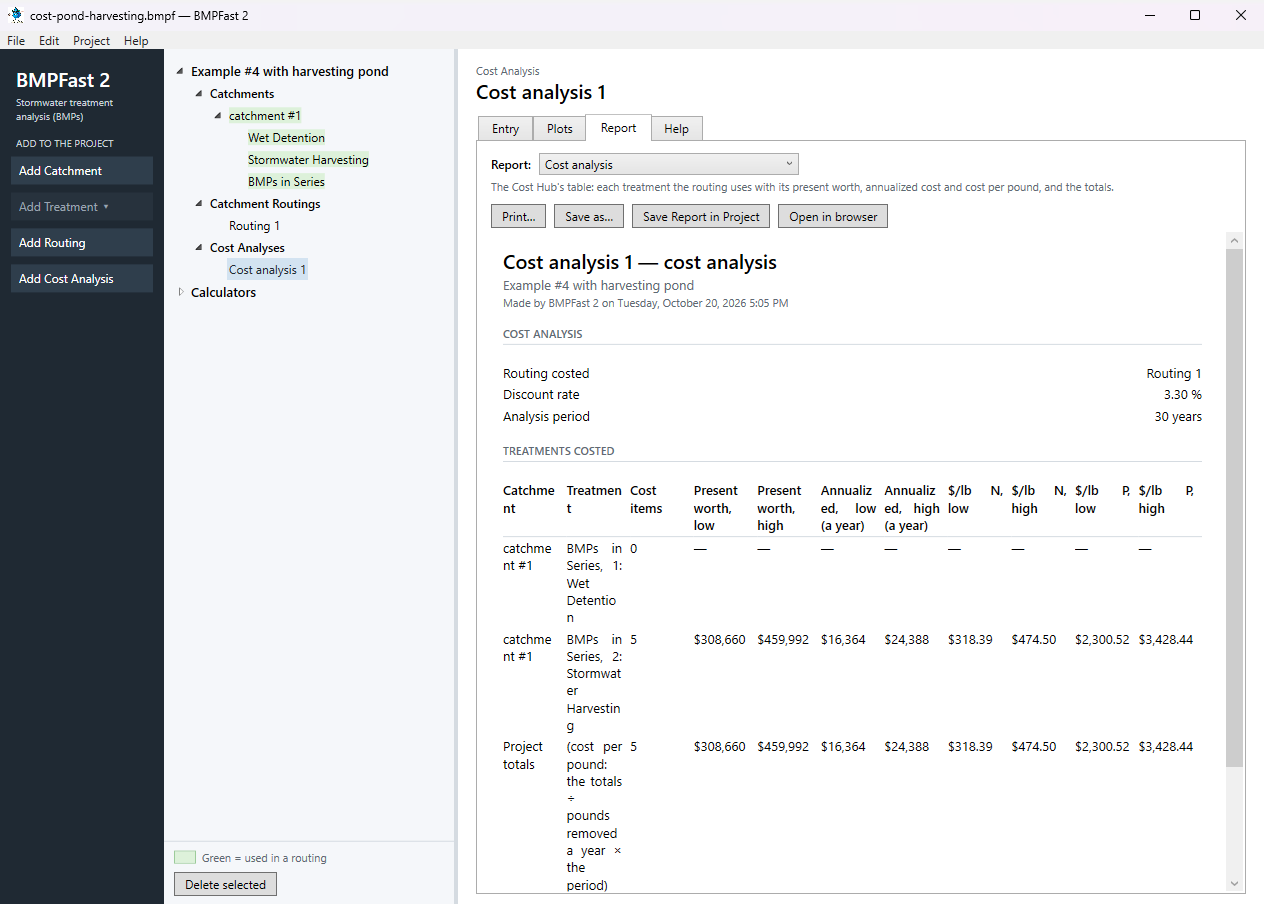
The Cost Analysis: its Report tab.
3Results
| Result, low – high (the Cost tab) | BMPFast 2 | BMPFast (v1) |
|---|---|---|
| Construction | $175,000 – $265,000 | $175,000 – $265,000 same |
| Replacements, today | $34,240 – $51,360 | $34,240 – $51,360 same |
| O&M, routine and energy, today | $99,420 – $143,632 | $99,420 – $143,632 same |
| Present worth | $308,660 – $459,992 | $308,660 – $459,992 same |
| Annualized cost ($ a year) | $16,364 – $24,388 | $16,364 – $24,388 same |
| Cost per pound of nitrogen removed | $318.39 – $474.50 | $318.39 – $474.50 same |
| Cost per pound of phosphorus removed | $2,300.52 – $3,428.44 | $2,300.52 – $3,428.44 same |
| Nitrogen / phosphorus removed | 32.31 / 4.47 lb/yr | 32.31 / 4.47 lb/yr same |
The Cost Analysis (v1’s Cost Hub)
| Treatment | Cost items | Present worth | Annualized ($ a year) | $/lb N, low |
|---|---|---|---|---|
| BMPs in Series, 1: Wet Detention | 0 | $0 – $0 | $0 – $0 | — |
| BMPs in Series, 2: Stormwater Harvesting | 5 | $308,660 – $459,992 | $16,364 – $24,388 | $318.39 |
| Project totals | $308,660 – $459,992 |
The treatment’s cost report (its Report tab)
Open this report on its own page.
v1’s Unit Cost Summary (Cost summary)
Open this report on its own page.
The Summary Report
Open this report on its own page.
BMPFast 2 and BMPFast (v1)
| Result | BMPFast 2 | BMPFast (v1), its page | |
|---|---|---|---|
| Nitrogen leaving the site | 5.894 kg/yr | 7.079 kg/yr | differs |
| Phosphorus leaving the site | 0.355 kg/yr | 0.519 kg/yr | differs |
| Site removal, nitrogen | 78.807 % | 74.550 % | differs |
| Site removal, phosphorus | 90.768 % | 86.510 % | differs |
| catchment #1: Multiple BMP removal, nitrogen | 78.807 % | 74.550 % | differs |
| catchment #1: Multiple BMP removal, phosphorus | 90.768 % | 86.510 % | differs |
BMPFast 2 gives a different number for: Nitrogen leaving the site, Phosphorus leaving the site, Site removal, nitrogen, Site removal, phosphorus, catchment #1: Multiple BMP removal, nitrogen, catchment #1: Multiple BMP removal, phosphorus. See the notes below the table.
When BMPFast 2 opened the v1 file it said:
- catchment #1, Wet Detention: BMPFast 2 takes the wet pond equations as a pond without a littoral zone, and adds a littoral zone credit of 10 percentage points (Appendix O's maximum) to this pond's removal, so it is higher than v1 shows; lower Littoral zone credit if your permit reviewer allows less. To calculate as v1, choose "Reduce without a littoral zone (v1)" in How the littoral zone counts (Design values) on the treatment's Entry tab.
4Check
| Present worth | = construction + replacements today + O&M today |
| = 175,000 + 34,240 + 99,420 | |
| = $308,660 (low; BMPFast 2 $308,660). |
| Annualized cost | = present worth × capital recovery factor |
| CRF | = i(1+i)N / ((1+i)N − 1) |
| = 0.05302 at i | |
| = 3.3 %, N | |
| = 30 |
$16,364 a year (BMPFast 2 $16,364).
| Cost per pound | = present worth / (pounds removed a year × years) |
| = 308,660 / (32.31 lb/yr × 30) | |
| = $318.39 per lb of nitrogen (BMPFast 2 $318.39). |
The Cost tab says the same under its Summary (Cost Analysis Methodology).
5Files
- cost-pond-harvesting.bmpf: the project, saved by BMPFast 2. Save it (your browser puts it in Downloads), then in BMPFast 2 choose File ▸ Open and open it. Opened again and calculated, it gives the numbers on this page.
- cost-pond-harvesting.bmpt: the same project as BMPFast (v1) saved it. BMPFast 2 opens it too (File ▸ Open); saving it then makes a .bmpf and leaves the .bmpt as it was.
- Routing 1 (BMPFast 2’s report, as Open in browser on its Report tab gives it)
- Routing 1 — Summary Report (BMPFast 2’s report, as Open in browser on its Report tab gives it)
- BMPs in Series (BMPFast 2’s report, as Open in browser on its Report tab gives it)
- BMPs in Series — calculations (BMPFast 2’s report, as Open in browser on its Report tab gives it)
- Stormwater Harvesting — cost report (BMPFast 2’s report, as Open in browser on its Report tab gives it)
- Cost analysis 1 — cost analysis (BMPFast 2’s report, as Open in browser on its Report tab gives it)
- Cost analysis 1 — Cost summary (BMPFast 2’s report, as Open in browser on its Report tab gives it)
6Help and methodology
Calculated with BMPFast 2 version 2.0.0 (2026-10-20), which opens the problem’s v1 project as it is. Screen captures are of BMPFast 2’s own window and are for demonstration only.